Tuesday, October 27, 2015

Book Review: The Perennial Life (La vida perenne) by José Luis Sampedro

The Perennial Life (La vida perenne) (2015)
José Luis Sampedro (1917-2013)

189 pages

The Perennial philosophy (Latin: philosophia perennis), also referred to as Perennialism, is a perspective in the philosophy of religion which views each of the world’s religious traditions as sharing a single, universal truth on which foundation all religious knowledge and doctrine has grown.
Agostino Steuco (1497–1548) coined the term...
The term was popularized in more recent times by Aldous Huxley … in his 1945 book: The Perennial Philosophy.
Wikipedia; opening lines of the article on Perennial philosophy
In the prologue to Spanish economist and author José Luis Sampedro’s The Perennial Life (La vida perenne), published posthumously earlier this year, his wife Olga Lucas notes that in an earlier novel, October, October (Octubre, Octubre), Sampedro wrote “I began to lean on a very well-known work of Aldous Huxley, The Perennial Philosophy.” (“Empecé apoyándome en un obra muy concida de Aldous Huxley, La filosofía perenne.”) Sampedro pays homage to Huxley both in this latest book’s title, and through the inclusion of several passages from Huxley’s work.

The Perennial Life serves as an encapsulation of Sampedro’s life-long immersion in the philosophy of humanism, a pursuit that was clearly guided by the concepts of Perennial philosophy.  In his book he integrates together thoughts and ideas from a broad range of Eastern and Western spiritual and religious traditions, as well as passages in which he presents his own thoughts on the texts, his own interpretations and conclusions. Collectively the text represents a bequeathal of what he learned about how one might most appropriately live one’s life.

The passages range from a few lines to a couple of pages, and are grouped into fourteen chapters, each reflecting a particular theme. The opening chapter Quiet the Voices, Awaken (Aquietar las voces, despertar), for example, considers how one might best turn away from hectic, quotidian concerns, to truly see and comprehend the reality of the world. Here he quotes Huxley’s observation that the
... one [divine] Reality is such that it cannot be directly and immediately apprehended except by those who have chosen to fulfill certain conditions, making themselves loving, pure in heart and poor in spirit. Why should this be so? We do not know. It is just one of those facts which we have to accept, whether we like them or not and however implausible or unlikely they may seem.
Already in these early lines, it becomes clear that true understanding first requires a willingness to open ourselves to, and make ourselves vulnerable to the world beyond our immediate concerns.

In another chapter, Die to Live (Morir para vivir), Sampedro notes that “we live in a society that skirts around the problem of death as much as possible,” (75) (“vivimos en una sociedad que escamotea el problema de la muerte todo lo que puede”). He quotes lines from Chuang Tzu (as translated by Thomas Merton) that conclude “[A man’s] thirst for survival in the future makes him incapable of living in the present.” (79), and he himself observes that in striving for immortality, human beings become “vain” (“endiosarnos”), which leads to a belief
... that we are the kings of creation, that the world is for little more than our pleasure, for our enjoyment, for our exploitation.” (81)

(... que son los reyes de la creación, que el mundo poco menos que está para nuesto goce, para nuestro disfrute, para nuestra explotación.”)
Thus, again, what prevents human beings from becoming more aware of the reality of our world is a blindness of the spirit.  In this context, it is a blindness resulting from a willful desire that lies outside the realm of nature's possibilities (immortality), and which impels us to subjugate or ignore the natural world instead of opening ourselves up to it.

In the concluding chapter, Sampedro portrays our lives as being “no more than the spark of a grand bonfire” (163) (“no es más que la chispa de una gran hoguera”). It is within our lives, ourselves, that he says we must look to understand reality. He includes a story from the Sanskrit text Chandogya Upanishad, in which a teacher leads a student toward an understanding of his place in the universe, concluding:
The spirit of the entire universe is an invisible and subtle essence. That is reality. That is truth. YOU ARE THAT.” (171)
(“El Espíritu del universe entero es una esencia invisible y sutil. Ésa es la Realidad. Eso es Verdad. TÚ ERES ESO.”)

Sprinkled throughout the book are wonderful photographs by Chema Madoz, an example of which can be found on the book’s cover, pictured above. Madoz takes common, everyday objects, both man-made and from nature, and creates subtle, yet striking images that can perhaps best be described as visual poetry. These photographs form an ideal accompaniment to the themes in the book's passages, in that they reinforce the notion that, for those prepared to learn how to seek them out, rich and unexpected wonders exist in the world around us.

In The Perennial Life, Sampedro adeptly blends selections from Eastern and Western philosophical traditions with his own thoughts summarizing what he has learned from studying these texts, and from integrating aspects of them into his own life. The result is a coherent and deeply engaging meditation on how one can approach the critical and rewarding task of living a conscious and fulfilling life. Centered around the concepts of perennial philosophy, Sampedro’s work provides a view that inherently sidesteps the (often violent) disagreements that develop between followers of particular religious dogmas, by embracing instead a broader outlook, one that seeks out the unifying principles that lie behind these varied traditions.

This is a work that you will find richly rewarding to read carefully, from the first page to the last, as Sampedro crafts his beautiful and hopeful invitation to turn away from one's daily concerns to instead behold the beauty of creation.  There are, however, also rewards to be found later, by simply turning to a random page and considering the particular reflection on life and nature that presents itself.


Have you read this book, others by this author, or even similar ones by other authors? I’d enjoy hearing your thoughts.
Other of my book reviews: FICTION Bookshelf and NON-FICTION Bookshelf

Saturday, October 17, 2015

Book Review: "California" by Edan Lepucki

California (2014)
Edan Lepucki (1981)


393 pages

In apocalyptic and post-apocalyptic fiction, the event that precipitates the apocalypse often occurs over a short period of time; it may be minutes, say in the case of an asteroid, or hours or days, in the case of a nuclear war, but a clear and evident before and after exists that separates the normal world from its dramatically altered future. What if, however, no such single, evident triggering event stands out? Suppose only in hindsight, looking back over a series of apparently unconnected events that may have spanned years, could one say “there, that was the final straw, since then everything’s been different.” Do the words “apocalypse” and post-apocalyptic” still apply?

Edan Lepucki’s novel California, set in the mid to late 21st century United States, has many elements of post-apocalyptic fiction --- but constitutes the apocalypse has played out through an extended series of natural disasters. Some of these disasters were apparently random, such as earthquakes that stagger a number of cities, such as Los Angeles, while others have the implication of human causes, such as devastating superstorms and flooding in the northeast. In Lepucki’s telling, no one of these events represents the moment marking the clear onset of a country (and by extension a world) that has succumbed to an ineluctable decline, but she clearly imagines a U.S. population and economy that has not had the capacity to overcome an escalating rash of calamites of the natural world. How many among us, observing the growing acrimony and fractionalization in what passes for public and political debate these days, and the resulting inaction and feelings of disenfranchisement, might not believe that such a dystopian future could result?

Set in the California wilderness west of Los Angeles, Lepucki’s story follows a young couple, Cal and Frida, who have fled the city in search of a better life. As the economy has collapsed, LA --- and seemingly the whole of the U.S. --- has devolved into secured enclaves of wealth called Communities, surrounded by large swaths of impoverished masses struggling to survive. Cal and Frida find that the wilderness has its own challenges, however, from bands of pirates rumored to be terrorizing the countryside, to the unsurprising but still stark reality that none of the infrastructure of modern life they grew up with, frayed though it may have become, exists to support them: no stores, no doctors, little more than what they can wrestle from the land around them.

As the story opens the pair have survived their second year in the wild, living in a small, unoccupied shed they discovered in the woods. They grow food in a small garden, supplementing it with some hunting and gathering in the surrounding forest, and items from a trader who occasionally passes by; life is difficult, but they have made a go of it.

When Frida realizes she is pregnant, however, an already solitary and arduous existence becomes overwhelming for her. Eager to find a more hopeful situation in which to raise her coming baby, she convinces her husband that they should seek out a settlement that they have heard lies just a couple of days walk to their west, and ask to be taken in. The two know little about this settlement except its general location, and that it has a reputation for being unwelcoming to strangers. Frida is undeterred by their sketchy knowledge, however, and the couple soon depart their shelter of two years in the desperate hope of find a larger group of people to join up with.

Upon reaching the settlement they are shocked to find themselves welcomed by the townspeople, though this is only the first surprise of many for them. The breakdown in authority throughout the country, and so in formal law and order, has created new norms, and vying political and philosophical outlooks on how to survive in the unstable new reality. As they build relationships and take on responsibilities in the settlement, Cal and Frida must not only come to grips with how much they value independence versus security for themselves as well as for their future baby, but also how they will balance their individual desires and fears with their love for one another.

A significant portion of the novel involves flashbacks by Cal and Frida to the time before they left LA, or had even met, years in which the crisis in the US was well underway, but had not yet reached the levels that would eventually drive them from the city. This part of the story, as well as the couple’s initial introduction to the settlement they seek out, worked best for me. A subtle yet unnerving tension fills the otherwise bucolic setting, potential danger lying around every corner, lurking in every interaction.

The final part of the novel, on the other hand, felt too compressed, as though Lepucki made a sudden decision that the story had to be wrapped up in a relatively few pages. The conclusion of the novel would perhaps seem less abrupt if the reader knew there was a sequel waiting for them to turn to, however that’s not immediately clear. In an interview Lepucki suggests that she has “an inkling of possibly writing a sequel to California, but not in a way that even really picks up where I left off."

The focus of the story in California remains tightly drawn to the immediate world within walking distance of Cal and Frida, to what they can see and hear and feel. The details of the situation in the larger, outside world remain ambiguous, no one quite certain exactly what, if any, political and legal authority still exists. This uncertainty for the pair, as well as for the reader, subverts any attempt to make sense of the rules and expectations of the wider world --- every encounter becomes potentially fateful. In the quotidian details of the couple’s lives becomes clear the harrowing reality of what it would truly mean to live without the infrastructure of goods, services and safety we, particularly in the U.S., often take for granted.


Have you read this book, others by this author, or even similar ones by other authors? I’d enjoy hearing your thoughts.
Other of my book reviews: FICTION Bookshelf and NON-FICTION Bookshelf
 

Thursday, September 24, 2015

Book Review: "How Jesus Became God" by Bart D. Ehrman

How Jesus Became God (2014)
Bart D. Ehrman (1955)


404 pages

One of the delights --- and challenges --- of reading a book that explores human history, whether it looks back a few decades or several centuries, is the frequent discovery that assumptions and understandings now widely taken for granted about particular events can be discovered to be oversimplifications, if not grossly incorrect interpretations of what occurred. A second similar benefit is the realization that views now considered established and unquestionable about an historical event may have once have seemed beyond the pale, perhaps even unacceptable to consider.

In his book How Jesus Became God, Bible scholar Bart Ehrman examines one such case of evolving understanding, which he summarizes in the book’s subtitle as: “The Exaltation of a Jewish Preacher from Galilee.” Modern day Christians view Jesus as a part of the Trinity, along with God and the Holy Spirit, and believe that Jesus is of the same stuff as God and has existed as long as God has existed. Ehrman argues, however, that these were not the beliefs of the very earliest Christians. Analyzing the words of the New Testament, Ehrman traces how early Christian understanding of Jesus’ divinity evolved during the years and decades immediately after his crucifixion. He then goes on to demonstrate how, within a couple of centuries, the concept of Jesus as part of the Trinity developed.

According to Ehrman, early Christian views of Jesus as something more than human, as in fact divine, began with the belief in the resurrection. In the book he does not attempt to prove or disprove that the resurrection occurred, noting that such discussions lie outside the realm of historical analysis, being ultimately a matter of faith and belief. Instead, his starting point is that early Christians believed that the resurrection occurred, and that subsequent understanding of Jesus’ divinity then grew from that core belief.

In the opening chapters, Ehrman recounts the ways that humans were understood by people in ancient societies to be able to become divine. Anyone familiar with the myths of ancient Greece and Rome will not be surprised by the three models he describes from these early societies, captured in sections descriptively entitled: “Gods who temporarily become Human,” “Divine Beings born of a God and a Mortal,” and “A Human who becomes Divine.” After reviewing these models, he goes on to provide examples of them, both to demonstrate their widespread conceptual acceptance in pre-Christian times, as well as to serve as a basis of comparison to statements made in Paul and the Gospels.

More surprisingly, Ehrman describes how versions of these same three models appear also in ancient Judaism, despite its monotheistic tradition; thus these concepts were present in the Jewish society in which Jesus was born, raised and preached. After a general overview of Judaism up to the time of the crucifixion, he gives examples from the Old Testament of each of the three models of human divinity. He also points out that there existed in Judaism an understanding that there could be gradations of divinity, for example the angels in heaven relative to God.

Having established the existing societal modes of thinking about divine beings around Jesus’ time, Ehrman then turns to the central question of his title: “how Jesus became God.” The key concept for Ehrman here, and throughout the book, is “in what sense”, within the gradations of divinity thought possible (from angels, say, to God himself), was Jesus thought of as divine?

He begins with a summary of the sources available to an historian examining this question: the Old and New Testaments, focusing in particular on the letters of Paul, and the Gospels: Mark, Matthew, Luke and John. He describes how theological historians study these texts, and the analytical tools used to discern what historical facts can be establish from them. He includes a summary of the current scholarly consensus on such topics as when each of these sources was written, how they appear to be, or to not be, reporting similar events, how they appear to have had one or the other earlier, yet unknown, source material. Thus, he demonstrates how historians analyze these texts to tease out both an historical understanding of Jesus life, as well as the development of early Christian beliefs in the years after the crucifixion.

Based on these approaches to analyzing the texts, Ehrman first examines how Jesus most likely thought of himself; that is, whether he thought of himself as God. Analyzing what Jesus is reported to have said about himself in the earliest works of the New Testament, Ehrman claims that while Jesus called himself (and so thought of himself) as the messiah, from an historical perspective of the sources he cannot be shown to have called himself (or considered himself) God. Ehrman argues that though Jesus claims in John, the latest of the Gospels, that he is God, such claims do not appear in any of the earlier Gospels, and so “are part of John’s distinctive theology; they are not part of the historical record of what Jesus actually said.” (125)

Turning then to the resurrection, Ehrman uses the historical record available to us (that is, the Gospels) to point out key events associated with the resurrection that cannot be known. He focuses in particular on two: whether Jesus received a decent burial; and whether his tomb was later found to be empty. In both cases he demonstrates that based on an historical analysis of the Gospels, as wells as our current understanding of Roman crucifixion and burial practices of that period, these events “are subject to historical doubt” (151).

He then describes events surrounding the resurrection that he feels can be considered known, based on the historical evidence in the Gospels, of which three key points are:
(1) some of Jesus’s followers believed that he had been raised from the dead; (2) they believed this because some of them had visions of him after his crucifixion; and (3) this belief led them to reevaluate who Jesus was, so that the Jewish apocalyptic preacher from rural Galilee came to be considered, in some sense, God. (174)
To substantiate each of these events he presents evidence from the Gospels, including evidence that aligns with what historians and scientists of other fields understand of the belief systems and behaviors of those times.

Having laid the foundation, in the opening half of the book, of the history up to the point just after Jesus’s crucifixion, Ehrman then goes on to address his primary question: how, and in what sense, Jesus came to be understood to be God.  Over the final four chapters of the book, he presents evidence from the Gospels demonstrating that in the decades after the resurrection a rapid shift occurred in Christian understanding of when Jesus became divine, as well as the extent of his divinity (i.e., how similar to God he was believed to be).

Based on evidence from the Gospels, Ehrman argues that in the immediate aftermath of the crucifixion, Jesus' disciples and others came to believe that he had been resurrected and exalted to heaven by God.   Thus the very earliest Christians believed that Jesus was a human who became divine after having died on the cross.

This understanding quickly evolved, according to Ehrman, in the years after the crucifixion.  Though he acknowledges that the process was not smooth, and that it happened in different ways and at different rates across the various groups and congregations, Ehrman argues that there began a "backward movement of Christology." (236)   Thus, belief in the moment of Jesus’ exaltation moved to ever earlier points in his life: in Mark to the moment of his baptism by John the Baptist, and later in Luke and Matthew to the moment of his birth (or more precisely his conception).  The common thread in these views, however, was that Jesus was a human who became divine.

Subsequent Christians took a significant, further step, developing "incarnation Christologies, ... maintain[ing] that Christ was a preexistent divine being who became human before returning to God in heaven." (249).  Ehrman reviews evidence from the letters of Paul that describes Christ as an angel come to Earth in human form, while the writings of John describe Jesus as God come down to Earth.   This was a part of the transition in Christian belief sometime around the end of the first century C.E. to the view that Jesus was a part of the same stuff as God, an understanding that would culminate, in the early fourth century C.E., with the Nicene Creed, which effectively established the idea of the Trinity.

The path from John to Nicea was not smooth, however, and Ehrman dedicates a chapter to examining various "Christological Dead Ends."  He notes that "within Christianity ... there is a right view and lots of wrong views" (285), and he provides a sampling of some of the "wrong views" that demonstrate the variety of ways in which Christian theologians of the second and third century C.E. attempted to explain the relationship between Christ and God, and how the vast majority of these views were eventually deemed heretical.

A substantial step forward in settling the matter came under pressure from the Roman Emperor Constantine.  Ehrman notes that in the early fourth century Constantine converted to Christianity, and made it a "favored religion" (345) of the empire.  Aside from his personal religious beliefs, Constantine did this at least in part to accrue the benefits of Christianity as a unifying social, cultural and political force.  When he learned, however, that Christian views of the relationship between Christ and God were creating contentious rifts among Christian theologians and their followers, he called upon them to come together and settle their differences, leading to the declaration of the Nicene Creed by the Council of Nicea in 325 C.E., and the formalization of the idea of the Trinity.

In an Epilogue, Ehrman looks beyond what was settled at Nicaea, presenting a sampling of the on-going controversies inside the Church in the years that followed concerning the finer points of orthodox doctrine. He points out repeated instances in which what was considered orthodox at one point in time becomes redefined just a few years later as heresy, in the face of a new, more developed orthodoxy.

Ehrman, a professor of Religious Studies at the University of North Caroline, Chapel Hill, has written a number of books on Christian history and traditions, and so is far from a newcomer to this field of inquiry. He mentions in the book that he was born-again in high school, converting into a conservative, evangelical Christianity, and that later, after having studied at a bible institute and while pursuing an advanced degree at a Theological Seminary, began to have doubts, doubts that grew to the point that he now considers himself an agnostic.

So, in a sense, he has the scholarly background as a theologian, and the skeptical aspect as an agnostic, to be able to examine the evidence, and report out his interpretation, while acknowledging that there is a critical and clear distinction between what is taken as faith and what can be analyzed from an historical perspective. He in fact points out near the beginning of the book:
I have tried to approach this question in a way that will be useful not only for secular historians of religion like me, but also for believers like my friend who continue to think that Jesus is, in fact, God. As a result, I do not take a stand on the theological question of Jesus’s divine status. I am instead interested in the historical development that led to the affirmation that he is God. This historical development certainly transpired in one way or another, and what people personally believe about Christ should not, in theory, affect the conclusions they draw historically. (3) 
Later in the book he does acknowledge that fundamentalists (such as he himself was in the past) who interpret the Bible literally and as the infallible word of God will likely not countenance this historical approach as being appropriate.

Anyone interested in a more thorough understanding of how early Christian belief in the divinity of Jesus developed in the decades after his crucifixion will find Ehrman’s book a clearly explained and fascinating examination of the historical record that comes to us through the Gospels and the letters of Paul. Ehrman deftly combines these New Testament writings with descriptions of beliefs and practices in the Greek, Roman and Jewish societies of that time, achieving just the right balance between convincing detail and engaging overview.


Have you read this book, others by this author, or even similar ones by other authors? I’d enjoy hearing your thoughts.
Other of my book reviews: FICTION Bookshelf and NON-FICTION Bookshelf

Saturday, September 12, 2015

Book Review: "The Library of Babel" by Jorge Luis Borges

The Library of Babel (2000; originally published in 1941)
Jorge Luis Borges (1899-1986)

Etchings by Erik Desmazières
Translated from the Spanish by Andrew Hurley


39 pages

Jorge Luis Borges’ short story The Library of Babel opens
The Universe (which others call the Library) is composed of an indefinite, perhaps infinite number of hexagonal galleries.
The people who live among these galleries are called librarians, and Borges’ narrator is one of them; he describes the bookshelves that line the walls of each of these hexagonal galleries, and how each gallery connects to others exactly like it, stretching out to unknown distances above, below and beyond. He tells us that over many centuries librarians have postulated and eventually accepted as true certain fundamental axioms about the Library, such as that each book is filled with a combination of a fixed set of “twenty-five orthographic symbols,” that the Library contains books with every possible combination of these symbols, and that no two books in the Library are the same.

Starting from this deceptively simple structure, Borges creates a strikingly intricate short story, filled with emotional and intellectual complexity. As generations of librarians build on their ancestors’ knowledge to develop a better understating of the Library’s structure and purpose and origin, some among them challenge the accepted understanding, and promulgate contrasting views, sometimes forcefully. The result is a messy, complicated, fabulous world, whose inhabitants experience hope and melancholy, awe and despair, as they spend their lives moving among the vast expanses of hexagonal galleries of books.

Told in compact, vivid prose, this story can be enjoyed by a reader as simply a creative piece of fantasy fiction. It becomes transcendent, however, with the recognition that Borges’ imagined library serves as an evocative allegory for our own universe, in which we, like the librarians of the story, seek to divine from our limitless surroundings some enlightenment about the structure of our reality, the meaning of our existence, the circumstances of our beginnings.

This piece was originally included in a book of Borges’ short stories published in the early 1940’s; a few years later it was included in perhaps Borges’ most well-known collection Ficciones (in English, Fictions). Though the collection has been translated into English, I encourage you to read this story in the gorgeous edition from the publisher David R. Godine (2000). It includes a series of eleven etchings by Erik Desmazières, which, as Angela Giral points out in her introduction to the book, “are no mere illustrations of the writer’s words; they are the product of a parallel imagination, inspired to create in visual images his own, equivalent universe."  (The cover picture is a partial example of one of the etchings.)

In this beautiful edition, which you will enjoy returning to again and again, the combination of Borges’ captivating story and Desmazières’ evocative etchings demonstrate the power of a book to transport readers to another world.


Have you read this book, others by this author, or even similar ones by other authors? I’d enjoy hearing your thoughts.
Other of my book reviews: FICTION Bookshelf and NON-FICTION Bookshelf

Sunday, August 30, 2015

Book Review: 'seveneves' by Neal Stephenson

seveneves (2015)
Neal Stephenson (1959)


 867 pages

In one of my recent book reviews I recalled the 50-page-rule --- that a book should be given 50 pages before deciding whether or not to finish it. As I read Neal Stephenson’s seveneves, the rule most definitely did not come into play; I was hooked from the opening line, and when I first checked on my progress I was already 57 pages in, fully engrossed in the world he creates.

Set just a few years into our future, the book opens with, quite literally, a bang: “The moon blew up without warning and for no apparently reason."

The explosion leaves behind seven large fragments, plus a cloud of smaller bits and pieces, and, once the initial shock of the dramatic change in mankind’s view of the heavens subsides, appears largely non-threatening. Within days, however, scientists begin to understand that the new arrangement in Earth’s orbit is not as stable and benign as originally thought, and the situation quickly devolves into an inexorable countdown to disaster, leaving humanity in a struggle against time and odds for survival. With a hard, if not precisely defined, deadline in place, the nations of the world organize their citizens around a dramatic build-up of the International Space Station (ISS), to create a refuge for humanity in space.

Stephenson has divided his story of the legacy of the moon’s explosion into three parts. The book opens with the initial disaster, and the reactions of the world’s peoples to the rapidly approaching deadline the Earth faces. The second part slips ahead to the moments immediately before the cataclysm, and continuing on into the first several years after it, as the contingent of humans in space attempt to achieve a sustainable existence from which the human race can again develop. The final third of the novel jumps to the far distant future, to what has developed from the humble re-beginnings of the first post-apocalyptic years.

Starting from a simple premise --- Earth’s people forced to find a way to survive an apocalyptic event by creating a viable, sustainable presence in orbit above the Earth --- Stephenson creates a truly epic vision of our future. He presents a rousing story of action and adventure, as the main characters careen from one predicament to the next, trying to avoid potentially species-ending disasters while they create their future home in space, and then, several millennia later, as they look back toward a radically altered Earth. Fortunately, however, Stephenson does not just settle for an easy, mindless thrill-ride in his novel; instead he works into his story significant detail, through descriptions of the psychological and physical realities faced by the characters. This was a choice that surely complicated the preparation and writing of the book, but adds tremendously to the drama of the telling.

The psychological aspects are perhaps the less surprising of these, given the pre-ordained apocalypse that no one on Earth can ignore. Beyond the obvious issues for those doomed to a certain death, and others crammed into a small space struggling to survive, Stephenson broadens the story to include the kinds of political and social maneuvering and intrigue apparent in even the most superficial review of our daily news, with of course the pressure cooker of an apocalypse to heighten the stakes. Human nature also survives the apocalypse largely unchanged, in Stephenson’s view of the future, complicating a future that may look on the surface dramatically different than our present, but in which not unfamiliar conflicts play out. All of this makes a spicy addition to what would otherwise have been a quite run-of-the-mill science fiction tale.

Stephenson’s novel truly shines, however, with his descriptions of the science of what occurs in the novel, the physics and engineering behind much of what happens. Not satisfied, for example, to simply describe the shifting of a space craft from one orbit around the Earth to another, he explains the many challenges that such a seemingly simple maneuver entails, the why behind the significant planning and energy required. Taking what could easily have been distracting asides, Stephenson works them into the flow of the novel, so that, even if a reader might not be interested in such details per se, the understanding provided actually adds to the intrigue and tension of the moment. And for readers are interested --- in the challenges of living and working and maneuvering in space --- the story becomes a fascinating exploration of what may be possible just short decades into our future (if, hopefully, without the need for an apocalyptic event to make them manifest.)

For most of the novel Stephenson pulls off this tricky integration of added scientific detail into the story. I will admit that one place it felt a little forced was in his description of weapons of the distant future; those few pages felt more inserted than most of the other such topics --- less seamlessly incorporated into the story. But, that quibble aside, I found the novel doubly compelling for having the added level of authenticity.

Fans of science fiction, and particularly post-apocalyptic fiction, will find a lot to enjoy in Stephenson’s engaging novel. With fast-paced action that keeps you pushing ahead for more, and nitty-gritty details that give you a feeling of intoxicating plausibility, it will be hard to set the book down once you start it.


Other reviews / information:
In an interview in the Seattle Times, Stephenson is asked the question that will be on every reader’s mind when they finish the final page of seveneves:
Q: The end of “Seveneves” cries out for a sequel. Do you have one in mind?

A: There’s nothing currently in the works. A lot depends on what happens in the next few months, how people respond to the book, if there’s any interest in doing media adaptations. All science fiction and fantasy is about building worlds. When I was a kid, I remember reading Frank Herbert’s “Dune” for the first time. (There’s) a glossary of some of the unfamiliar terms used in the book. At first it was off-putting, though now it’s commonplace … by the time I had read through the glossary, I had a picture in my head of the way that this world works. It’s not just one story, it’s a whole world. … Almost any successful fantasy or science-fiction book is going to leave you with the sense that there could be more. 


Read quotes from this book


Have you read this book, others by this author, or even similar ones by other authors? I’d enjoy hearing your thoughts.
Other of my book reviews: FICTION Bookshelf and NON-FICTION Bookshelf

Saturday, August 22, 2015

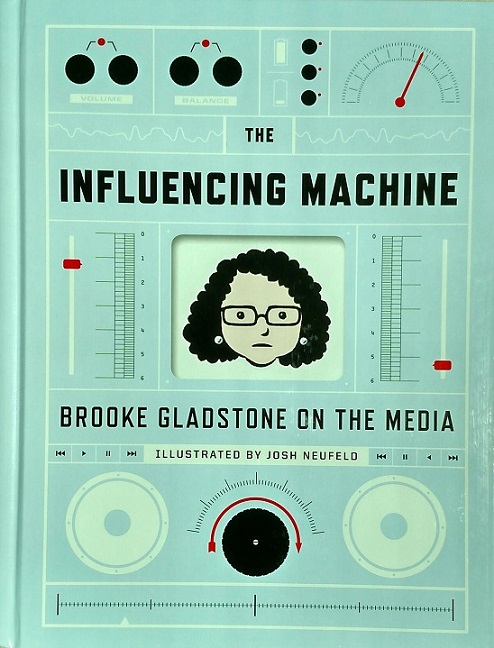
Book Review: "The Influencing Machine" by Brooke Gladstone

The Influencing Machine (2011)
Brooke Gladstone

Illustrated by Jeff Neufeld


170 pages


Brooke Gladstone edits and, along with Bob Garfield, hosts the engaging and informative weekly National Public Radio program On the Media, which analyzes how the media reports stories, as well as the complex relationships between the media and its audience, advertisers, and government leaders. In 2011, building off of her many years of experience on the show, Gladstone released a graphic nonfiction book, The Influencing Machine, in which she reviews the long history of the media. She tells the story using a comic book format in which she herself appears as a character, serving as our guide as she distills down for the reader how the media has evolved, and the variety of psychological biases that challenge reporters as they do their work.

The story opens with a summary of the history of the media, starting in the ancient societies of Guatemala and Egypt, where rulers put in place people responsible for documenting their deeds. After brief stopovers in Roman Empire and seventeenth century Europe, Gladstone quickly focuses in on “The American Exception,” tracing the early development of the press in the American colonies, its growth in the newly formed United States, and on up to modern times.

As she traces the development of the press in the US, it becomes clear that this represents a kind of history of the country itself; we discover that many of the contentious issues playing out today between the press and the government have their origins in the early years of our Republic. So, for example, the Sedition Act signed into law by President John Adams in 1798 during an undeclared naval war with France empowered the government to restrict speech that it felt maligned its policies and officials. Though the act was allowed to expire a few years later under Thomas Jefferson, similar acts have reappeared every few decades, whenever the government has felt threatened by too much free speech.

Gladstone goes on to describe the conflicted relationship the press has had, and continues to have, with its audience. She points out that levels of public trust in the media have varied widely over the course of the republic, and that recently, aside from a brief spike after 9-11, have reached painfully low levels. The reason often given for this low opinion of the press is that it is politically biased --- generally expressed as being too liberal.

The real problems for the media, Gladstone claims, are a host of other biases, which she examines in successive, short chapters: Commercial Bias (novelty sells), Bad News bias (threatening events sell), Status Quo Bias (resisting change sells), Access Bias (reporters enjoy contact with powerful figures), Visual bias (pictures sell), Narrative bias (stories with a clear beginning, middle and end, sell), and Fairness bias (bending over backwards to appear balanced sells). She notes that it can be all too easy for the media to fall into these various biases, often under the claim of giving the public what it wants. As she makes clear, however, each of these biases serves only to pervert and distort the reporting being done.

In an extended section she looks at how the negative effects of these existing biases become strengthened in times of war, as reporters struggle between their role as journalist and their role as citizens, and the government and the military balance the need to get the story out that they want told, while keeping secret what they don’t want revealed. Gladstone takes examples from the U.S. Civil War up through the War in Iraq to describe how the press, the government and military have performed a complicated dance with one another, each seeking the maximum advantage. As she points out, the public often suffers from the resulting confusion and obfuscation.

Her discussion on the role of the press in war-time leads directly to her next topic: Objectivity. She calls it “an unreachable goal – because it’s unprofitable to ignore your readers’ emotions, assumptions, and values,” (98) and goes on to describe the challenges to achieving it, using examples from as far back as the early 1800’s.

A particular aspect of Objectivity that she discusses, one that has been addressed extensively by scholars such as Noam Chomsky, is that much of the press constrains its reporting to within starkly defined limits. She cites a description from ‘historian Daniel Hallin [that] divides the journalist’s world into three spheres’, with reporters limiting themselves to a narrow, doughnut-shaped region of what’s allowed to be reported on, a region bounded on the inside side by “consensus ... unquestionable values and unchallengeable truths,” and on the other by “deviance ... the place for people and opinions that the ‘mainstream of the society reject as unworthy of being heard.’” Again citing Hallin, Gladstone notes that the mainstream media not only confines itself to these hard bounds, but also “plays gatekeeper, by defining and defending ‘the limits of acceptable political conduct.’”(105) To go beyond these bounds to be marginalized, almost by definition.

This last thought plays into perhaps the most critical role of Gladstone’s book, her debunking of the idea that there is some sort of conspiracy of the media, through which the media are attempting to control the public --- that is, that there is an “influencing machine” at the heart of the media. Already in the Introduction, Gladstone firmly declares
There is no conspiracy. Even though the media are mostly corporate-owned, their first allegiance is to their public because, if they lose that allegiance, they lose money. … Conspiratorial. That’s a joke. Craven? Not quite so funny. (xiv)

The book comes in at some 170 pages and with its comic book format one could imagine that ultimately there is not much content. Quite the opposite is true, however; Gladstone has done an excellent --- and undoubtedly crazy-time-consuming --- job of condensing a huge amount of detailed information into each page, using the strengths of the comic strip format and the wonderful illustrations by Jeff Neufeld, to reinforce and amplify her message. Someone looking for a clear and yet compact summary of the role of the media, and the issues facing it, would be well-served starting with Gladstone’s excellent book.


Other reviews / information:

For Noam Chomsky's take on the limitations within which the media operate, and which they also help to enforce, see for example Necessary Illusions: Thought Control in Democratic Societies, a thorough and pointed discussion of the history and implications of the situation.
 

Have you read this book, others by this author, or even similar ones by other authors? I’d enjoy hearing your thoughts.
Other of my book reviews: FICTION Bookshelf and NON-FICTION Bookshelf


Saturday, August 1, 2015

Book Review: "The Siege in the Room" by Miquel Bauçà

The Siege in the Room (1997)
Miquel Bauçà (1940-2005)

Translated from the Catalan by Martha Tennent


 149 pages

When you hear about the so-called 50 page rule, the discussion seems to fall into two camps: those who tend to stop reading a book they don’t like after just 10 or 20 pages, and so use the rule to force themselves to always give a book at least 50 pages before quitting on it; and those who generally always finish a book they start, even if they have to struggle through it, and use the rule to give themselves the excuse to sometimes quit a book early. My tendencies place me firmly in that second group: I try to be selective when I choose a book (so probably miss out on some good ones --- there’s no perfect solution when time is limited), but once I start a book, I feel a commitment to the author to finish it. Even when I was in principle following the 50 page rule, I only seldom invoked it; nonetheless there were a few books I gave up on.

Then, some years ago, I read Mario Vargas Llosa’s The War of the End of the World. As I approached the 50 page mark, I found myself on the verge of setting it aside --- there were another 500 some pages to go, and I wasn’t finding myself engaged. Suddenly, on page 48, Vargas Llosa’s story reached out and grabbed me by the neck, and it didn’t release its grip until I had finished the book. I recall the moment when it took hold of me very clearly, including my realization that, if the typeset or the structure of the edition had been ever so slightly different, and what I read on page 48 had been instead on page 52, I may have quit too early, thus depriving myself of an amazing, thrilling, engaging story. From that point on, my use of the 50 page rule went from seldom to essentially never.

But.

The idea of it, the option, has still been there in the background. And I must admit that, as I struggled through the first of the three novellas by Miquel Bauçà collected into The Siege in the Room, I was tempted to set the book aside. Ultimately I persevered --- in part because the 50 page mark was already a third of the way through the book anyway--- but it was a dogged fight on to the end.

That said, I don’t necessarily want to scare you off from giving these novellas a try. The first, Carrer Marsala, won literary prizes in Barcelona, and brought Bauçà some amount of fame; the fact that, according to the translator’s introduction, Bauçà steadfastly refused to acknowledge these honors, and the resultant renown, may ultimately not be wholly unrelated to his challenging writing style. Picking up this book, you just need to enter with an understanding of Bauçà’s style in these novellas, and your own preference as a reader.

The three stories are each told in a first person, stream of consciousness style, though in each case by a narrator who doesn’t bother to fill in any background, and who is unable to maintain a coherent train of thought for more than a few successive sentences. That is not to say that our narrator’s ruminations are random; rather, he follows a line of thought for a couple few sentences, then suddenly keys in on some element of what he has just told us, and allows it to take his thoughts into a new direction, only to diverge yet again onto another path a few sentences later.

The result is a surreal mixture of introspection that sometimes can seem on the verge of a profound conclusion, before veering again and again into the banal. The overall impact of his style is best comprehended by simply reading several pages of one of the stories, but, to give a hint of what to expect, here are the opening paragraphs of the first story:
Maybe the world hadn’t always been sad. When we say our words are dragged down by inertia, we mean that what we learn as a pup stays with us. The same applies to other things. Girls, for example, use the phone but don’t know its precise function.
I spread my fingers. Carefully I study the outline of their bones. Who can deny me this innocent activity? More than one person might be annoyed by it. Many people believe that it’s impossible to agree with all your neighbors at the same time. Faced with this situation, isn’t it only fair to choose what best suits me? (5)

This first story continues on in this manner, with no definable plot, or even a recognizable order to what we learn about the narrator and his world. The effect is one of tapping into the mental ramblings of a somewhat paranoid loner, who is looking out at a frenetic world, unable to find a stable place within it.

The second novella, The Old Man, is told in a similar style, though it at least contains a single, tiny plot point, around which the narrator’s thoughts revolve. Specifically, he recalls having moved into an apartment building to which came an “officer who, on the first Wednesday of every month, climbed the stairs to give the old man on the first floor a beating.” (67) Curious to learn why this happens, but hesitant to become involved in the loathsome gossip-mongering of the menagerie of his fellow residents, our narrator drifts along on the edge of resolution, and of coherent thought.

In the final novella, The Warden, our narrator is apparently the charge of a female warden, though the precise relationship between the two appears more complex than simply that of a prisoner and jailer. The narrator describes moments of apparent (or imagined?, or past?) freedom, but his thoughts always return to the enigmatic connection he has with his jailer.

In each of these three novellas there is the indication of the passage of time; in the first story, for example, the narrator mentions at one point that “Today … is … Thursday,” and, a little later, that “Tomorrow is Saturday.” But these statements provide no firm handle for the reader to grasp onto. If anything they imply, or perhaps reinforce, that we only get pieces of the narrator’s thoughts, stitched together. The point of the stories seems to be the particular style and structure Bauçà created; the plot remains unimportant. A potential analogy in art, for example, would be the movement from paintings that tell a specific story --- historical or biographical or religious --- to Surrealist art, in which a coherent story can be difficult to fathom.

If you appreciate the surreal, or simply like to experience unusual forms of storytelling, give Bauçà’s three novellas in The Siege in the Room a go. Just prepare yourself for a strange ride.


Have you read this book, others by this author, or even similar ones by other authors? I’d enjoy hearing your thoughts.
Other of my book reviews: FICTION Bookshelf and NON-FICTION Bookshelf