Sunday, July 12, 2020

Book Review: "What Is Real?" by Adam Becker

What Is Real: The Unfinished Quest for the Meaning of Quantum Physics (2018)
Adam Becker (1984)
370 pages


Based on the title, physicist Adam Becker’s What is Real: The Unfinished Quest for the Meaning of Quantum Physics promises a relatively sober, if potentially fascinating, exploration of how to understand what could be considered the fundamental scientific advancement of the 20th century. His book certainly delivers on the fascinating part, providing an accessible discussion of efforts over the past century to achieve a consensus about the physical meaning behind the mathematics of quantum physics.

But whoo, boy, the path toward consensus has turned out to have been anything but sober and dispassionate, despite broad agreement that the theory is “wildly successful” (287) in explaining experimental results. Becker describes what has been a bitter, century-long internecine battle among physicists over how to interpret quantum physics, a struggle that has included broadside attacks against, and repeated backstabbing of, colleagues and students, and has even involved connections between some physicists’ interpretations of the theory and their political stance in the cold war disputes between Marxism and the West. And all of this has involved many of the most famous physicists of the twentieth century, as we discover in this entertaining tour of the history.

Who knew what darkness lurked behind the staid, popular image of objective scientists simply dedicated to pursuing understanding?

Early on, Becker introduces the central dilemma that has driven these disputes:
Quantum physics – the physics of atoms and other ultra-tiny objects, like molecules and subatomic particles – is the most successful theory in all science. … But … [it] doesn’t seem to apply to anything at human scale. … Why not? Maybe quantum physics really is only the physics of tiny things, and it doesn’t apply to large objects … [but then] where is the boundary, and how does it work? (1-2)

Even just the possibility of coming to a concrete interpretation of what the mathematics of quantum physics tells us about reality has divided physicists. Early in the 20th century, Niels Bohr, along with his colleagues and students at the Institute for Theoretical Physics in Copenhagen, “developed and championed” (13) what came to be known as the Copenhagen interpretation of how to think about the quantum world. Summarizing it, Becker writes:
What does [the mathematics] of quantum physics tell us about the world? According to the Copenhagen interpretation, this question has a very simple answer: quantum physics tells us nothing whatsoever about the world. … According to Bohr, there isn’t a story about the quantum world because “there is no quantum world. There is only an abstract quantum physical description.” (14) 
Effectively this constitutes, as one disparaging physicist later observed, a “shut up and calculate” (6) view of quantum physics – use the theory as a development tool that describes the quantum world, and don’t worry about trying to develop a detailed understanding of the reality of it.

The Copenhagen interpretation came to be, already in the first half of the 20th century, the leading way of thinking about quantum physics for most physicists. Some, however, had serious misgivings about its cavalier attitude toward knowing actual reality; Albert Einstein, for example, wrote that “the theory reminds me a little of the system of delusions of an exceedingly intelligent paranoiac.” (14)

Such criticism of the Copenhagen interpretation has been driven in large part by what is referred to as the measurement problem. Schrödinger’s wave function, which lies at the heart of quantum physics, describes a particle’s behavior by “tell[ing] you the probability that the electron is in [a particular] place.” (17) The measurement problem arises from the fact that
once you do find [an] electron, a funny thing happens to its wave function. Rather than following the Schrödinger equation like a good wave function, it collapses – it instantly becomes zero everywhere except in the place where you find the electron. Somehow, the laws of physics seem to behave differently when you make a measurement: the Schrödinger equation holds all the time, except when you make a measurement, at which point the Schrödinger equation is temporarily suspended and the wave function collapses everywhere except at a random point. (17-18)

And this inexplicable behavior, Becker points out, relates then to the boundary problem of quantum mechanics: large objects do not seem to follow quantum behavior, and so there seems to be a boundary between the size of tiny objects that do, and larger objects that do not. But that boundary, or threshold, beyond which quantum mechanics apparently no longer applies, doesn’t appear to be definable.

Acolytes of Bohr’s Copenhagen interpretation, according to Becker, have effectively side-stepped these issues by viewing measurements as obeying classical physics – that is, they distinguish between the quantum world and the world of larger objects, but without ever defining where that boundary exists. They argue, in particular, that it can’t be known, and so isn’t worth pursuing.

Despite these criticisms, the predominance of the Copenhagen interpretation expanded in the wake of World War II according to Becker, as funding for physics – and the number of freshly minted physicists – increased dramatically to support the technology demands of the growing military-industrial complex. In that post-war environment, physicists had a rich field of well-funded practical applications to work on, and since the mathematics of quantum physics worked so well, they simply accepted the Copenhagen interpretation as taught. It seemed a waste of effort (and funding) for anyone to explore the more fundamental questions of what Becker refers to as quantum foundations, the pursuit of the understanding of what is real at the quantum level.

And yet some physicists have continued to balk at this decision to remain ignorant of an understanding of what’s physically happening in the quantum world. Even as the Copenhagen interpretation has cemented its place among the majority of their colleagues, these physicists have continued to seek out alternative interpretations that resolve the measurement issue, while still maintaining the fundamental mathematics that has proven through testing to work so well. In the process they have faced at best indifference from many of their colleagues, though more often outright disdain and active resistance.

Becker explores several of the alternative interpretations that have been developed, and in so doing demonstrates the push-back faced by the physicists who proposed them. This has included rejection of their work from colleagues, journal editors, and even their own doctoral advisors, often apparently behind their backs. And, it’s important to recall, such rejection is not associated with the proposed interpretations being proven wrong, through theoretical counter-arguments or experimental results, but rather out of principle, out of a hardened belief that their interpretation simply couldn’t be correct.

One such example was the work of physicist David Bohm in the 1950’s. Through his studies, Bohm had learned about and come to accept the Copenhagen interpretation without serious concern. But a meeting with Einstein led him to take a closer look, and what he found unsettled him enough that he decided to pursue an interpretation that addressed the measurement issue. His solution was
mathematically equivalent [to the Schrödinger equation] … but the picture of the world suggested by the math, the story it told, was radically different. … Objects have definite positions at all times, whether or not anyone is looking at them. Particles have a wave nature [but] particles are just particles, and their motions are guided by pilot waves. (97-98) 
His theory provided a concrete description of what was happening at the quantum level, resolving the measurement issue, and also showing that quantum physics applies to all objects – eliminating the boundary question.

In the mix with Bohm was that he was watching developments in Europe in the 1940’s and had become a Marxist, even briefly joining a communist party chapter at Berkley, until finding the meetings interminable. This got him into trouble in the US of the 1950’s, and he ended up in Brazil.

At this point the story gets wild, as scientists’ political beliefs and interpretation of the science collide.

Becker explains that the development of the Copenhagen interpretation was heavily influenced by a school of thought known as logical positivism, according to which “any statement that made reference to something unobservable was not only bad science, it was literally meaningless. Thus, talking about what happens in quantum systems when nobody’s looking is nonsensical.” (48) The promoters of the Copenhagen interpretation used logical positivism to support their rejection of any pursuit of an interpretation of quantum physics that attempted to make concrete statements about what happens at the quantum level, including Bohm’s, since they considered it “unobservable."

However, Becker notes that in the Soviet Union, from the time of Lenin through to Stalin’ death, there was a strong ideological “emphasis on “materialism” and rejection of positivism [in] Marxist thought.” (108) And Bohm’s theory aligned well with his own Marxist philosophy supporting materialism – in that it provided a specific description of what happened at the quantum level. Thus,
Bohm [had] hoped for support from Soviet physicists and other communists [in that] his interpretation made quantum physics explicitly about stuff existing in the world, rather than an abstract statement of what physicists can say about experimental outcomes. (108)
That is, like the Copenhagen interpretation.

It turned out, however, that the disdain in the Soviet Union for positivism “died with Stalin in 1953,” (109) right around the time Bohm’s work was published. The resulting political changes freed Soviet physicists who had studied with Bohr to be more vocal in their support of the Copenhagen interpretation, and so also to reject Bohm’s work, one of them in fact referring to its way of thinking as an “illness.” (109)  Likewise,
Léon Rosenfeld, Bohr’s right-hand man in Copenhagen … successfully prevented Bohm from publishing a paper in Nature … [and later] wrote a scathing review, claiming Bohm had hopelessly misunderstood quantum physics. (109-110)

In the end, political shifts inflected even Bohm’s thinking about his own theories. He gradually abandoned them in the mid-1950’s for a number of reasons, but, notes Becker, this change of heart came
at roughly the same time as another, related, major intellectual shift for Bohm: in the wake of the brutal suppression of the Hungarian Uprising in 1956, Bohm abandoned his Marxism. This change in philosophy altered Bohm’s thinking about the nature of the quantum world, which further motivated him to abandon his old ideas. (115)

Certainly there has been a long history of political and social ideologies influencing the interpretation of scientists’ work and conclusions – one must look no farther than to current day topics such as climate change. Becker points out, however, that different than for climate change, “in the debate over quantum foundations, everyone agrees that science works … [the debate] has been a dispute among physicists about the meaning of a theory they all agreed was correct.” (281)

Aside from the political wrangling over Bohm’s theory, a challenging aspect of it is its strange and unintuitive feature of nonlocality. Locality, Becker writes, is “the principle that something that happens in one location can’t instantly influence an event that happens somewhere else” (51) – effectively, non-locality requires faster-than-light information transfer between particles. He notes that the Copenhagen interpretation also assumes non-locality, though considers it not something worth questioning, and that Einstein was no more comfortable with Bohm’s theory than with the Copenhagen interpretation, “reject[ing] any violation of locality, calling it “spooky action at a distance” … [and that] the facts at hand could easily be explained by the incompleteness of quantum theory.” (56)

Tackling the connection between non-locality and quantum physics head-on, according to Becker, was a theorem developed by physicist John Bell.  (Bohr, Bohm, Bell: perhaps there’s an opportunity for a Ph.D. thesis in psychology on Becker’s attraction to physicists whose names start with B….) Bell's theorem establishes two possibilities: “either the predictions of quantum physics are wrong and nature can be local, or quantum physics is right and “spooky action at a distance” is real." (151)

In clear and engaging prose, Becker describes a series of experiments in the late 20th century set up to test Bell’s theorem, and so explore the non-locality implications of quantum physics. A central feature of these experiments was to send two photons in opposite directions, and, while they are en route, randomly change the polarization of devices they then pass through at their destinations. To-date these experiments have consistently demonstrated the apparent non-locality characteristic of quantum mechanics: the results do not demonstrate the random behavior that might be intuitively expected, instead leading to the conclusion that the photons communicate with each other en route. In the terms of Bell’s theorem, the results match the expectations from quantum physics in that the photons’ behavior is correlated to a greater degree than if it was random and independent.

Thus, Bohm’s theory of particles on pilot waves provides an explanation of what happens at the quantum level, but fundamental to it is non-locality – “spooky action at a distance."

Becker describes an alternate explanation, proposed by physicist Hugh Everett in the mid-1950’s, that doesn’t require non-locality, but leads to a perhaps even stranger and more non-intuitive explanation. Everett showed that quantum mathematics can be interpreted as describing that
a single universal wave function is all there is, a massive mathematical object describing the quantum states of all objects in the entire universe … [one that] obeyed the Schrödinger equation at all times, never collapsing, but splitting instead. Each experiment, each quantum event, spun off new branches of the universal wave function, creating a multitude of universes in which that one event had every possible outcome. Everett’s shocking idea came to be known as the “many-worlds” interpretation of quantum physics. (124)

Although Everett’s paper was ignored for many years, Becker notes that nowadays, as the field of cosmology has blossomed, the many-worlds interpretation has become a part of a set of theories together labeled the multiverse, an infinity of universes that exist in parallel to ours. Becker summarizes these ideas in his book, but a deeper and quite fascinating exploration of them can be found in physicist Max Tegmark’s Our Mathematical Universe, in which he details the various theories that have been proposed about the multiverse, from the fairly mainstream to the still controversial. (A link to my review of Tegmark’s book at right.)

https://tertulia-moderna.blogspot.com/2018/06/our-mathematical-universe-my-quest-for.htmlAs an introduction to Everett’s theories, Tegmark describes his own sudden awakening regarding concerns with the Copenhagen interpretation:
No, this just doesn’t make sense! There’s got to be a mistake somewhere! I’m alone in my girlfriend’s dorm room in Stockholm, studying for my first college quantum-mechanics exam. The textbook says that small things such as atoms can be in several places at once, whereas big things such as people can’t. No way! I tell myself. We people are made of atoms, so if they can be in several places at once, surely we can, too! It also says that every time a person observes where an atom is, it randomly jumps to just one of the places where it previously was. But I can’t find any equation defining what exactly is supposed to count as an observation. Would a robot count as an observer? How about a single atom? And the book just said that every quantum system changes deterministically according to the so-called Schrödinger equation. Isn’t that logically inconsistent with this random-jumping business?

Flustered, I muster up the courage to knock on the door of our great expert, a physics professor on the Nobel Committee. Twenty minutes later, I emerge from his office feeling stupid, convinced that I’ve somehow misunderstood the whole thing. This marks the beginning of a long personal journey of mine that still continues, and leads to quantum parallel universes. It’s not until a couple of years later, when I move to Berkeley to do my Ph.D. that I realize that it wasn’t I who had misunderstood. I eventually learn that many famous physicists had been vexed by these problems with quantum mechanics. (157, Our Mathematical Universe)

Interestingly, Everett’s theory has even made it into a fictional setting, playing a central role in the short story Anxiety is the Dizziness of Freedom in Ted Chiang’s collection Exhalation. Chang describes a device central to the plot, one that operates based on the many-worlds interpretation:
https://tertulia-moderna.blogspot.com/2019/10/book-review-exhalation-by-ted-chiang.htmlEvery prism – the name was a near acronym of the original designation, “Plaga interworld signaling mechanism” – had two LEDs, one red and one blue. When a prism was activated, a quantum measurement was performed inside the device, with two possible outcomes of equal probability: one outcome was indicated by the red LED lighting up, while the other was indicated by the blue one. From that moment forward, the prism allowed information transfer between two branches of the universal wave function. In colloquial terms, the prism created two newly divergent timelines, one in which the red LED lit up and one in which the blue one did, and it allowed communication between the two. (273-4, Exhalation)

In describing the interpretations of Bohm, Everett and others, Becker’s point is not that one or the other is necessarily correct. Rather, he wants to encourage the pursuit of understanding the quantum world, and to not simply, as those who follow the Copenhagen interpretation do, “shut up and calculate.” And in that pursuit he notes, considering now also Everett’s interpretation,
Bell’s theorem really leaves only three unequivocal possibilities: either nature is nonlocal in some way, or we live in branching multiple worlds despite appearances to the contrary, or quantum physics gives incorrect predictions about certain experimental setups. (160) 
Thus, one must accept nonlocality or multiple worlds, or resign oneself to the possibility of, as Einstein wrote “the incompleteness of quantum theory.” (56)

Unfortunately, from Becker’s point of view, despite the fact that the study of quantum foundations – the pursuit of an understanding of what the world is like at the quantum level – is no longer as disparaged by the scientific community as it once was, the vast majority of physicists still subscribe to the Copenhagen interpretation, even if only passively. He ascribes this in large part as due to the increased specialization that occurred after WWII, which he concludes has led current-day physicists, unlike their forbearers, to be not only ignorant of, but openly dismissive of the study of philosophy:
Even Einstein complained about this, and how it helped keep the Copenhagen interpretation entrenched. “This state of affairs will last for many years,” he wrote in 1951, “mainly because physicists have no understanding of logical and philosophical arguments." (273)

The result, according to Becker, is that physics students learn the Copenhagen interpretation during their studies, and then, motivated by funding and the pursuit of tenure, put their heads down and focus on concrete problems. Without the scholastic training and tools that the study of philosophy could give them, they remain unwilling to engage in the logical evaluation of the validity of the underpinnings of particular interpretations, and so unmotivated to pursue a more complete understanding of the quantum world.

In What is Real, Becker tells the fascinating history of the search for meaning in quantum physics, a theory that physicists universally agree works, but which has seen “deep and bitter conflict” (281) over its interpretation. He describes the coalescence of physicists around the Copenhagen interpretation, with its rejection of the need to, or even the possibility of understanding the details of the world at the quantum level. And he examines the lives and work of those who have dissented from this consensus, scientists from Einstein through to the present day who have refused to be cowed by the willful desire among followers of the Copenhagen interpretation to remain ignorant of the physical reality behind quantum physics, and who have as a consequence risked the disapproval and opprobrium of their colleagues to pursue a deeper understanding of the quantum world.

Becker clearly encourages this spirit of exploration – not at the expense of the work done by the “shut-up and calculate” crowd, but as an acceptable and important addition to that work.
We have a wildly successful theory, an embarrassment of interpretations, and a major challenge in moving past our theory to the next one. Pluralism about interpretations might be the right answer, pragmatically, while we face that challenge. Or if not pluralism, at least humility. Quantum physics is at least approximately correct. There is something real, out in the world, that somehow resembles the quantum. We just don’t know what that means yet. And it’s the job of physics to find out. (287)


Other notes and information:

As it is something that I find to be too often neglected and poor in many works of non-fiction, I want to take note of the fact that the book’s Index is excellently executed: complete, thorough and very helpful for tracking down connections as you read the book. Bravo!


Have you read this book, others by this author, or even similar ones by other authors? I’d enjoy hearing your thoughts.
Other of my book reviews: FICTION Bookshelf and NON-FICTION Bookshelf


Thursday, June 25, 2020

Book Review: "Winners Take All" by Anand Giridharadas

Winners Take All: The Elite Charade of Changing the World (2018)
Anand Giridharadas (1981)
288 pages

Despite being implicated in a dramatic rise in inequality that has led to increasingly dire economic and social disruptions, as well as in practices that have contributed to world-wide environmental degradation and hampered efforts to counter the existential crisis of climate change, free market capitalism has maintained an iron grip on the Western imagination as being the preeminent economic system.

Certainly the argument has been made – perhaps most famously by Steven Pinker – that the ascendancy of free market capitalism has resulted in significant improvements in people’s lives over the past several centuries, reflected in improved standards of living and longer lifespans. According to this line of reasoning it has been a net benefit – despite its role in the current challenges and in the well-documented exploitation that accompanied colonization and empire, the destructive impacts of which continue to play out.

Whatever the final assessment of the historical benefits however, its apparent triumph over other economic systems has come to take on a kind of end-of-history aura in the past few decades, a conviction that the final summit in human economic development has been reached. So convincingly have its proponents inculcated recent generations with the belief in the supremacy of free market capitalism that questioning it often elicits the rote response, so, you prefer Soviet style communism?, as if that’s the only other option – shutting down even consideration of future alternatives.

Not surprisingly, the elite who have most benefited from the global expansion of this system have become the most passionate champions of its superiority. And, according to journalist Anand Giridharadas, their unshakable belief has recently led them to promote a self-serving form of market-based philanthropy. In his book Winners Take All: The Elite Charade of Changing the World, he presents a thorough and compelling examination of how the very people who have profited from the free market capitalist framework that has caused so many of the social, economic, and environmental problems that plague our societies now promote market approaches as the only viable path to solutions.

Giridharadas labels this empire of believers convinced in the unique ability of business methods to solve social issues MarketWorld, which he describes as populated by
an ascendant power elite that is defined by the concurrent motivations to do well and do good, to change the world while also profiting from the status quo … These elites believe and promote the idea that social change should be pursued principally through the free market and voluntary action, not public life and the law and the reform of the system that people share in common; that it should be supervised by the winners of capitalism and their allies, and not be antagonistic to their needs; and that the biggest beneficiaries of the status quo should play a leading role in the status quo’s reform. (30)
Through an engaging combination of personal stories of people caught up in the MarketWorld philosophy – its champions as well as those conflicted by its contradictions – and big-picture descriptions of the MarketWorld milieu and ethos, he makes clear both the powerfully seductive nature of its beliefs and the strict requirements and constraints, in thought and deed, that it imposes on its disciples.

The origins of MarketWorld thinking, according to Giridharadas, can be found in the rise of “organized philanthropy” (156) as an expectation for the wealthy in the late 1800’s, a time of growing anger over the vast riches industrialists were amassing. Reminiscent of elite reaction in so many other similar episodes of agitation in American history – such as over working conditions, working hours or child labor – powerful business leaders found themselves unable to ignore the populist pressure, and so finally resolved to concede just enough of their advantage to reduce the boiling point.

In that vein, Andrew Carnegie wrote in 1889 what Giridharadas identifies as a pivotal essay, one that effectively brokered a deal between the masses and the wealthy elite. In it he argued that it is perfectly acceptable that those with the talent to make money not be constrained from doing so by government regulation or other limitation, but that in return they also had the responsibility to give back a part of their wealth for public works.

Thus the foundation was laid for the modern concept of philanthropy. However uncomfortable the wealthy came to feel about their largesse and the devastation caused in amassing it, they never-the-less held tightly to the advantages that had permitted their success. To assuage their guilt they embraced philanthropy – for many years expressed through privately funded infrastructure building, but now, according to Giridharadas, also through investment in (profitable) business solutions to social issues.

The consequence of the bargain Carnegie struck for the elite has been to unleash them to pursue ever more deregulation and tax reduction, which has undermined the government’s ability to resolve social and economic problems by weakening its authority and starving it of funds. And, having de-legitimized the government as an effective institution, the elite – the winners in the game of free market capitalism – have then argued that since government is so ineffective, society must needs turn to business people to fix its problems.

Not surprisingly, Giridharadas points out, the elite then pursue solutions consistent with their experience and personal goals – market-based, profit-making solutions. He notes that traditional social justice movements tend to pursue systemic changes that lead to a win-lose scenarios, such as workers getting more rights at the expense of business profits. MarketWorlders, on the other hand, pursue win-win scenarios, market-based solutions intended to help those impacted, but without changing the fundamental (and profitable) systems causing the original devastation, and allowing still (further) profit to be made.

When MarketWorlders develop such win-win solutions for solving social, economic, and environmental issues, they tend to build off of techniques and processes originally developed to address business problems and improve business efficiency. These types of protocols, writes Giridharadas, result in solutions that typically focus on dealing with the impact of problems at the scope of individuals, as opposed to correcting them at the systemic issues at a community level.

Giridharadas goes on to point out a broader predicament for society that arises from these protocols, referencing a 2011 essay by Harvard Business School professor Michael Porter and his colleague Mark Kramer:
“The capitalist system is under siege.” … “A big part of the problem lies with companies themselves,” [which] had become too focused on “optimizing short-term financial performance.” … Again and again, companies that employed droves of brilliant people and had high-priced outside advisers were making decisions that ignored “the well-being of their customers, the depletion of natural resources vital to their businesses, the viability of suppliers, and the economic distress of the communities in which they produce and sell.”   Porter and Kramer were critiquing a culture that had overtaken the business world: the culture wrought by the atomizing protocols that obscured context. (144) 
And this business culture, Giridharadas argues, with the limitations and destructive consequences identified by Porter and Kramer, is nonetheless now promoted as the solution to the very same societal issues it has created.

Outside of the direct control exercised by the business community over what constitute viable approaches to solving social problems, Giridharadas notes that the MarketWorld ecosystem also leverages its monetary largesse to subtlety but effectively co-opt many of those who might otherwise pursue social justice movements focused on systemic change through governmental action – that is, who might put in jeopardy the profitable economic climate that currently exists for MarketWorlders.

He points out, for example, that college students in recent decades have
come of age [in] an era in which capitalism has no ideological opponent of similar stature and influence, and in which it is hard to escape the market’s vocabulary, values, and assumptions, even when pondering a topic such as social change. (17)
In this environment, idealistic students who want to make a difference are naturally guided toward the idea of market-based solutions, rather than systemic change, as being most appropriate. Such thinking diverts them from government and non-profits, leading them instead to pursue business and management degrees, and eventually take jobs at consulting firms, having come to believe that such a path is the only viable one through which to make an impact.

The other group that MarketWorld quite effectively pulls into its orbit according to Giridharadas, are politicians, professors and others actively working on identifying and addressing systemic social issues. Using the experience of one professor in particular, but also providing examples of public intellectuals in other disciplines, he effectively ‘follows the money’ that leads such critics into the embrace of the MarketWorld firmament as so called thought leaders.

Those who successfully navigate this transition to becoming thought leaders are rewarded financially with on-going speaking engagements and involvement at MarketWorld events. In exchange they tone down their message and shift away from pointing out the systemic wrongs being perpetrated, instead focusing on “helpful solutions” (92) for the victims of these now anonymously-caused wrongs. Successful thought leaders quickly learn to not implicate and antagonize MarketWorlders as the source of these problems, and to not promote the kind of systemic solutions that are of a win-lose nature.

Giridharadas pulls together his main themes in an extended examination of the Clinton Global Initiative (CGI), a conference held yearly from 2005-2016, and for which Bill Clinton defined the goal as “require[ing] the rich and powerful people it brought together to commit, as a condition of showing up, to tangible projects for the global good.” (203)  Focusing on the last of these conferences, which occurred in 2016 in the atmosphere of rising populism that led to the successful vote for Brexit and the election of Donald Trump, Giridharadas demonstrates how the conference panels kept ‘on-message’ with MarketWorld thinking.

Referencing a session entitled Partnerships for Global Prosperity, for example, he writes that “[though] the panelists represented the left and the right … everybody onstage was part of the globalist, cosmopolitan, technocratic, win-win consensus, promoted and sponsored by MarketWorld.” (215) Similarly, he summarizes another panel as one “that could be counted on to provide the right amount of stimulation while worrying absolutely no one.” (228)   Giridharadas concludes that these conferences demonstrated how Clinton, who “when he started public office … believed public problems were best solved through public service and collective action,” had completed the transition already begun during his time in office, to a belief in “the theory that it was preferable to solve problems through markets ... [with] win-win solutions.” (205)

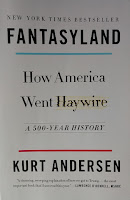
Throughout his book Giridharadas’ examples focus on US leadership in the promulgation of the MarketWorld thinking. In that sense, his descriptions of the unshakable belief of MarketWorlders in the market as the solution to social issues, and also of the almost mystical status they give to applying the latest technologies to these problems – there’s an app for that – resonates all too well with author Kurt Andersen’s conception of the U.S. as Fantasyland. In Andersen’s eponymous book, subtitled How America Went Haywire: A 500 Year History, he notes that
America was the dreamworld creation of fantasists, some religious and some out to get rich quick, all with a feverish appetite for the amazing. … Mix the Protestant impulse to find the meaning and purpose in everything with the Enlightenment’s empiricism, and you get our American mania for connecting all the dots, irrationality in rationalist drag. (427-428, Fantasyland) 
https://tertulia-moderna.blogspot.com/2020/03/book-review-fantasyland-how-america.htmlMarketWorlders, with their credulous – fantasist – belief in the supremacy of technology-centric, market-based solutions, could be considered to fit in comfortably as citizens of Andersen’s Fantasyland empire. (My review of Andresen’s book at right.)

Despite their success, MarketWorlders have faced push-back in recent years in the form of populist uprisings. Giridharadas notes that suddenly, “the world’s elites were being revolted against, and the revolts perhaps had something to do with how disconnected they were from the realities of others.” (210)  To describe how MarketWorld elites have come to be viewed, he borrows historian Niall Ferguson’s term rootless cosmopolitans, a term that hearkens back to a damning observation by writer Bill Kauffman in Utne Reader in 2000:
For almost 60 years, the placeless have waged war on the rooted, stealing their children, devastating their neighborhoods, wiping out local peculiarities and idiosyncrasies. What we have is class war – though this war has never been acknowledged because the casualties are places and attachments and sentiments; nothings, really; everythings, in fact – waged by the mobile against the immobile, by the cosmopolitan against the rooted, and the winners are he professionals, people so depraved that they would actually move to a different place for mere money. How bizarre.

It could well be, however, that these rootless cosmopolitans – Kaufmann’s depraved – will finally have the last laugh, beyond the current period of populist revolt. The historian Noah Yuval Harari, in his 21 Lessons for the 21st Century, extrapolates forward current trends in the development of information technology (“info-tech”) such as artificial intelligence driven automation and data analysis, and biological technology (“bio-tech”) such as medical treatments and genetic enhancement, toward a potential future in which the elite create a self-reinforcing benefit-structure that allows them to extend their existing advantages over the rest of the population to ever more extreme levels, ultimately allowing them to live in entirely self-sufficient, isolated communities. Unless we develop paths that avoid this dystopian future, Harari argues, the masses will become “expendable” to an extent not seen before:
The two processes together – bioengineering coupled with the rise of AI – might therefore result in the separation of humankind into a small class of superhumans and a massive underclass of useless Homo sapiens. To make an already ominous situation even worse, as the masses lose their economic importance and political power, the state might lose at least some of the incentive to invest in their health, education, and welfare. It’s very dangerous to be redundant. The future of the masses will then depend on the goodwill of a small elite. Maybe there is goodwill for a few decades. But in a time of crisis – like climate catastrophe – it would be very tempting and easy to toss the superfluous people overboard.
https://tertulia-moderna.blogspot.com/2018/12/book-review-21-lessons-for-21st-century.htmlIn countries such as France and New Zealand, with a long tradition of liberal beliefs and welfare-state practices, perhaps the elite will go on taking care of the masses even when it doesn’t need them. In the more capitalist United States, however, the elite might use the first opportunity to dismantle what’s left of the American welfare state.” (75, Harari; my review of his book linked to at right.) 

Certainly the shifting emphasis toward addressing social issues through market-based solutions that focus on making a profit (and that are simply given up on if they don’t) subverts governments’ ability to prevent, or at least ameliorate the worst impacts of the bleak future Harari imagines possible.

The question, finally, is will populist unrest sufficiently threaten the elite’s hold on power to an extent that forces them to back down from the MarketWorld ideology and to allow governments to lead systemic change? Or have we as a civilization already passed the point of no return toward Harari’s dystopic vision of a future with an isolated elite and “redundant … superfluous” masses?

Similar to Harari, Giridharadas argues that the social, economic and environmental crises we face must be addressed through a restoration of our “shared democratic institutions,” which represent all of us as “free and equal citizens.”  Instead of allowing the denizens for MarketWorld – the “winners” in the current system – to continue denigrating and delegitimize governments in order to further their own profitability under the pretense of beneficence, he calls for a strengthening of our “common institutions,” noting that “when a society solves a problem politically and systemically, it is expressing the sense of the whole; it is speaking on behalf of every citizen.” (262)  Only in this way, he argues, can we have the opportunity to achieve a more successful, sustainable and socially just society.

In the Acknowledgements at the end of the book, Giridharadas concedes his own flirtation with becoming a MarketWorld thought leader, a path that eventually led him to question the fundamental assumptions behind its approach to solving social and economic issues, and finally to write a book on what he had learned. This insider view, as he points out, not only gave him access to the people that inhabit MarketWorld, but also a direct understanding of the seductive nature of its promises and the well-defined limits of what it consents to consider.

The result is an engrossing and convincing critique of the MarketWorld ethos. Giridharadas himself views his book as a step on the path to weakening its orthodoxy, describing his text as “a letter to the public, urging them to reclaim world-changing from those who have co-opted it.” (268) He bluntly calls out the status quo, writing:
if anyone thinks that the MarketWorld complex of people and institutions and ideas that failed to prevent this mess even as it harped on making a difference, and whose neglect fueled populism’s flames, is also the solution, wake them up by tapping them, gently, with this book. For the inescapable answer to the overwhelming question – Where do we go from here? – is: somewhere other than where we have been going, led by people other than the people who have been leading us. (246)


Other notes and information:

Read quotes from this book


Michael Porter’s conclusion as summarized above from Giridharadas’ book – that the “capitalist system is under siege” – has been suggested by a growing number of authors in recent years. While some, like Porter in the quotes included above, imply that the problems lie in the current practices of capitalism, others go farther, arguing that the capitalist system is, in fact, fundamentally unsustainable.

This latter point has been made, for example, by Martin Hägglund in his book This Life, in which he discusses what he refers to as the immanent contradictions in the capitalist system, which he argues originate from the fact that “under capitalism, all questions of what we need, what we want, and what is durable, must be subordinated to the question of what is profitable.” (250)  Distinguishing between “socially necessary labor time” as the time we work to survive (to secure food and shelter), and “socially available free time” as the time we work on the things that bring meaning to our lives, Hägglund states that
The very calculation of value under capitalism, then, is inimical to the actualization of freedom. Indeed, the deepest contradiction of capitalism resides in its own measure of value. Capitalism employs the measure of value that is operative in the realm of necessity [necessary labor time] and treats it as though it were a measure of freedom [available free time]. Capitalism is therefore bound to increase the realm of necessity and decrease the realm of freedom. (258) 

Through references to the work of Martin Luther King Jr., Hägglund make his ideas concrete:
the problem of value becomes specially manifest in the replacement of living labor time with nonliving, automated production time. In his speeches and books, King keeps returning to automation as a double-edged phenomenon. The automation of previously necessary labor should be emancipatory, since it liberates us from the need to expend our lifetime on tedious forms of work. Yet, under capitalism, automation does not lead to the emancipation of workers but rather to their unemployment, which makes them available for further exploitation in temporary jobs and with lower wages. “As machines replace men, we must again question whether the depth of our social thinking matches the growth of our technological creativity,” King emphasizes in a [1962] speech. (343)

And, to be clear, for Hägglund the immanent contradictions of capitalism as a sustainable system are not at all tied to a few greedy profiteers:
The privileging of the profit motive is not a moral failure of individuals under capitalism but expresses what we are collectively committed to in being committed to capitalism and its necessary requirement of an annual growth of value. (250) 
https://tertulia-moderna.blogspot.com/2019/06/book-review-this-life-by-martin-hagglund.htmlGiven this inherent goal of the system, he argues that ‘fixing’ capitalism is therefore not a viable option.

Hägglund’s critique of capitalism forms just one part of a fascinating exploration of what it means to find value in one’s life. My review of his book is linked to at right.


Have you read this book, others by this author, or even similar ones by other authors? I’d enjoy hearing your thoughts.
Other of my book reviews: FICTION Bookshelf and NON-FICTION Bookshelf

Friday, June 12, 2020

Book Review: "The Best of Richard Matheson"

The Best of Richard Matheson (2017)
Richard Matheson (1926-2013)
Introduction by Victor LaValle
407 pages

Déjà vu all over again.

That’s the surprising experience awaiting most anyone who reads through the 33 stories collected in The Best of Richard Matheson. Even though many will perhaps not recognize Matheson’s name, they will discover sprinkled throughout this engaging collection of horror, fantasy, mystery and science fiction stories, plots that seem strikingly familiar.

I certainly came to these stories unfamiliar with Matheson’s work. Though Victor LaValle’s delightfully crafted introduction tips readers off, I was unprepared for the number of stories that I suddenly recognized as classic TV episodes or movies.

So it was for Duel, which opens with a driver heading to San Francisco who uneventfully passing a tractor-trailer on an isolated, two-lane highway in a region of dry scrub and mountains. A few miles later, having “drifted into a reverie” on the empty road, the driver “started as the truck roared past him on the left, causing his car to shudder slightly,” and, after cutting in, forced him “to brake to maintain a safe distance behind it.” The duel has begun, as made famous in the eponymous Hitchcock movie. It turns out that Matheson not only provided the inspiration for the movie with his story, but also wrote the screenplay.

Several of the stories included in the collection also became the basis for Twilight Zone episodes. Perhaps the most famous of these, Nightmare at 20,000 Feet, starred William Shatner as a man not completely comfortable with flying who becomes convinced during a flight on a stormy night that a kind of ape-man is jumping onto the wing and trying to remove a cover plate of the engine. Can he, however, convince the airplane’s crew of the imminent danger?

Matheson does brilliant job of building up of the tension in the stories of this collection. Each tends to open with the main character or characters in the midst of an unremarkable activity or moment, one that then gradually – ever so deliberately – spirals out of their ability to control or even comprehend. Quotidian lives that most any reader can identify with become suddenly transformed into dogged battles for survival against a seemingly relentless force.

If you’re the least bit skittish about the unexplained, Matheson’s tightly crafted tales will have you glancing over your shoulder at unexpected sounds or glints of light that before would have passed unnoticed. For, unlike the more famous movie and TV versions, these stories play out in our imagination, a fertile if mysterious ground in which they can link into our profoundest personal fears.


Other reviews / information:


Have you read this book, others by this author, or even similar ones by other authors? I’d enjoy hearing your thoughts.
Other of my book reviews: FICTION Bookshelf and NON-FICTION Bookshelf


Saturday, May 23, 2020

Book Review: "Light of the Stars" by Adam Frank

Light of the Stars: Alien Worlds and the Fate of the Earth (2018)
Adam Frank (1962)
262 pages


When I was a boy living on a dirt road in farmland outside a medium-sized city in central Michigan, my sister and I and a few other children would be recruited each summer by my godmother, who we all called Aunt Betty, to walk with her along the nearby roads with trash bags to collect the many bottles and cans – and other accompanying pieces of garbage – littering the ditches. Then, in 1976, Michigan passed a bottle deposit law, and our clean-up walks immediately became a thing of the past, as the littering largely stopped.

Would that the understanding of, and solution to, all our environmental problems was so straight-forward.

Instead, we face an array of complex environmental challenges – most principally from global warming – arising out of an inability to evolve our civilization to the point of achieving a sustainable presence on Earth. That human activity impacts and, in fact, fundamentally alters the planet has become broadly accepted by scientists, leading some to embrace a new name for our current era, as described by astrophysicist Adam Frank, in his book Light of the Stars:
Ten thousand years ago, our project of civilization was born after the beginning of what geologists call the Holocene, a planetary epoch of warm, wet conditions following the end of the ice ages. But, in driving climate change, we’re now pushing the Earth out of the Holocene into a new era in which human impacts dominate the planet’s long-term behavior. The new era is called the Anthropocene. (12)

Because we have so far been unable to come to a common understanding about the extent of our impact on the biosphere, we have consequently failed to find the political and social will to address it. Frank claims that this “failure is rooted in the mistaken view that we, and our project [of civilization], are a one-time story” (12); to correct this he proposes, as described in the subtitle of his book, that we consider the connection between Alien Worlds and the Fate of The Earth. In engaging and accessible prose he summarizes the history of our scientific understanding of other planets, and the possibility of alien civilizations, as a means toward helping us better comprehend the existential threat our civilization now faces, and the possibilities for maintaining Earth’s habitability for our project of civilization.

He pursues his goal by marshaling what has been learned about other worlds – from the planets in our own solar system to the planets now understood to be circling distant stars – in order to tie our understanding of the evolution of the biosphere on Earth to that of other planets, and of the implications of human impact on the biosphere to the challenges technologically advanced life on other planets, so-called exo-civilizations, might similarly face. Through such an understanding he believes, we can better grasp the deeply intertwined nature and fate of our civilization and Earth’s biosphere.

Frank begins with the story of perhaps the most well-known question about technologically advanced life beyond Earth: in 1950, during a conversation with colleagues about the possibility of such alien civilizations, Enrico Fermi suddenly asked: “But where are they?” Known as Fermi’s Paradox, his question arose from his consideration that, if exo-civilizations are common, then given the age of the universe relative to that of our own civilization, they would have had plenty of time to spread through the galaxy, and so we should see evidence of them.

Noting that the actual search for life beyond Earth has had a checkered history of wild claims, resulting in many scientists having had fairly dismissive attitudes to any of their colleagues taking such study seriously, Frank then introduces Frank Drake, an astrophysicist who in the 1950’s became one of the first scientists to methodically search for signs of alien civilizations. In 1961, having been asked to host a small conference on the topic – effectively, to address Fermi’s paradox – Drake sought a structure around which to organize the meetings, and ended up developing now the most famous equation related to the search for exo-civilizations.

With the goal of estimating the number of exo-civilizations in the galaxy that could currently be detectable, he wrote an equation with seven factors, each of which could be individually investigated by scientists. Specifically, he postulated that the number of detectable civilizations, N, could be estimated by the equation N=N* fp np fl fi fc L where N* is the rate of star formation in the galaxy per year; fp is the fraction of stars with planets; np is the number of planets in “the Goldilocks Zone” in which life is possible as we understand it; fl is the fraction of planets with life; fi is the fraction of planets with life that develop intelligent life; fc is the fraction of planets with intelligent life that develop a technological civilization (defined as capable of broadcasting radio signals); and, L is the average lifetime in years of a technological civilization.

Frank notes that when Drake proposed this equation as a guide for focusing the conference discussions, little, if any, concrete evidence existed for knowing what values to assign to any of its constituent terms. In the mid-twentieth century, even the formation process of stars was just being worked out, and the formation of planets was still thought to be a rare event, with the leading theory being that they occurred when two stars passed close to one another, something known to be extremely unlikely. Over the past half century, however, there has been a revolution in the understanding of several of these terms, and Drake’s equation becomes the foundation for Frank’s further analysis.

But before looking to alien worlds for keys to the fate of the earth, Frank first explores the question as to whether the planetary processes observed on Earth apply on other planets. After covering the rather wild history of expectations about our neighboring planets, he reviews what has been learned over the past several decades from numerous probes launched to planets throughout the solar system. Focusing in particular on the missions to Venus and Mars, he describes how scientists have determined from analysis of data sent back from probes that the physics of Earth’s climate processes generalize to other planets, and so are not unique to Earth. As a consequence, not only have models developed for Earth’s climate aided in the understanding of the climate evolution on our neighboring planets, but what has been learned from past and present conditions on these other planets has enabled scientists to improve models of Earth’s climate evolution, including into the future.

These learnings become a key element in Frank’s framework for understanding and addressing the dangers we face in the Anthropocene. Improved understanding of the evolution of Earth’s climate over the 4.5 billion years of our planet’s existence provides bracing cautions for our actions today. In particular, Frank notes, we now understand from this history that life can dramatically transform the planet – the Anthropocene will not be the first time. As with Copernicus moving Earth from the center of the universe, it’s now also understood that man is not the only form of life with the power to alter its climate.

Frank describes a previous such event from the distant past, pointing out that 2.7 billion years ago, “[the Earth’s] “air” was composed almost entirely of nitrogen and CO2.” (99) But then, some 2.5 billion years ago, “the concentration of atmospheric oxygen increased by a factor of a million” (116), completely transforming the biosphere, in what is referred to as the Great Oxidation Event (GOE). And, in a consequence that has ominous implications for our current climate crisis, Frank points out that
changing the planet may not work out well for the specific forms of life that caused the change. The oxygen-producing (but non-oxygen-breathing) bacteria were forced off the Earth’s surface by their own activity in the GOE. (118)

This past fundamental transformation of our planet has made clear that there is a coevolution of Earth’s biosphere and life. Combined with the understanding that the physics of the biosphere are universal, it has become clear that any “planet could be deeply transformed by the life it births, including when that life goes on to create its own globe-spanning civilization.” (130)

But before this understanding of the coevolution of a planet’s biosphere and life could be engaged to understand what planets outside our solar system can tell us about the possibility of exo-civilizations, it had first to be understood whether there are such planets. Frank summarizes the fascinating history of the search for planets around other stars, describing some of the more charismatic and sometimes eccentric personalities that have led the way over the past couple of hundred years. Success came only in the present century, however, as the obsessive dedication and work of a few key scientists laid the necessary groundwork for the Kepler Mission, a telescope sent into space in 2009 specifically to search for planets around other stars. With planets being discovered from already the first moments of the mission, within a few years the accepted value for the fraction of stars with planets went from “very low … [to] about 1” (150).

With astronomers having thus provided solid estimates to the first there terms in Drake’s equation – the rate of star formation in the galaxy (~1/year), the fraction of stars with planets (~1), and the number of habitable planets (~0.2) – attention shifted to the final terms, the domains of biology, sociology and anthropology: the fraction of planets with life; the fraction that develop intelligent life; the fraction that develop a technological civilization; and, the average lifetime such civilizations.

Given the challenges to determining estimates for these final terms, Frank and several of his colleagues considered a bounding question: could they define a value that estimates how many civilization have ever existed in the universe. To do so, they created a simplified version of Drake’s equation, which lumps together the original seven factors into two – one for the first three terms describing the likelihood of habitable planets, and a second for the likelihood of technological civilizations developing; for their purpose, L, the length of time a technological civilization lasts is not germane.

Using this equation, they calculated what they refer to as a “pessimism line,” which defined, given what is known now about the likelihood of habitable planets existing, “how bad the probability of a civilization forming would have to be in order for ours to be [the] only one that has ever existed.” (155) They determined this probability to be “one in ten billion trillion,” (155) which is to say that, if one identified in the universe ten billion trillion planets in the habitable region around stars, then only on Earth would there be civilization. Though Frank brings up skeptics of his team’s work, and addresses their positions, from his point of view one would indeed have to be fairly extremely pessimistic about the chances of life occurring and civilization developing to not be convinced that there has been somewhere, at some time, other civilizations in the universe than only on Earth.

Having established values for the existence of habitable planes, and developed a numerical framework demonstrating the likelihood that at least some exo-civilizations have existed, Frank turns to the final factor in the Drake equation, noting that it has garnered the most debate and discussion: the anthropological question of how long (radio capable) civilizations tend to last.

Hard-set on avoiding the rabbit hole of hand-waving arguments, Frank grounds his exploration of this question on the history of how the development of the predator-prey model in the early 20th century led to a shift in the work of biologists to the use of models to analyze and understand biological phenomena. Based on that approach, Frank and his team developed a model that allows them to evaluate how a planetary civilization might evolve once it reaches its Anthropocene moment, their base assumptions being that the development of technology requires energy and in fact leads to an inevitable increase in energy demand, and that any civilization exploiting that energy will at some point not only impact, but ultimately alter, their planet’s biosphere. (As Frank points out: “even [energy generation from] wind … has a planetary cost (though far lower than fossil fuels).” (191))

When he and his team ran their model under different scenarios – different reactions of a civilization upon reaching the Anthropocene – the results were not encouraging. Most scenarios lead to either a die-off, or a complete collapse of civilization. Frank makes the concept of civilizational collapse concrete by referencing the example of Easter Island made famous by Jared Diamond in his book Collapse, which demonstrated the devastating results when a “civilization overshot the carrying capacity of its environment.” (182)

The knowledge that life has the ability to completely transform the planet – as happened in the GOE some 2.5 billion years ago; the recognition that human civilization – entering the Anthropocene – has initiated a shift in the climate that may already have passed the point of being reversible; and the modeling that indicates dire outcomes if our civilization fails to take active steps to counter its impact on the planet’s biosphere. Taken together, Frank argues, the threat that these understandings make clear demands immediate action, at a civilization level, before it becomes too late.

To better clarify the situation we find ourselves in, Frank explores ways of classifying the level of impact of a planet’s biosphere from processes that transform energy. He first recalls a scale developed by the Soviet astronomer Nikolai Karadashev in 1964 to describe a civilization’s level of technological development, based on how much energy it harvests for use: Type 1, all on the planet; Type 2, all in its stellar system; and, Type 3, all in its home galaxy. He points out, however, that this scale fails to recognize the impact of a civilization on its planet, a connection fundamental to a civilization’s ability to survive long-term.

To address this, Frank and his colleagues propose a new scale based on the level of energy transformation on a planet: Class 1, no atmosphere, so none; Class 2, atmosphere present, but no life present to alter it; Class 3, “life has gotten started [and] it’s affecting the rest of [the planet’s] coupled systems, but does not yet dominate these systems.” (218); Class 4, a planet that has “been hijacked by life” (218), which creates a coupled system with the planet; and, Class 5, have “agency-dominated biospheres [with] the civilization … deliberately working with the rest of the natural systems to increase the flourishing and productivity of both itself and the biosphere as a whole.” (219) Frank argues that human civilization, having entered the Anthropocene, has moved beyond Class 4, but “is not yet, and may never be, a Class 5 planet,” (220) – depending on what we do next.

In Light of the Stars, Frank looks to move the discussion around the existential threat of climate change beyond the simplistic calls to save the planet – “the Earth will happily move on without us” (223), or particular solutions. Instead, by exploiting the knowledge that’s been gained over particularly the past 70 years or so through the dedicated work of astronomers, biologists and others, he wants us to understand that the challenges we face are fundamental to any other civilizations that may have arisen or may yet arise in the universe as we understand it.

Engaging these challenges requires that our human civilization not simply consider itself to be using the planet. Instead, Frank argues, in order to develop a sustainable civilization humanity must acknowledge its transformational impact on the planet’s biosphere, and develop processes of energy use with an understanding of the coupled nature of civilization’s systems and the planet’s processes. We must recognize that our civilization must co-evolve with the planet, understanding how our actions impact the planet and, crucially, whether our transformed planet will be able to support us. Failure to do so, he argues, condemns us to a possibly irrecoverable collapse.

At a time when humanity seems to be splitting apart at the seams, with populations in many advanced nations bifurcating into seemingly hopelessly divided factions, it seems a tall order that Frank asks of us. But by a least understanding the full scope of what is required, and the universal nature of the challenges we face, we can perhaps take the necessary steps to summoning the will to ensure the continuation of our “project of civilization.


Other reviews / information:

A nice video graphic from NASA/SYSTEM sounds of the exoplanets that have been discovered highlights the accelerated pace of discovery after 2010.


Have you read this book, others by this author, or even similar ones by other authors? I’d enjoy hearing your thoughts.
Other of my book reviews: FICTION Bookshelf and NON-FICTION Bookshelf

Wednesday, May 13, 2020

Book Review: "Cloudbursts" by Thomas McGuane

Cloudbursts (2018)
Thomas McGuane (1939)
556 pages

Life weighs heavily upon the characters in the forty-five short stories of Thomas McGuane’s collection Cloudbursts – they feel out of sync with their family and friends, their communities and the world in general. Whether raging against perceived unfairness and injustice, or succumbing to a forlorn hopelessness, all struggle to make their way through a seemingly unforgiving world. Though some are clearly – to borrow a phrase from the story The House on Sand Creek – “a bubble and a half off plumb” (283), others simply grapple with some combination of bad choices, limited opportunities and the vicissitudes of modern life; most remain perpetually slightly mystified by what happens to them.

Into the lives of these characters, McGuane introduces a sudden, defining moment – a cloudburst as it were. The stories become richly detailed character studies exploring how people already at best muddling through life fight to maintain their equilibrium in the face of an unexpected event, one that forces them to directly confront the personal social struggles and awkwardness they’ve mostly managed to ignore or repress. Despite the deep-seated melancholy and listlessness of the characters we meet, and the seeming hopelessness of the situations they find themselves in, McGuane’s sympathetic treatment of them allows us to feel compassion for their plight.

He sets the tone in the first story, Sportsmen, which opens with a boy spending the summer with a friend, hunting and fishing and generally trying to act grown up in the woods and riverfront near their homes – until a freak accident leaves his friend with a broken neck. The boy is sent away to a summer camp, and upon returning home visits his now wheelchair-bound friend, surprised to discover him surrounded by the aggressively hip students the two of them had always feared and avoided. The boy doggedly bides his time however, hoping to somehow reestablish the connection that had been lost.

In Motherlode, a young man who “was astonishingly uneducated in every respect, though clever in keeping an eye out for opportunity” has drifted into a “moderately successful” career helping ranchers with their cattle breeding, having taken an on-line course. When a stranger forces him at gun point to drive to an isolated house from which the stranger and his girlfriend partner are running opium, his ambivalence about his job and his life leaves him open to the temptation of a get rich quick scheme, and to ignoring all the potential warning signs associated with it.

Canyon Ferry introduces us to a divorced father who learned “only long after it mattered that [his wife and her lover] had been exhausting their erotic urgency over four vigorous years of infidelity prior to the separation.” Painfully aware that bringing his young son back to his place for visitations only reinforces that it isn’t home, he looks for outside activities to help them stay connected, and so one day buys the necessary equipment to go ice fishing. Despite his earnest intentions, his lack of understanding about the vagaries of the weather around the high mountain reservoir they head out onto results in the excursion nearly ending in disaster, only further alienating him from his son.

In many of these stories the characters fail to overcome the challenges of the losing hand life has dealt them, stymied by some combination of their own weaknesses and the situation they have landed in. But some do finally achieve moments of clarity. In Skirmish, a boy who must contend with the three brutish brothers from a neighboring house with whom he gets crosswise finds solace in the natural world, at one point finding
small painted and mud turtles whose cool weight in my hands and striving far-focused eyes thrilled me. The flare of the shell, the arrangement of openings for heads and legs, their symmetry and gleam of burnished camouflage, were aching to comprehend. (52)

More somberly, Clay, the main character in A Long View to the West, has spent a lifetime listening to his father’s stories, many repeated so often over the years that he knows the details and maintains a running dialogue about them in his thoughts as his father carries on. But, after a visit with his now dying father at the hospital in which he finds himself again enduring a story he’s heard many times before, he was suddenly
surprised to feel so shaken. He’d known when he’d brought his father [to the hospital] that it was the end of the trail, but hearing [his father] admit it reminded Clay that he was more frightened than his father was. Soon he would be gone and the stories with him. Maybe he’d be able to remember them during hard times or, really, whenever he needed them. Maybe he needed them now. (332)

McGuane mostly sets the stories in his current home state of Montana, though several take place near his birthplace of downriver Detroit, and a few others in Key West and elsewhere. And he describes these settings, whether towns or wilderness, with the same kind of careful detail he brings to his characters: as opposed to a generic ‘view of the mountains,’ he locates a house as “with a view of the Absarokas” or “out on Skunk Creek,” or sets a story on “Canyon Ferry Lake, an impoundment of the Missouri River” at “Confederate Gulch” where “the Big Belt Mountains rose against a blue sky marbled with cirrus clouds streaming toward them from the Gate of the Mountains,” all of these real locations in Montana. McGuane’s descriptions of setting ground his characters in specific places and times, giving us insight into the world in which their lives play out, whether deep in a majestic, if often unforgiving wilderness, or cooped up in a house that can barely contain their nervous energy.

Though moments of revelation occur throughout McGuane’s stories, often as not that hard won knowledge comes at a steep price for the characters. These are stories of hard scrabble lives, and though a few characters manage to find some measure of redemption and success for their travails, most fail in the critical moment, unable to overcome the limitations that have long colored their lives.


Other reviews / information:


Have you read this book, others by this author, or even similar ones by other authors? I’d enjoy hearing your thoughts.
Other of my book reviews: FICTION Bookshelf and NON-FICTION Bookshelf

Sunday, April 19, 2020

Book Review: "The Order of Time" by Carlo Rovelli

The Order of Time (2017)
Carlo Rovelli (1956)
240 pages

evolution endowed us with intuition only for those everyday aspects of physics that had survival value for our distant ancestors, leading to the prediction that whenever we use technology to glimpse reality beyond the human scale, our evolved intuition should break down.
Max Tegmark, Our Mathematical Universe (363)
This observation from Max Tegmark could have served as an appropriate epigraph for his fellow physicist Carlo Rovelli’s wonderful new book, The Order of Time, which explores how physicists’ current thinking about the concept of time calls into question our intuitive understanding of it based on millennia of interactions with the physical world. In a richly lyrical account, Rovelli employs an engaging mix of science, philosophy, history, music and literature to make his case for how we should think about time.

Rovelli opens his book with a sequence of five chapters grouped under the appropriately ominous section heading The Crumbling of Time. In each, he presents a particular expectation we have about time, one that seems unimpeachable based on our daily experience but which he goes on to quite thoroughly eviscerate. These include our impression that time: passes at a uniform rate everywhere; flows from the past, through the present, to the future; has a single now or present applicable across the universe; is independent of physical events and so represents a fundamental measure for everything in the universe; and, is continuous even at the smallest scales. Together these could be summarized as that our intuition tells us that time is an independent scale, around which everything in the universe aligns itself.

He demonstrates, however, that these beliefs about time do not align at all with the understandings scientists have developed and, particularly over the past century, validated through experiment. Fortunately, despite the inherent complexity of the terrain he covers, Rovelli’s captivating prose helps guide us through the intricacies of the mind-blowing discoveries that have overturned our intuitive expectations about time.

We learn for example that time doesn’t pass at a uniform rate throughout the universe: the closer one is to a large mass the slower, in fact, time passes – for someone on top of a mountain, time passes more quickly than for someone down in a valley. Perhaps more strangely, it turns out that there is no single now throughout the universe – the now we experience at any given moment on Earth does not have an equivalent now-moment on a distant star, on another planet in our solar system, or even on the other side of a room, though the difference becomes more and more insignificant at such close range.

Such non-uniformities of time can seem strange and unexpected, but they come to feel like minor oddities compared to what follows, as Rovelli next dismantles our view of time as necessarily having a flow, from the past of the future. He notes that with the exception of the law of physics that says that heat cannot pass from cold to hot, all other physical laws are independent of time – they can run forwards and backwards, and so do not distinguish past from future.

Examining more closely the phenomenon of heat, Rovelli notes that the irreversible progress of heat in one direction is labeled entropy, a quantity that can only stay the same or increase, and that is “the only equation of fundamental physics that knows any difference between past and future … that speaks of the flowing of time.” (27) This connection, between entropy and time, becomes the basic building block for much of Rovelli’s subsequent discussion.

According to Rovelli, Ludwig Boltzmann made the critical association of entropy with increasing disorder – from configurations more special and particular to those less so – though he points out that this does not
clarify the difference between past and future … it just shifts the question [to] …: Why, in one of the two directions of time – the one we call past – were things more ordered … was entropy lower? (30)

The answer, Rovelli argues, lies in our inability to see all the details of a particular state of the universe, a concept he refers to as blurring. He explains by referencing a deck of cards: if we have a deck with the particular ordering of the first half red and the second half black, then shuffling them will, to our minds, disorder the deck – increase its entropy. But, Rovelli points out, if we pay attention to all the details of the cards in the deck, then any initial ordering is a particular, or special one, and shuffling will increase the disorder relative to it.

The end result is the understanding that any ordering of the deck can be considered particular if we are paying sufficient attention to all the details, and shuffling simply leads to a different particular configuration. Thus, crucially, if we comprehend all the details of a deck of cards, then as it is shuffled there is not actually any evolution from past to future, just transformation from one configuration to another. Extending this to the physics of the universe, Rovelli claims that only because we lack the ability to “apprehend the world in all of its minute detail” (33) do we perceive that a flow of events takes place from past to future; this becomes a key element later in the book in Rovelli’s reconstruction of how we perceive time.

Having demonstrated how our intuitive expectations about time have been misled by our interactions with the physical world, in the middle section of chapters Rovelli takes a brief detour to address a question at the heart of his own research work: if the universe is not governed by time, then … by what?

https://tertulia-moderna.blogspot.com/2017/05/book-review-reality-is-not-what-it.htmlSummarizing the extended exploration of this topic in his book Reality is Not What it Seems (my review linked to at right), Rovelli points out that
the distinction between past, present, and future is not an illusion. It is the temporal structure of the world. … [But] the temporal relations between events are more complex than we previously thought. (110) 
To address this question he begins, as in his earlier work, by looking back to the work of early philosophers in Greece, and from there builds up the history of science’s understanding, the fits and starts along the path to the models physicists are currently grappling with.

In recent years, Rovelli notes, a number of theories have been proposed to describe what happens at the level of the most fundamental building blocks of the universe, the bits, as it were, that “form, matter, photons, electrons, other components of atoms and the gravitation field.” (124) String theory is perhaps the most well know, but Rovelli leads a research team that is part of a cohort of scientists who propose what is referred to as loop quantum gravity as the appropriate model for the fundamental basis of the physical world.

He explains quantum gravity as tying together the fundamental elements of the universe, quanta or grains, in webs called spin networks. The key point – tying back to the question of what is time – is that these webs “transform into each other in discrete leaps,” (126) transformations that are described by, crucially, “equations without time.” (127)  Employing the analogy of the deck of cards: at a detailed enough level, each shuffle is a transformation from one particular configuration to another, and the act of shuffling could take us in either direction between two successive configurations.

Having already demonstrated that our intuitive expectations of time do not align with physicists’ current understandings, and hinted at how the physical world could be described without a time variable, in the third and final section of chapters, Rovelli explores how we should think about time.

He describes time as not an intrinsic quantity, but rather something that emerges from the physical processes we experiences in our world. In particular, he recalls the concept of blurring described in the opening chapters – our inability to completely describe the state of a system at a microscopic level. He notes that the discoveries of quantum effects support the idea that we can only have a blurred vision of the world, since they point out the fundamental importance of the order of knowing the speed and then the position of a particle such as a molecule:
If what materializes first is the speed and then the position, the state of the molecule changes in a different way than if the order of the two events were reversed.” (138, italics in all quotes as in the original)  
This difference, Rovelli argues – this blurring at the microscopic level – creates a variable that we experience as time.

He refers to what emerges as thermal time, tied to the thermodynamics of the microscopic changes in the state of a system. He notes, however, that the ‘time’ variable described in this way does not yet have flow – it has no direction as we experience time, from past to future. This leads him to his central proposition: that the flow of time may be found in “the fact that the entropy of the world was low in the past,” (143) and our experience of time is then that of the shift from lower to higher levels of entropy.

To explain this, he recalls from the opening chapters the idea that “the entropy of a system depends explicitly on blurring … on what I do not register, because it depends on the number of indistinguishable configurations.” (145)  Critically, this makes the level of entropy a “relative one” (145), dependent on how human beings as physical systems interact with the world. That is, for a state of the world based on another system’s different interaction with it (than ours), a different level of entropy may be experienced.

Here he returns again to his example of a deck of cards to provide a simple, but profoundly clarifying explanation. In particular, he recalls the situation in which the deck of cards is sorted so the first half are red, the second half then black – shuffling the cards then transforms them from the highly ordered, special initial state, to a more disordered one, one in which there are more indistinguishable configurations from our point of view, focusing on red versus black, and not other details of the cards.

But, he suggests, consider a deck shuffled into a random configuration, and memorize the first six cards. Now, as we shuffle further, we are again going from a particular, special configuration to a more disordered one relative to our particular starting configuration. We again observe ‘entropy’ to be increasing, but only relative to a configuration we determined to be particular, based on our memorization of the first six cards. Thus, Rovelli point out, the original point of ‘low’ entropy depends on our interaction with the system – what we consider to be the starting configuration based on our blurred understanding – and is not intrinsic.

Exploring in more detail how entropy leads to our experience of time, Rovelli examines the relationship between energy and entropy. He points out that though we commonly consider the energy from the sun as the source of what happens on Earth, the reality is that energy is conserved by a process, such as a plant growing or a machine operating. The actual driver of these processes, and all others, is the transformation of energy during the process from low entropy to higher entropy – ultimately to heat. The sun provides low entropy photons to the Earth, and
in turn, the sun is born out of an entropic configuration that was even lower: the primordial cloud from which the solar system was formed had lower entropy. And so on, back into the past, until we reach the extremely low initial entropy of the universe. (161) 
It is this transformation of energy – entropy – that causes the flow of events of the world and the universe, and that thus gives us the experience of time flowing form the past to the future.

Rovelli acknowledges that this leads directly to the question of why we, as a physical system, ended up in the fortunate position of having an interaction with the universe that we experience as having the special initial configuration of low entropy – a situation critically important for life as we know it. Here, though he doesn’t use the word, he resorts to a version of what has been referred to by some physicists as the multi-verse concept (see for example the book by Max Tegmark, from which I took the opening quote; my review at right), noting that
in the vastness of the universe, there are innumerable physical systems, and they may interact with each other in ways that are even more numerous. Among these, through the endless play of probabilities and large numbers, there will surely be some that interact with the rest of the universe precisely with those variables that find themselves having a particular value in the past.
It is hardly surprising that there are “special” subsets in the universe as vast as ours … and that someone [us in this case] wins the lottery. … For this subset the entropy of the universe is low in the past, the second law of thermodynamics obtains; memories exist … and there can be evolution, life, and thought.” (149)
https://tertulia-moderna.blogspot.com/2018/06/our-mathematical-universe-my-quest-for.html(For more on the idea of multiverses see, for example, Max Tegmark's book, from which I took the opening quote; my review of that book at right.)


Rovelli concludes with a captivating rumination on how this flow of events leads to our experience of time, noting that “inexorably … the study of time does nothing but return us to ourselves.” (170)  He turns to those who study how human beings perceive time, how it emerges as part of our identity – neuroscientists, certainly, but also philosophers. He finds that our perception of time, finally, is built into how our minds are wired, the neurons and synapses through the formation of which are collected the
traces of the past … [containing] a blurred image, no doubt – think of how many millions of details our eyes see every moment that do not stay in our memory – but one which contains worlds.
Boundless worlds. (187)

Other reviews / information:


For those interested in meditation, and the exploration of how we perceive the world, Rovelli offers a his perspective on the feeling of 'self' that we feel we have:
The experience of thinking of oneself as a subject is not a primary experience: it is a complex cultural deduction, made on the basis of many other thoughts. My primary experience – if we grant that this means anything – is to see the world around me, not myself. I believe that we each have a concept of “my self” only because at a certain point we learn to project onto ourselves the idea of being human as an additional feature that evolution has led us to develop during the course of millennia in order to engage with other members of our group: we are the reflection of the idea of ourselves that we receive back from our kind. (177)
https://tertulia-moderna.blogspot.com/2016/10/book-review-seven-brief-lessons-on.html

Along with Rovelli's book Reality Is Not What it Seems, mentioned above, I've also read his wonderful introduction to some of the key developments in physics over the past century, Seven Brief Lessons on Physics; my review linked to at right.


Have you read this book, others by this author, or even similar ones by other authors? I’d enjoy hearing your thoughts.
Other of my book reviews: FICTION Bookshelf and NON-FICTION Bookshelf

Tuesday, April 14, 2020

Book Review: "Serotonin" by Michel Houellebecq

Serotonin (2019)
Michel Houellebecq (1956)
Translated from the French by Shaun Whiteside
309 pages


In his 2015 novel Submission, French writer Michel Houellebecq imagined the intensifying present-day social and economic tensions in France leading to the rise to power in that country’s 2022 elections of a Muslim Brotherhood party that cloaks itself in moderate language and proposals, highlighted by an explicit promise to bring peace to the streets. Houellebecq implicates moderates and the left in this electoral outcome, presenting them as so beholden to an extreme and undifferentiated support for cultural diversity that they have become willing to sacrifice even the most core elements of liberal democracy at its alter – not only unwilling to forcefully condemn those who participate in violent riots, but also paranoid about appearing racist if they oppose the Muslim Brotherhood politically. Through his main character, an academic in his forties stuck in a listless, unengaged existence, Houellebecq personifies the decadence he feels has consumed French – and by extension Western – democracy.


Returning to this theme of Western decline in his new novel, Serotonin, Houellebecq again has as his protagonist a man in his mid-40’s, Florent-Claude Labrouste, a career civil servant. As the novel opens, Labrouste has sunk into a profound mid-life crisis: having undermined the promising relationships of his youth with a seemingly incorrigible hedonistic carelessness, he suddenly feels old. A decaying and loveless relationship with his latest youthful partner only reinforces the growing disgust he feels for his perceived failures, leaving him obsessing over the opportunities he has let slip by.

And neither has he found relief in his work, a series of jobs supporting agricultural policy makers at the local, federal and European community levels. Despite having had an apparently successful career analyzing agricultural policies, Labrouste has come to realize that he can only report out on the implications to French farmers of political decisions that promote globalization over local concerns, that he remains powerless to stop the dire social consequences his work details. Having recognized that the merciless logic of capitalism has created the fundamental reality that, as science write Colin Tudge notes in The Time Before History, “the agricultural systems of the [modern] world are not actually designed to feed people,” Labrouste can only lament the quixotic fight French farmers wage in trying to protect their livelihoods against the powerful forces seeking profit from a globalized economy.

Fueled by his personal failures and a general hopelessness about the future, he has sunk into a deepening depression. And while the drugs he has been prescribed for it – to raise his levels of the chemical serotonin of the title – help alleviate the worst impacts of his depression, they have also severely curtailed his libido, further exacerbating his dark mood.

His sexual adventures thus limited to his imagination, he finds himself reflecting more and more on past relationships, and what and whom he has sacrificed in his pursuit of carefree pleasure. Desperate now to right his life, he sets off on a journey to resurrect some of these past relationships, seeking to find an anchor point from which to construct a more promising future for himself. His hopes are plagued by fears however: can the reunions and rehabilitations he seeks live up to his out-sized expectations for them?

Houellebecq paints a dim view of French society, and by extension the West, as on a misguided and self-inflicted path of abandoning its most fundamental and cherished values – economically through a single-minded focus on globalization that ignores local concerns and inequality, and culturally through an emphasis on diversity based on a moral relativism that considers any culture’s values as inherently valid, giving preference to each individual’s self-expression over any cultural norm. Perhaps most disturbing, however, is his implication that nothing can be done at this point to stem the tide, that the West lacks the social will to resist the decay, or at best has left the fight to destructive and xenophobic nationalist forces.

In Submission, Houellebecq’s main character eventually succumbs to the pull of the legions on the left and center who flock to the new Muslim Brotherhood regime, scared of otherwise being left socially and politically in the cold. By contrast in Serotonin, Labrouste finds himself unable to recover from a youth squandered lightly and unwilling to make peace with a socio-economic system centered on globalization, and so becomes resigned to a solitary future without hope, an existence that he can only make minimally bearable by hiding in the cloud of his anti-depressants. Craven submission or medicated self-isolation – either way, a dismal view of the West’s future.


Other reviews / information:
 
https://tertulia-moderna.blogspot.com/2015/12/book-review-submission-by-michel.html
My review of Submission is linked to at left.


Have you read this book, others by this author, or even similar ones by other authors? I’d enjoy hearing your thoughts.
Other of my book reviews: FICTION Bookshelf and NON-FICTION Bookshelf