Monday, May 30, 2022

Book Review: "Close Range: Wyoming Stories" by Annie Proulx

Close Range: Wyoming Stories (1999)
Annie Proulx (1935)
283 pages

In Annie Proulx’s collection of short stories Close Range: Wyoming Stories, the state’s rugged rangelands not only provide the setting, but also play a central role in events. The farmstead owners and ranch hands in these stories find themselves in an often bitter struggle against a land prone to extremes; and, those who escape to the city or the far-flung rodeo circuit fair little better, indelibly connected to the land they have left behind.

Proulx (/ˈpruː/, I had to look it up...) characterizes the unremitting force of this land at the heart of all of these stories in the powerful opening lines of People in Hell Just Want a Drink of Water, a tale of two families who arrive to Wyoming from elsewhere in the country looking for a fresh start, and who, through inscrutable twists of fate, come to cross paths in a violent reckoning of frontier justice:

You stand there, braced. Cloud shadows race over the buff rock stacks as a projected film, casting a queasy, mottled ground rash. The air hisses and it is no local breeze but the great harsh sweep of wind from the turning of the earth. The wild country – indigo jags of mountain, grassy plain everlasting, tumbled stones like fallen cities, the flaring roll of sky – provokes a spiritual shudder. It is like a deep note that cannot be heard but is felt, it is like a claw in the gut.
Dangerous and indifferent ground: against its fixed mass the tragedies of people count for nothing although the signs of misadventure are everywhere. No past slaughter nor cruelty, no accident nor murder that occurs on the little ranches or at the isolate crossroads with their bare populations of three or seventeen, or in the reckless trailer courts of mining towns delays the flood of morning light. Fences, cattle, roads, refineries, mines, gravel pits, traffic lights, graffiti’d celebration of athletic victory on bride overpass, crust of blood on the Wal-Mart loading dock, the sun-faded wreaths of plastic flowers marking death on the highway are ephemeral. Other cultures have camped here a while and disappeared. Only earth and sky matter. Only the endlessly repeated flood of morning light. You begin to see that God does not owe us much beyond that. (97)

The opening story of the collection, The Half-Skinned Steer, features an octogenarian who left Wyoming as a young man, escaping his father’s struggling ranch and never going back. Learning of the death of his brother, who had remained home and taken over the ranch, he decides to drive for the funeral, from his east coast home. The trip leaves plenty of time for his thoughts to drift into a morass of recollections about his last days on the ranch; but, as he at last approaches his boyhood home, his dark reminiscences become manifest in a natural world that seems to rise up to greet him.

Many readers will recognize the final story in the collection from the well-known film it spawned of the same title: Brokeback Mountain. Two down-on-their-luck ranch hands in their late teens hire on “as herder and camp tender” (254) for a sheep operation; the pair are tasked with herding the sheep up into the summer grazing lands on the eponymous range while keeping their charges safe from predators. Having first met when they hired in, they come to find each other welcome companions, and as the summer goes on the isolated meadows allow their intimacy to grow in ways that surprise both of them, and that leaves them profoundly connected well beyond that summer. They struggle to adapt to their subsequent lives off the mountain, however, in a society that would violently react to knowledge of their relationship.

The tension between the pair’s relationship and the expectations of the community they live in highlights a theme that runs through many of the stories in this collection. As Proulx writes in Pair a Spurs, Wyoming’s stark and unpredictable landscape has bred a stubbornly resilient populace, one that has adopted an “unwritten motto, take care a your own damn self” (149). But this celebrated independent streak only goes so far – stray outside the bounds of expected behavior and the community will all too quickly engage aggressively in your business, your independence be damned.


Other notes and information:

The book is sprinkled through with a half dozen or so gorgeous painting by William Matthews, such as the one below.


Have you read this book, others by this author, or even similar ones by other authors? I’d enjoy hearing your thoughts.
Other of my book reviews: FICTION Bookshelf and NON-FICTION Bookshelf

Tuesday, May 10, 2022

Book Review: "Small Wonder" by Barbara Kingsolver

Small Wonder (2002)
Barbara Kingsolver (1955)
269 pages

Traumatic events have a way of focusing the mind, revealing to a person what really matters to them. For author Barbara Kingsolver, the terrorist attacks of 9/11 appear to have had just such a clarifying impact. Asked the following day “to write a response” to them, she ended up producing several essays that together helped her process the horror of what happened by examining connections to the larger challenges and complexities of our present day, global civilization. The resulting pieces, along with others that followed and some earlier essays that touched on the same issues, eventually came together in the book Small Wonder.

Kingsolver reveals the themes that tie together the broad range of topics in this collection, and her goal in addressing them, in the eponymous opening essay: 

Political urgencies come and go, but it’s a fair enough vocation to strike one match after another against the dark isolation, when spectacular arrogance rules the day and tries to force hope into hiding. (21) 

In each essay, Kingsolver strives to “raise up a yell across the fence” on issues typically shrouded and clouded by ignorance and often bad faith arguments. Her knowledge and concern ranges widely, from the continued environmental degradation of our planet to the tragic short- and long-term devastation that war imparts on the vanquished – as well as the putative victors, from the risks of modern agricultural practices to the false narratives around poverty in the U.S.

The intersection of the environment and agri-business takes center stage in A Fist in the Eye of God, in which Kingsolver explores the dangers of genetically modified seeds. She dismisses as short-sighted the typical arguments made in their support: their supposed importance for feeding the world’s growing population, and the claim that they pose no health concerns; such assertions, she argues, fail to acknowledge the dangers of the loss of genetic diversity caused by the shift to manufactured seeds. Over millennia, plants have developed a built-in robustness to changing conditions – in years that are cooler or hotter, calmer or windier than others, the genetic variation in natural seeds will mean that some percentage will grow into plants that can survive in such conditions. By contrast, while GMO seeds may have greater productivity in a normal year, they will be less capable of adapting to the vagaries of the climate over the long run.

Compounding this lack of robustness to varying conditions, some producers of such seeds have maneuvered to protect their investment by adding genetic modifications that don’t allow the resulting plant to create viable seeds. She points out that farmers using such seed cannot follow the ancient practice of holding back a portion of their harvest for the next year’s planting; instead, they need to buy new seeds each year. Thus, farmers must earn sufficient money from the current crop to afford the next year’s, leading to another kind of lack of robustness for farmers, as a bad crop year or falling harvest prices can leave them unable to pay for the new seed. This tension between the profit focus of seed manufacturers and its impacts on farmers is part of a larger dynamic succinctly captured by Colin Tudge, in his book The Time Before History: 5 Million Years of Human Impact: “... the agricultural systems of the [modern] world are not actually designed to feed people.”

For Kingsolver, the bottom line is that, given the bountiful outcome provided by nature after millennia of evolution, humankind should take care “to enter the doors of creation not with a lion tamer’s whip and chair, but with … reverence.” (108)

In the essay Marking a Passage, Kingsolver turns to her hometown and her vocation as a writer, lamenting the closing of a local, beloved, independent bookstore, one that she notes was important in the success of her first novel. Her description of “those sad last weeks of its closing sale” (221) reminded me of my own feelings at the loss of such a bookstore I had long frequented, Shaman Drum. Right up to the end, I was, as Kingsolver writes, “banking on a miracle” (221) that it remain open; I recall asking the cashier almost pleadingly, as I paid closing sale prices for some books, If I pay full price will it enable you to stay in business?.

Linking the shuttering of her favored local bookstore to broader societal implications, Kingsolver makes a plea to put “an extra dollar or two back into our hometown’s economy, rather than sending it off to a distant, faceless conglomerate.” (220) It can feel quixotic to fight back against the rise of such “conglomerates,” but her arguments resonated with me. I have my own small way of pushing back on them: using the Amazon search engine to look up information about a book, but then jumping over to my local bookstore’s website to order the book from them – really, how often does one need next day delivery on a book?

Across the essays collected in Small Wonder, Kingsolver touches on environmental, political, and social topics that continue to roil the world today, two decades after these essays first appeared. Generally, she begins locally, setting the stage by describing a very personal scene or moment around or outside her home, or on a trip she has taken into nature, before pivoting to explore the global concerns it implicates. Thus, her daughter’s discovery on a vacation trip to the beach that a beautiful shell she had hoped to add to her collection still has its hermit crab occupant becomes a mediation on the too often willful neglect of concern for animals; and, visits to the Yucatan peninsula and to the wild Pacific coast of Costa Rica become jumping off points to describe the loss of wilderness forest and critical animal habitat, respectively.

As a trained biologist, Kingsolver brings a strong, technical training to accompany her wonderful abilities as a writer. This combination enables her essays to be persuasive clarion calls for change in how we treat both the natural world and one another, presented within engaging prose at once demanding and compassionate. In more than one essay she acknowledges her own challenges and imperfections in fully abiding by the way of life she calls us to.

Our religious and cultural heritage is to deny, for all we’re worth, that we’re in any way connected with the rest of life on earth. We don’t come from it, we’re not part of it; we own it and were put down here to run the place. It’s deeply threatening to our ideology, at the corporate and theological levels, to admit that we’re constrained by the laws of biology. (226)

Ultimately, however, she returns consistently to her key message: we must all constantly strive to treat our world as a gift that requires our care, not a personal play pen for us to exploit.


Other notes and information:


Have you read this book, others by this author, or even similar ones by other authors? I’d enjoy hearing your thoughts.
Other of my book reviews: FICTION Bookshelf and NON-FICTION Bookshelf

Wednesday, May 4, 2022

Book Review: "Termination Shock" by Neal Stephenson

Termination Shock (2021)
Neal Stephenson (1959)
708 pages

A recently released report of the United Nations Intergovernmental Panel on Climate Change makes disturbingly clear that nations have failed to take the actions necessary to address global warming, with UN Secretary-General António Guterres lamenting “a litany of broken climate promises.”   Certainly, the debate in the United States over climate change has become so filled with rancor and bad faith arguments that little, if any, nuanced public – or political –discussion about it (or much else, it must be said) appears possible. Globally, while the question of the reality of climate change may be less divisive than in the US, the political will to act has been, for the most part, just as weak.

In his novel Termination Shock, author Neal Stephenson projects this lack of political engagement on reducing greenhouse gas emissions as persisting into the coming decades, even as the resulting impacts continue to worsen. He also portrays the governmental abrogation of responsibility as symptomatic of a broader unwillingness of politicians to control the actions of the rich and powerful, particularly in the U.S.

As a consequence, even as rising temperatures leave parts of the world increasingly inhospitable, and rising sea levels threaten ever more islands and coastal regions, Stephenson imagines countries leaving it to their populations to find ways to cope, particularly in the dogmatically free-market Western economies. The novel in fact turns on the idea that, in an environment of government inaction and free-market ideological dominance, some among the wealthy elite will decide to take matters into their own hands. Not surprisingly, they will justify their engagement by creating for themselves a narrative for action that deftly combines humanitarian concern over the global impacts of climate change with an opportunity to profit by addressing them.

Precisely such reasoning motivates the character T. R. Schmidt, an enterprising, in-your-face billionaire from Texas who’s made his money from “a vastly successful regional chain of family restaurants cum-mega-truck-stops.” (141) Schmidt decides to implement a geoengineering approach to countering the immediate effects of climate change while longer-term strategies for reducing CO2 emissions are developed. He unabashedly declares his motives as a mix of Somebody’s got to do something now! and the opportunity to maintain his profit margins by finding a way for people – especially in his part of the US – to continue a lifestyle of profligate energy use that supports his business interests.

The story opens as Schmidt pulls together a group of leaders whom he hopes will support his efforts out of a shared interest in avoiding sea level rise. Realizing he cannot engage government officials, hamstrung as they are by national political realities, he turns to powerful global elites who wield significant economic and political influence in places threatened by rising seas, such as The Netherlands, Venice, London and Singapore. He brings them together in southern Texas at the site of an operation he has built for executing his geoengineering plan, hoping that being present to view the initial launch of his project will convince them of its viability, and so to join him in expanding it world-wide.

Of course, altering the climate through geoengineering, despite being just as human-induced as the problem of climate change itself, leaves in place the fundamental dynamic that some will benefit while others suffer – it only shifts which parts of the world fall into each camp. And so, as TR spins up his efforts, he must contend with those who feel that they will be negatively impacted, and who will therefore go to great lengths to stop him. The story develops toward an inevitable confrontation as TR and his supporters contend with attacks from those arrayed against them.

Stephenson’s approach to the story in Termination Shock has similarities to an earlier novel of his that I’ve read, seveneves; each has a long, relatively deliberate – if still action-filled – build-up laying the groundwork for a dramatic climax, and each provides science and engineering geeks with fairly detailed explanations of the technology involved. In seveneves, the first two-thirds of the story is set in our near future, describing an existential cataclysm that fundamentally alters our biological and social future, before a reader turns the page to encounter a chapter titled Five Thousand Years Later, and discovers the world that has arisen as a consequence. I found that story brilliant: engaging, exciting, and ultimately thrilling the imagination. (My review linked to at right.)

In a similar way, the first two-thirds of Termination Shock set the stage for the inevitable conflict, which then plays out quickly. The entire story takes place over a period of a few years, several decades from now, and while it opens with a bang – a dramatic plane crash – it then becomes an odd mix of adventure and long, drawn out set-up. I found myself enjoying the story, but also constantly waiting for it to take off, in some sense; and, when it finally reaches its climactic moment, I found it a bit underwhelming given the long build up.

Stephenson’s setting of the novel in our near future, and its theme of humankind’s reaction to the threats of global warming reminded me of another novel set in the same time frame and dealing with the same issues: Kim Stanley Robinson’s The Ministry for the Future, which I read just a few months ago. (My review linked to at right.) Both stories imagine a world muddling through the next few decades, unable to marshal an effective, global response to the threat of climate change.

However, whereas in Stephenson’s story this results in a wealthy few implementing a particular geoengineering technology, Robinson portrays a world in which a broad variety of technical and economic approaches are explored by groups of all kinds, from governments to industries, private individuals to terrorist organizations, all of it largely uncoordinated and with mixed results. Appropriately, both stories end with the future uncertain; but the chaotic hodgepodge of climate related actions Robinson imagines in his story seem the more likely scenario as, in the face of climate related disasters, citizens of many countries not only take action themselves, but also finally force political institutions to act.

Nonetheless, Stephenson’s Termination Shock delivers readers action playing out on a global scale, while exploring the existential threat to civilization of climate change and the inherent challenges of using geoengineering approaches to address its impacts.


Other notes and information:

A well-done graphic on the evolution of Earth's temperature over the past 22,000 years at XKCD.
 

Have you read this book, others by this author, or even similar ones by other authors? I’d enjoy hearing your thoughts.
Other of my book reviews: FICTION Bookshelf and NON-FICTION Bookshelf

Saturday, April 9, 2022

Book Review: "Memory of Fire" by Eduardo Galeano

Genesis (1982)
Faces & Masks (1984)
Eduardo Galeano (1940-2015)
Translated from the Spanish by Cedric Belfrage
306 and 290 pages, respectively

With sufficient remove, the history of the Western Hemisphere since 1492 can seem to have followed an ineluctable trajectory: a flood of European settlers arrived seeking a new life; they rapidly expanded their colonies by displacing or subjugating native peoples, importing slaves, and exploiting resources; and, finally, they aggressively threw off the yoke of distant rulers to form independent countries. Even in texts that acknowledge the cruel and so often deadly impacts of the past half-millennium of colonialism in the Americas, the horrific scope of the destruction can tend to fade within a broader narrative suggesting civilization’s inevitable progress.

 Uruguayan author Eduardo Galeano manages to upend this dynamic in his engrossing trilogy Memory of Fire. Through a kaleidoscopic series of vignettes that meld historical description and historical fiction, Galeano presents the epic and yet devastating history of the Western Hemisphere since Columbus set sail from Spain. By keeping a tight focus on particular events and people, he highlights the ruinous impact of the colonial history on individuals and communities, letting readers draw their own conclusions about the overarching course of social and political development.

Galeano imposes a strict chronological order on his narrative. Each vignette has for a title the year, the place and a brief descriptor of the content, with the body, typically less than a page long, then presenting a micro-history of a moment, a person, or a community. At the bottom of each, Galeano links to the works that inspired it, by referencing a source list at the end of the book; he indicates literal transcriptions from those sources by putting them in italics in the text.

This structure, and the need to make the historian’s choice of what to include and what to leave out, means that while several vignettes may cover a related set of incidents, the general effect is one of precipitous shifts in focus from one location and episode to another. This can leave a reader’s head spinning a bit, especially to the extent that one does not come to the book with a strong overall understanding of the places, peoples, and events of this history. The method in the madness, however, is that by honing in on particular localized details from across the hemisphere, Galeano dramatically personalizes their impact, while also conveying the commonality of concerns and reactions throughout the region.

As I write this, I’ve read the initial two books of the trilogy. In the first, Genesis, Galeano opens with a few dozen pages that sample from the variety of origin stories of the native peoples of the Western Hemisphere. He then shifts to his chronological rendering, beginning in 1492 with the embarking of Columbus’ three caravels west into the uncharted waters of the Atlantic Ocean, and continuing on up to 1700. Over this roughly 200-year period, the invasions of the conquistadors in search of riches give way to waves of colonizers exploiting the land and its people, and enslaved natives and Africans beginning almost immediately to rise-up against the brutality of their masters, both secular and clerical.

Already from the first moments the European’s disembarked onto the islands of the Western Hemisphere their lust for gold led them to subjugate local peoples, forcing them to work under such horrific conditions that “those who choose death by hanging themselves or drinking poison along with their children are many.” Others attempt to flee, as Galenao captures in a description of Hatuey, an Indian chief: 

He fled with his people from Haiti in a canoe and took refuge in the caves and mountains of eastern Cuba.
There he pointed to a basketful of gold and said: “This is the god of the Christians. For him they pursue us. For him our fathers and our brothers have died. Let us dance for him. If our dance pleases him, this god will order them not to mistreat us.”
They catch him three months later.
They tie him to a stake.
Before lighting the fire that will reduce him to charcoal and ash, the priest promises him glory and eternal rest if he agrees to be baptized. Hatuey asks:
”Are there Christians in that heaven?”
”Yes.”
Hatuey chooses hell, and the firewood begins to crackle. (57, Genesis)

Galeano writes too of the ways in which the church was implicated in the conquering and controlling of the populations of the Western Hemisphere, and also the ways that native peoples integrated icons of their Christian colonizers with their own local beliefs. Of course, this often didn’t end well; Galeano describes the “incineration” of several men:

The six are burning as a punishment and as a lesson: they have buried the images of Christ and the Virgin that Fray Ramón left with them for protection and consolation. Fray Ramón taught them to pray on their knees, to say the Ave Maria and Paternoster and to invoke the name of Jesus in the face of temptation, injury, and death.
No one has asked them why they buried the images. They were hoping that the new gods would fertilize their fields of corn, cassava, boniato, and beans.” (51, Genesis

 What becomes clear is that in the Western Hemisphere of this time the benefits claimed by those who now argue that the project of civilization has lifted so many out of poverty remain many generations into the future.

The second volume, Faces & Masks, covers the period from 1701 to 1900. The mixing of native peoples, European colonizers and African slaves led, with the course of time and human nature, to populations in the lands of the Western Hemisphere with widely varying ancestries and experiences. While the newly arrived from Europe still felt some bond to their home countries, the descendants of Europeans, sometimes several generations in the Americas, felt an ever more tenuous attachment to the countries of their ancestors. At the same time, for the increasing numbers of mixed-race individuals, there came varying degrees of mistreatment and persecution from the European elite.

In this environment, slave uprisings that earlier were doomed from the start due to the overwhelming power and unity of the colonizing forces began to find allies among colonists interested in overthrowing the ruling European powers. Galeano describes a chaotic series of battles and allegiances, as colonies attempted to break free from their European masters, while also fighting one another for land and resources.

Not surprisingly, once European political leaders and militaries were ousted, the colonial elite shifted to consolidating their hold on power by turning on the mixed race and slave groups that had supported the independence movements. For those not intimately familiar with the history of the many lands of the Western Hemisphere over this period, Galeano’s telling of this deadly dance of shifting alliances can become challenging to follow, as generals and political leaders of various stripes and communities fight their way back and forth across the Americas.

In these first two books of his trilogy, Galeano demonstrates the pernicious and, it becomes clear, enduring impacts of the exploitation of the Western Hemisphere by European conquistadors and colonizers, and their descendants. While not ignoring the reality that conflict and subjugation existed in the hemisphere already prior to 1492, such as within the Aztec and Incan empires, Galeano’s history makes evident that Europeans considered the Americas an essentially unoccupied land, one whose resources – material and human – were available to anyone able to exploit them. He lays bare the destructive consequences of often ruthless greed for power and wealth, and the heroic, if all too often futile, resistance of those who stood in the way of its realization.


Other notes and information:

Once I’ve read the final book in the trilogy, Century of the Wind, which covers the 20th century, I’ll update the review accordingly. 

For a more traditional history of the post-1492 world – focused on the Americas but considering in its sweep the broader global implications – I highly recommend Charles C. Mann’s engaging 1493: Uncovering the New World Columbus Created. And also, as a complement to it, his earlier and equally fascinating 1491: New Revelations of the Americas Before Columbus. Links to my reviews of both books below.


Have you read this book, others by this author, or even similar ones by other authors? I’d enjoy hearing your thoughts.
Other of my book reviews: FICTION Bookshelf and NON-FICTION Bookshelf

Saturday, March 12, 2022

Book Review: "Bambi" by Felix Salten

Bambi (1923)
Felix Salten (1869-1945)
293 pages

I recently received, as a gift for my children, a copy of the book Bambi, by the Austro-Hungarian author Felix Salten. Although I had only ever known the Disney movie version and associated story books, I wasn’t particularly surprised to learn that there lay behind it all an earlier novel.

And, as I began reading the story to them, the opening chapters proceeding much like I dimly remembered the movie, with the newborn Bambi’s wide-eyed wonder at the world of the forest, as he discovered it with his mother and other animal friends. I recalled that a dark turn lay waiting in the story – no spoiler here for those who might not be familiar – but it became clear that my kids were aware of it too, so I wasn’t too worried about its impact.

But already well before that climactic moment, Bambi finds the frolicking and enchantment of the forest giving way to starker realities. Deadly encounters with “Him” – a hunter – make concrete what had been for Bambi and his young friends the previously amorphous warnings of danger from their parents. And He is far from the only predator in the forest; Bambi comes to witness, and initially struggle to accept, animals hunting others, in quite graphic terms. Tennyson’s “nature, red in tooth and claw” indeed.

It gradually becomes clear, then, that in Bambi Salten wrote not a children’s book but a bildungsroman, one both tender and bracing. As Bambi grows up, he continues to discover new wonders in the forest, but also finds to his dismay his mother leaving him on his own for ever longer periods of time; with the changing of the seasons, he suffers through his first winter, with the constant struggle to find food a radical shift from the seemingly boundless bounty of the summer; and, the mysterious predators that hunt on two legs continue to plague him and the other animals of the forest. To help Bambi find his way, an elder stag, a Prince, repeatedly seeks him out to give him laconic chidings and advice, before just as abruptly disappearing and leaving him to ponder their meaning.

Having read translations of the original Grimm’s Fairy Tales, in which the stories of Cinderella, Snow White and others were much darker, and often bloodier, than their Disney interpretations in which mild tension gives way to lived happily ever after, I perhaps should not have been surprised to encounter something similar in the case of Bambi. And, although it can be easy to write-off a story in which the animals talk as written for children, no one does so, for example, with George Orwell’s Animal Story. By giving voice to Bambi and other life in the forest, Salten has written an engaging coming-of-age story, heart-warming in its portrayal of the discovery of the beauty of the world, but also heart-rending in its recognition that with that beauty come harsh realities.

Salten crystalizes this enigmatic mystery of the cycle of life in perhaps the most poignant scene in the novel, one in which Bambi doesn’t actually make an appearance. In a brief chapter – a vignette really – as autumn deepens toward winter, two leaves in a great oak attempt to make sense of what is happening to them, having watched so many other leaves fall out of the tree. They wonder who’s next and what falling will mean, despairing of the unknown to come, until one attempts to cheer the other up:

Let’s remember how beautiful it was, how wonderful, when the sun came out and shone so warmly that we thought we’d burst with life. Do you remember? And the morning dew, and the mild and splendid nights… (109)


Other notes and information:

Bonus review, from my daughter, including her drawing of Bambi:
BAMBI by Felix Salten

Characters:
Bambi is the protagonist
Him (man) is the antagonist
Faline (soulmate) and Gobo, siblings, friend hare and owl are some friends of the protagonist, Bambi.

Something that I liked about the story is it's very realistic to the circle of life.  Something that surprised me is the leaves speaking to each other.  it made me feel like some questions can't be answered.  I wrote that because the leaves wonder what will happen when they fall off their tree but that question will never be answered until they feel it for themselves.

It was gratifying to find that, without prompting on my part (she hadn't read my review yet, and I only kept telling her to write what she liked or didn't like about the story, or what stood out for her) she also was struck by that scene with the two leaves.


Have you read this book, others by this author, or even similar ones by other authors? I’d enjoy hearing your thoughts.
Other of my book reviews: FICTION Bookshelf and NON-FICTION Bookshelf

Saturday, March 5, 2022

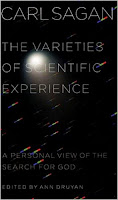
Book Review: "The Varieties of Scientific Experience" by Carl Sagan

The Varieties of Scientific Experience:
A Personal View of the Search for God
(2006)
Carl Sagan (1934-1996)
Edited by Ann Druyer
284 pages

In 1985, renowned astronomer and author Carl Sagan gave the Gifford Lectures on Natural Theology at the University of Glasgow; two decades later his wife, Ann Druyer, collected and edited the resulting transcripts, and published them as The Varieties of Scientific Experience. Noting in her Editors Introduction that in giving the lectures Sagan was “following in the footsteps of some of the greatest scientists and philosophers of the last hundred years – including James Frazer, Arthur Eddington, Werner Heisenberg, Niels Bohr, Alfred North Whitehead, Albert Schweitzer, and Hannah Arendt,” she recalls that he viewed the series as an opportunity to “detail his understanding of the relationship between religion and science.” (xiii)

Sagan opens by evoking the awe that people have felt since ancient times when gazing up at the heavens. Augmenting his characteristically eloquent descriptions of the cosmos with gorgeous photographs and fascinating diagrams of both our Solar System and more distant wonders, he reveals the complexity and beauty in the structure of the universe, as well as its immense size and myriad wonders.

Turning to the theme of his lectures, he describes how advances in scientific understanding that challenged religious claims about the natural world have altered our view of ourselves and our place in the universe. He recalls in particular the revolution that began with Copernicus, overturning the concept of humankind as having a privileged position in the universe, shifting us from its center to a planet circling an average star, at the fringes of a galaxy that is one of trillions.

But, he argues, by the late 20th century this revolution had stalled in the face of the propagation of the concept of intelligent design – the claim that only an intelligent being could create something as complex as a human.

He pushes back against the arguments for intelligent design by noting the fundamental fallacy of the assumption that the complexity of human beings, or even bacteria for that matter, could not have arisen naturally, that it must needs have required a purposeful designer. Given the power of evolution when operating over immense timespans, he argues that rather than imagining humans – or bacteria – as suddenly appearing, fully formed, their current appearance must be recognized as the quite natural cumulative result of a vast series of tiny, incremental steps over many tens of millions of years.

Broadening the implications of evolutionary change, he explores how scientists’ growing understandings about the possibility of extraterrestrial life support the reanimation of the revolution de-emphasizing humankind’s privileged position in the universe.

In their search for life beyond Earth, scientists have discovered significant amounts of organic matter on various bodies in the Solar System, as well as beyond it. Coupled with an understanding of the power of evolution, it becomes natural to look out into the Milky Way galaxy and consider whether there are not other worlds with life.

In that vein, Sagan describes the Drake equation, the product of some half-dozen factors that when multiplied together given an estimate of the number of technologically advanced civilizations in our galaxy – those capable of radio astronomy and so of interstellar communication. (For a description of the equation, see my review linked to at right of astrophysicist Adam Frank’s Light of the Stars: Alien Worlds and the Fate of the Earth.)  Though the values of several of the factors in Drake’s equation are quite uncertain, it has served, according to Sagan, as a basis around with scientists have pursued an answer to the question of the existence of extraterrestrial life. And, he notes, even just asking the question about life elsewhere has significant implications for religions centered on the idea that humankind occupies a unique place in the universe.

More generally, Sagan explores the ways in which the possibility of extraterrestrial life has impacted people’s thinking about both human history and our future. In a lecture titled Extraterrestrial Folklore, he describes the cottage industry that arose in the second half of the 20th century around supposed evidence of pre-historic visits by aliens, and the recurring reports of UFO sightings. Noting the emotional and psychological motivations that trigger the popular imagination about such theories and reports, he shines a scientific light on them, and, in the end, finds that they don’t stand up to thorough examination.

In a similar manner, Sagan explores the many and varied concepts of God, and more generally of religious experiences people report. Here, as throughout these lectures, he does not attempt to disprove such beliefs or experiences; he does not argue that a specific piece of scientific evidence – or lack thereof – means that a particular belief or experience is not true. Rather, he applies his scientific approach to understanding the world as a lens through which to examine religious belief and experience, and so to question whether they can make sense in such a light.

In The Varieties of Scientific Experience, as in his earlier work, Sagan presents an enthralling view of the cosmos, and an engaging and thought-provoking view of humankind’s place in it. Though he maintains a fairly light tone through most of the lectures, he concludes with a bracing, final talk in which he makes a plea for recognizing, and acting to avoid, what he refers to as crimes against creation, describing the dangers of nuclear war, environmental destruction and the petty disputes that lead nations to war. In a statement that recalls his famous quote about a photograph of Earth from Voyager 1 as it departed for the edges of our solar system, “a pale blue dot,” he writes: 

When you look at the Earth from space, it is striking. There are no national boundaries visible. They have been put there, like the equator and the Tropic of Cancer and the Tropic of Capricorn, by humans. The planet is real. The life on it is real, [but] the political separations that have placed the planet in danger are of human manufacture. They have not been handed down from Mount Sinai. All the beings on this little world are mutually dependent. It’s like living on a lifeboat. We breathe the air that the Russians have breathed, and Zambians and Tasmanians and people all over the planet. Whatever the causes that divide us, as I said before, it is clear that the Earth will be here a thousand or a million years from now. The question, the key question, the central question – in a certain sense the only question – is, will we? (210)


Other notes and information:


Have you read this book, others by this author, or even similar ones by other authors? I’d enjoy hearing your thoughts.
Other of my book reviews: FICTION Bookshelf and NON-FICTION Bookshelf

Sunday, February 13, 2022

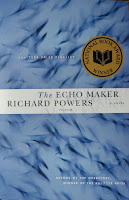
Book Review: "The Echo Maker" by Richard Powers

The Echo Maker (2006)
Richard Powers (1957)
451 pages

“God have mercy on the man
Who doubts what he’s sure of”
Bruce Springsteen, Brilliant Disguise

In the opening pages of Richard Powers’ novel The Echo Maker, a truck traveling down an isolated road in Nebraska suddenly “arcs through the air, corkscrewing into [a] field.” (4) Once on the scene, firemen need torches to cut it open and free the driver, Mark Shulter, who ends up in the hospital with traumatic injuries. Mark’s sister, Karin, arrives at his bedside hours later, and over the subsequent weeks dedicates herself to his care as he undergoes surgeries, a coma, and finally a long, slow recovery.

When Mark does eventually regain his ability to walk and speak, however, Karin discovers to her profound shock that he views her as an imposter, convinced that she has replaced his ‘real’ sister. Mark’s doctor diagnoses him as having Capgras Syndrome, describing it to Karin as that the 

sufferer … misidentifies his loved ones. A mother or a father. A spouse. The part of his brain that recognizes faces is intact. So is his memory. But the part that processes emotional association has somehow disconnected from them. (61) 

Attempting to reestablish their relationship, Karin reminds Mark of experiences from their childhood. Although surprised that this ‘imposter’ could know such details, Mark’s mind manages to create ever more complex explanations for how she could have learned about them, in order to justify his certainty that she’s not his actual sister.

Desperate to find a way to help her brother, Karin contacts a famous cognitive neurologist, Gerald Weber, who has written books documenting examples of the many and varied states of consciousness that can occur – “the brain’s mind-boggling plasticity and neurology’s endless ignorance.” (93) Weber’s curiosity piqued by his understanding that Capgras Syndrome does not typically occur as a result of brain injury, he comes out to see Mark.

But Karin soon discovers that Weber is fighting his own demons – mild apprehension over the worthiness of his fame exploding into full-fledged insecurity as his latest book meets with a growing crescendo of criticism over his anecdotal methods, accusing him of exploiting the people in the case histories he describes. Wracked by increasingly debilitating self-doubt, Weber oscillates between engaging closely with Mark as a patient, in order to assuage his concern over the exploitation charge, and trying to maintain the dispassionate distance of a researcher. Ultimately, it becomes clear to Karin that Weber has come largely out of analytical interest, and that clinically he has little more to offer regarding Mark than reaffirming “neurology’s endless ignorance.”

Through Mark, and the characters impacted by the disorienting changes to his view of the world, Powers explores the cryptic realm of consciousness – deeply mysterious even in what could hazardously be defined as a “normal” person, but on dramatic display when things go wrong in the mind.

Mark certainly represents an extreme example, his injury causing him to find not only his sister to be a double, but even his dog, his house and his neighborhood. While they all look familiar to him, they all at the same time feel just a bit off, changed in some immeasurable way that his mind works overtime to justify by seeing it all as a secret conspiracy that he’s become caught up in.

The other characters, however, have no traumatic physical injury to fall back as explanation.

Weber, for his part, finds in Mark a particularly dramatic example of consciousness gone awry – a perfect case study for a future paper or book. But, with the fame and stature that had come to undergird his view of himself having now been turned upside down by the criticism of his new book, his travels to Nebraska to interview Mark only further unmoor him from the life he had made for himself.

And Karin, brought back to her hometown by Mark’s injury, finds herself reengaging with people and events she had tried to leave behind by moving away. Combined with the shock of hearing Mark’s third person description of her, one fundamentally at odds with her own image of herself, Karin comes to feel increasingly adrift, unsure what to do next, for her brother or with her life.

Ultimately, then, it is not just Mark who comes to doubt what he’d thought he was sure of. And the question becomes not just whether Mark will regain an emotional connection to those closest to him, but also whether Karin and Webber will be able to regain their psychological equilibrium, as the stability of their conception of themselves and their lives becomes increasingly precarious.

Unfortunately, I found all of this largely unmoving. The various syndromes and afflictions that Powers works into the story, and what they reveal about the broader mystery of consciousness, are titillating and perhaps necessary to demonstrate the range of experience of Dr. Weber and the variety of afflictions that can occur, but at a point it becomes evident that no one knows much of anything concrete about consciousness.

And I found it hard to generate much sympathy for the main characters. They have a variety of manias and neuroses – don’t we all – but they have seemingly little or no self-awareness, and even less ability or will to push back when they do become even dimly aware of what they are experiencing. Mark, at least, has the excuse of the impact of his near-fatal accident. But the others come to seem like a bunch of out-of-control bumper cars, bouncing off one another and the walls of their inner worlds with little indication that they have any ability to deal with what fate has handed them.

It could be that I came to Powers’ The Echo Maker with unrealistic expectations, having been completely and utterly taken with his tour de force in The Overstory (my review linked to at right). Or perhaps the uncertainty that still dominates scientific understanding of consciousness makes its menagerie of manifestations an ineffective path to establishing an emotional connection to Power’s characters. But, although Powers does eventually resolve the fundamental plot questions that drive Mark’s search for understanding of what has happened to him, readers end up with little insight into the mysteries of consciousness that Powers introduces.

Perhaps, though, that is Powers’ point. For those who have confronted the mystery of consciousness and the self, the story is mostly a rather straightforward drama wrapped up in mysteries of which you are already aware; it does little to deepen understanding. If, however, a reader arrives at the story not having thought much about consciousness, not having spent much time contemplating or questioning their own understanding and image of themselves, then perhaps this story opens their eyes to the fundamental mysteries of consciousness, and the disquieting fluidity of our conception of ourselves.


Other notes and information:

Late in the story, Karin is at a public hearing which features a clash between developers and environmentalists, and suddenly: 
A wave moved through her, a thought on a scale she’d never felt. No one had a clue what our brains were after, or how they meant to get it. … For an instant, as the hearing turned into instinctive ritual, it hit her: the whole race suffered from Capgras. (347) 
Although the book was published in 2006, these words seem strikingly prescient. Watching not only Mark’s injured brain, but also the minds of others of the characters without such a physical injury, constructing ever more complicated conspiracy theories to explain why their own view of themselves and the world makes sense despite all they are told to the contrary seems frighteningly applicable to many on both sides of today’s increasingly fraught political and social battles.
 

Have you read this book, others by this author, or even similar ones by other authors? I’d enjoy hearing your thoughts.
Other of my book reviews: FICTION Bookshelf and NON-FICTION Bookshelf