Wednesday, May 7, 2025

Book Review: "Demon Copperhead" by Barbara Kingsolver

Demon Copperhead (2022)
Barbara Kingsolver (1955)
548 pages

My mind had only one thought in it as regards childhood. For any kid that gets that as an option: take that sweet thing and run with it. Hide. Love it so hard. Because it’s going to fucking leave you and not come back. (97)

At just eleven years old, the title character of Barbara Kingsolver’s novel Demon Copperhead has had his childhood stripped away from him. And he has clear and painful awareness of what’s been lost. 

Not that his life to that point had been easy, his father having died before he was born and his mother ever struggling to stay sober and hold down a job. His birth name was Damon Fields, but it didn’t take long for those around him to switch it to Demon and, having inherited his dead father’s red hair, his dad’s nickname Copperhead. The kindness of a neighboring family toward him and his mom somewhat eased his early years, allowing a boyhood spent exploring the mountain forests around his rural home. Sheltered for a time from the worst of the world, he could at least imagine the possibility of a decent future.

Events conspire, however, to crush any such hopes, culminating in a moment that definitively destroys the life he has known, forcing him to recognize that his childhood has been left irrevocably behind. It causes a profound scar, with consequences that he contends with every day that follows. He struggles to ever again generate enough faith in himself – or the world – to take a risk on a good option when it arises, as opposed to assuming that the worst path is inevitable and so might just as well be chosen upfront.

The setting both in time and place plays a core role in Kingsolver’s story. Demon grows up in the Appalachian hill country of western Virginia, near the borders with Kentucky and Tennessee. And he enters his teenage years around the turn of the 21st century, as drug use spreads like wildfire through rural communities such as his.

With mining jobs disappearing and little else besides farming and some service work for job prospects, all too many people around him are unemployed or underemployed. Underfunded social services unable to fill the huge gaps that result, people sink into poverty, leading to frustration and hopelessness. Narcotics like OxyContin come to fill the breach.

Compared to the view of OxyContin abuse one typically gets in news stories, Kingsolver gives a far more complex picture of the insidious ways that such drugs create an ecosystem of dependency.

Not surprisingly, her characters include a drug rep who wheedles and bribes doctors into prescribing increasing amounts of the painkiller to patients by providing kickbacks such as exotic vacation getaways, and doctors who freely prescribe the drugs in response. But at the heart of her story lies the impact of OxyContin availability on the community.

Users abound, of course, attempting to deaden their suffering; but some end up selling a part of what they get to other users to make money – whether to eat, pay rent or buy yet other drugs. It’s a kind of underground economy, one able to grow in the absence of other opportunities, but that only further undermines the community’s future. Demon resists this siren song of OxyContin use for a time, but finally slips into its dark embrace, hesitantly at first, then more fully, any reticence he feels overwhelmed by his desperate needs and the pit of hopelessness he’s fallen into. 

And yet, Kingsolver brings sensitivity and complexity to her description of the lives of Demon and, through his experiences, his community. She distinguishes the misery and poverty weighing down the people in this region bypassed by our present-day economy, from the love of place that coexists with it. At a distance, it can be all too easy to assume that those who leave such places must think “good riddance,” while those who stay are only waiting for the opportunity to leave. The reality, Kingsolver reveals, can rather be that while those who leave simply follow a path of survival, those who elect to stay fight to do so despite the long and tough odds.

We observe this love of place through Demon’s eyes, when he ventures beyond his rural home. Early in the story he makes his first trip to a large city, traveling with family friends to Knoxville, to visit relatives. He struggles to make sense of what he sees in the city, his shock palpable. He can scarcely imagine why anyone would want to live there, describing the apartment building of the aunt they visit as a

doom castle. A thousand other families living there, every front door opening into one hallway. … Outside the main front door, a street full of cars and cars, people and people. There was no outside anywhere … no running wild here like we did at home … [a child] not on [their] own for one second, due to all the unknown people and murder potential. (23) 

Much later, when he has to live in a city for an extended period, he comes to realize how

Up home, it’s different. … you want money and a job, but there’s a hundred other things you do for getting by. … Hunting and fishing, plus all the woman things, making quilts and clothes. Whether big or small, you’ve always got the place you’re living on. … Having some ground to stand on, that’s our whole basis. (516) 

Demon, however different he may wish his life to have been, recognizes the goodness that accompanies the many challenges that weigh upon his community.

And, although not something Kingsolver explores directly in the story, there is a tragic dilemma for such communities. Bringing the present-day economy to the area – companies and so jobs – would increase people’s standard of living, but likely at the cost of much of what those who’ve grown up there love about their region. Not that one cannot imagine that a business could come in and attempt to fit within the existing lifestyle, but it all too often seems to take a low priority. Wendell Berry makes that point about agriculture, forestry, and mining in particular, in his powerful collection of essays, Our Only World (my review linked to at right), though his point applies broadly to businesses in a profit-focused economy:

Once they have been industrialized, they no longer recognized landscape as whole, let alone as homes of people and other creatures. (6, Berry) 

Threading that needle – not losing what they have in order to gain the temptations of the modern world they see on TV – is challenging in a broader social and economic system that prizes scale and commonality and profit. As one of Demon’s friends tells him in describing what their community has been up against:

It’s the ones in charge…. They were always on the side of the money-earning [city] people, and down on the land people…. Dissing the country bumpkins, trying to bring us up to par … to turn [us] into wage labor. … [The result has been our] two-hundred-years war to keep body and soul together on our mountains. (522-4)

This threat is pointedly captured by William Kauffman, quoted in an article in Utne Reader in 2000: 

For almost 60 years, the placeless have waged war on the rooted, stealing their children, devastating their neighborhoods, wiping out local peculiarities and idiosyncrasies. What we have is class war – though this war has never been acknowledged because the casualties are places and attachments and sentiments; nothings, really; everythings, in fact – waged by the mobile against the immobile, by the cosmopolitan against the rooted, and the winners are he professionals, people so depraved that they would actually move to a different place for mere money. How bizarre.

Another, more psychological challenge haunts the story for readers. While some of the pain Demon experiences results from the actions of people that he, as a child, must simply submit to, in other cases he reaches a decision point conscious of the correct, or at least better, option, but unable to choose it. With Demon as a sympathetic protagonist, it can be frustrating to watch him again and again choose the more destructive path, and to do so with full self-awareness. Through Demon, Kingsolver forces readers to recognize how someone beaten down long enough can come to imagine that pain and misery are their due, and for that reason pick the worse choice at any given moment, seeing it as what they deserved in a life that has cut them no breaks.

In Demon Copperhead, Barbara Kingsolver provides readers a clear-eyed yet sympathetic portrait of rural America. Communities gutted by job losses and cajoled by drug companies into burying their frustration and disappointment in painkillers, struggling to keep and get by on what little they have left. An eye-opening and disturbing revelation for those readers on the other side of the resulting social and political chasm. Giving Demon the last word for his world:

If you’re standing on a small pile of shit, fighting for your one place to stand, God almighty how you fight. (103)


Other notes and information:

This book is one of three that journalist Nicholas Kristof recommended in an article entitled Join My Bewildered Liberals Book Club.


Have you read this book, others by this author, or even similar ones by other authors? I’d enjoy hearing your thoughts.
Other of my book reviews: FICTION Bookshelf and NON-FICTION Bookshelf

Saturday, April 26, 2025

Book Review: "The Human Condition" by Hannah Arendt

The Human Condition (1958)
Hannah Arendt (1906-1975)
333 pages

I’ll freely admit from the get-go that I’m not a philosophy major, or even someone who’s read a lot of books on philosophy. Not surprisingly, then, reading Hannah Arendt’s The Human Condition represented a pretty significant stretch. Nonetheless, I learned much as I – quite literally at times – worked my way through it. In the following, I’ll aim to give a flavor of her arguments and what I found most impactful, particularly her analysis and conclusions regarding our present-day economic system, and its implications for our society’s future.

Arendt opens by pointing out the sharp distinction made in ancient Greece between one’s private life – home and family – and one’s political life – engaging in the activities of the city-state; she describes these realms as having been “mutually exclusive” for Greeks. Beginning already with the Romans, however, this dichotomy evolved and weakened, and eventually leading to

the emergence of the social realm, which is neither private nor public, strictly speaking, … [and] whose origin coincided with the emergence of the modern age and which found its political form in the nation-state. (28) 

This rise of the social realm has led to a dramatic shrinking of the importance of the private – the household – and its public nature has engendered an enforced conformism, with “society always demand[ing] that its members act as though they were members of one enormous family which has only one opinion and one interest.” (39)

She notes that, contrary to the common understanding, this social conformism came before the focus on equality, and that “the victory of equality in the modern world is only the political and legal recognition of the fact that society has conquered the public realm.” (41) This enforced conformism has also had a variety of follow-on effects, including enabling “economics … [to] achieve a scientific character,” (42) and suppressing deviation to the extent that “large numbers of people, crowded together, develop an almost irresistible inclination toward despotism, be this the despotism of a person or of majority rule” (43) in order to enforce it.

I found particularly intriguing Arendt’s observation that such conformism also enables the social sciences to work with “laws of statistics … valid only where large numbers … are involved, and acts or events … appear only as deviations or fluctuations,” (42) and that this, effectively, results in the “obliteration” of analysis of politics or history, making it “a hopeless enterprise to search for meaning in politics or significance in history when everything that is not everyday behavior … has been ruled out as immaterial.” (42) As I argue in my review of the trilogy Granada, by Radwa Ashour (linked to at right) , historical fiction can help fill the breach here: while history texts tend to focus on the elite of a society and the broad directions of a period, fiction can take a reader into the day-to-day lives of people, how they experienced and reacted to the events of the moment. The generality one loses by focusing on the particular reactions of a few people is more than made up for by achieving a much more intimate and impactful understanding of that period in history.

To analyze in detail the dramatic changes in the human condition that have occurred from ancient Greece to the modern age, Arendt defines “three fundamental human activities: labor, work, and action.” (7) Action involves our engagement as humans with one another. Work and labor she notes, broadly overlap in modern usage, but have a fundamental distinction: labor consists of all activities required to directly sustain life, to produce the consumables necessary to stay alive; work, on the other hand, results in what can be considered durable goods – chairs, buildings, the infrastructure of life. She distinguishes the implications for the human conditions as:

Labor assures not only individual survival, but the life of the species. Work and its product, the human artifact, bestow a measure of permanence and durability upon the futility of mortal life and the fleeting character of human time. Action, in so far as it engages in founding and preserving political bodies, creates the condition for remembrance, that is, for history. (8-9)


Arendt argues that in antiquity, people exalted action and contemplation. In order to pursue these activities more fully, they relegated both labor and work to slaves, based on their view

of the slavish nature of all occupations that served the needs of the maintenance of life. It was precisely on these grounds that the institution of slavery was defended and justified. To labor meant to be enslaved by necessity. (83) 

Thus, the human condition in antiquity was based on the primacy of action, at least for those fortunate few who were wealthy and powerful enough to have others perform the labor and work required to provide life’s necessities.

In the modern age, however, (which she defines as having begun some several centuries ago) the human condition has fundamentally changed. There has developed “a glorification of labor as the source of all values,” (85) as well as an emphasis by theorists such as Adam Smith and Karl Marx on distinguishing not between labor and work, but between productive and unproductive labor. She notes that Smith classified

all occupations which rest essentially on performance – such as the military profession, “churchmen, lawyers, physicians and opera singers” – together with “menial services,” [as] the lowest and most unproductive “labor.” By contrast, for early Greeks it was precisely these occupations – healing, flute playing, play-acting – which furnished ancient thinking with examples for the highest and greatest activities of man. (207)


This focus on productivity over all else has so dominated humankind’s thinking in the modern age that it can be difficult, she points out, for historians to recognize that

the institution of slavery in antiquity, though not in later times, was not a device for cheap labor or an instrument of exploitation for profit but rather an attempt to exclude labor from the conditions of man’s life, [since] what men share with all other forms of animal life [that is, the labor required to stay alive] was not considered to be human. (84) 

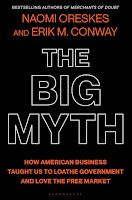
Aside from helping historians more accurately interpret the past, a recognition of our present-day obsession with productivity and our capture by capitalist, free-market fundamentalist ideology could open our current thinking to consider alternative ways of structuring our economy and society in the future – discussions that could finally move beyond the tired, dead-end, either-or debates over capitalism versus communism. (Historians Naomi Orestes and Erik M. Conway provide an engaging and thought-provoking review of the crusade for, and ultimate conquest of, free-market fundamentalism in the United States in The Big Myth: How American Business Taught Us to Loathe Government and Love the Free Market; my review linked to at right).

With the subsequent atomization of production through the division of labor, argues Arendt, we have largely abandoned a reverence for work – for craftsmen who create durable goods. We have sacrificed the “ideals … of permanence, stability, and durability” of work, shifting instead to an ideal of abundance, becoming a consumer society with “labor and consumption … but two stages of the same process, imposed on [us] by the necessity of life.” Concrete examples of Arendt’s observations abound: the tendency to settle for less expensive furniture that we construct ourselves and do not expect to last perhaps even our own lifetime, as opposed to buying the work of a craftsman that might last generations; more generally, the ubiquitous lament that products today seem made to have a short life, forcing us to buy a replacement.

As a consequence, our social and economic systems now require that we be productive to demonstrate our worth. We have arrived at a

leveling [of] all human activities to the common denominator of securing the necessities of life and providing for their abundance. Whatever we do, we are supposed to do for the sake of “making a living,” such is the verdict of society. (126) 

The only exception granted, Arendt observes, is for the artist, the only worker left; otherwise, anything not labor (not productive) is considered play, or a hobby. And she finds that the growing focus on labor has become self-reinforcing for society. For a modern laborer,

spare time is never spent in anything but consumption, and the more time left to him, the greedier and more craving his appetites. That these appetites become more sophisticated, so that consumption is no longer restricted to the necessities but, on the contrary, mainly concentrates on the superfluities of life, does not change the character of this society, but harbors the grave danger that eventually no object of the world will be safe from consumption and annihilation through consumption. (133)


Critically, this shift to a focus on labor has effects far beyond what we spend our lives doing: the resulting ever-increasing consumption leads to the consumptive destruction of the natural world, as “our whole economy has become a waste economy, in which things must be almost as quickly devoured and discarded as they have appeared.” (134) As a result, as Wendell Berry observes in
Our Only World
, present-day enterprises “regard landscapes as sources of extractable products … ‘efficiently’ shed[ding] any other interest or concern [for people and other creatures].” (6, Berry) (My review of his book linked to at right.)  And given that we measure our worth by the productivity of our labor, it becomes almost unthinkable to break out of the labor-consumption cycle and so reduce the destructive impact on our ecosystem.

More profoundly for our future, Arendt also foresees an inability of our society “to recognize its own futility,” (135) in no longer striving for the durable, the permanent – that which distinguishes humans from animals. This lack of recognition of what we have lost has the dire consequence that with the increasing implementation of automation, we now live in

a society of laborers which is about to be liberated from the fetters of labor, and this society does no longer know of those other higher and more meaningful activities for the sake of which this freedom would deserve to be won. … We are confronted with … the prospect of a society of laborers without labor, that is, without the only activity left to them. Surely, nothing could be worse. (5)

Perhaps the most dramatic confirmation of the success in our present day of this “glorification of labor” and “transformation of the whole of society into a laboring society” (4) is how unintelligible and counter-intuitive it is for most people to imagine “higher and more meaningful activities” than their job. We have come to believe (that is, have been raised to be convinced, as Orestes and Conway make clear) that laboring and being productive are the only metrics by which we can legitimately judge the success of our lives. We can no longer imagine it otherwise. And the seeming threat of having free time, even with some sort of universal basic income, to pursue activities that interest us but that may not be considered by society (and so by us) as productive, feels scary for many, if not most. In a future in which automation paired with artificial intelligence will likely (whether 10 or 50 years hence) make many or most humans “irrelevant” as laborers (to borrow historian Yuval Noah Harari’s phrasing in 21 Lessons for the 21st Century, my review linked to at right), the question may not be whether we can afford to pay for people to live in such a world, but rather whether we are psychologically fit to benefit from it.

There is much more to learn in Arendt’s deeply considered analysis. But the challenges to our future that she identified already some 70 years ago as arising from a shift in the human condition to an economic structure of laborer-consumers have only become more pressing as our technologies have progressed. How will we address the increasingly widespread environmental destruction that our economic system causes? How will society adapt to a future in which labor may for many no longer be necessary or even available?


Other notes and information:

More quotes from this book

Arendt has a fascinating discussion on the shift, since Galileo turned his telescope on Jupiter, from science as a contemplative exercise of philosophers to one focused on experimental results, eventually reaching the point in the 20th century that “scientific truth may not only not be eternal, it need not even be comprehensible or adequate to human reason.” (290)
She discusses a consequence of the shift in the human condition in modern age as “a glorification of violence as the only means for” making a “new body politic,” (228) noting “Marx’s dictum that ‘violence is the midwife of every old society pregnant with a new one,’ that is, of all change in history and politics.” (228) Pankaj Mishra arrives at a similar conclusion in his book Age of Anger, in which he argues that the loss, during the Enlightenment, of seemingly immutable social structures and the introduction and spread of the idea of equality for all, has meant a constant roiling of society as the
have nots
repeatedly rise up against the haves. (My review linked to at right.) 


In the chaos of the first half of 2025, hard not to stop and reflect long on Arendt’s observation that: “The will to power … far from being a characteristic of the strong, is, like envy and greed, among the vices of the weak, and possible even their most dangers one.” (203)
At the dawn of the space age, Arendt lamented the idea that humankind welcomed the initial steps into space as being, quoting a front-page news story, the first “step toward escape from men’s imprisonment to the earth.” She notes “the banality of the statement” and observes that
nobody in the history of mankind has ever conceived of the earth as a prison for men’s bodies or shown such eagerness to go literally from here to the moon,” and goes on to describe “the earth [as] the very quintessence of the human condition, and earthly nature, for all we know, may be unique in the universe in providing human beings with a habitat in which [humankind] can move and breathe without effort and without artifice. (1-2)

Have you read this book, others by this author, or even similar ones by other authors? I’d enjoy hearing your thoughts.
Other of my book reviews: FICTION Bookshelf and NON-FICTION Bookshelf

Saturday, March 15, 2025

Book Review: "Meditations" by Marcus Aurelius

Meditations
Marcus Aurelius (121-180)
Translation and Introduction by Gregory Hays
191 pages

I don’t recall now how many years ago I first heard about Marcus Aurelius’s collected writings, Mediations. Coming across an edition in a bookstore a few months ago, however, I decided the time had come to read it. The wait turns out to have paid dividends, both for my understanding, as well as for more fortuitous, personal reasons.

In terms of understanding: since Sam Harris introduced his Waking Up meditation app in 2018, I’ve been doing the daily mediation (regularly the first few years, more occasionally the past few), as well as listening to some of the other theory, practice and conversation sessions included. Harris has described his intent with the app to be less about helping a user relax (though that can be a side benefit) than to explore – by evoking our direct experience – how our mind works, what consciousness is. Through his teachings one can approach mindfulness, but they go far beyond the typical kind of popular training one receives on that topic.

While freely acknowledging that I’m hardly more than a novice at meditation and the understanding that comes with it, through Harris’s lessons (as well as conversations with others on the concepts he introduces and reading books such as the one linked to at right) I’ve deepened my understanding of the mind and consciousness. And, bringing this back around, what I’ve learned set me up well for engaging with the ideas I encountered in
Meditations
. Without the preparation, I can imagine I would have struggled with the extreme … austerity … of the vision in Marcus’s notes.

This edition was translated by Gregory Hays, associate professor of classics at the University of Virginia, and he provides an extremely helpful Introduction, in which he discusses what is known about Marcus’s life, the present understanding of what these writings might have represented for Marcus, and the Stoic philosophy at their heart. He notes that while Marcus’s writing contains other philosophical influences, Stoicism was “the most important philosophical tradition both for Romans in general and for Marcus in particular.”  Hays points out that, “of the doctrines central to the Stoic worldview, perhaps the most important is the unwavering conviction that the world is organized in a rational and coherent way. … a deterministic system that appears to leave no room for human free will or moral responsibility.” (xix-xx)

The text consists of a series of entries, grouped into 12 books that “represent the individual papyrus rolls of Marcus’s original, or perhaps of a later copy.” (xxxix) Begin to read, and it immediately becomes evident that, as Hays notes

Marcus … did not think of [the collected entries] as an organic whole …. Not only … not written for publication, but [he] clearly had no expectation that anyone but himself would ever read it. (xxxvi)


 The entries vary in length from a few lines to perhaps a page. Most, if not all, seem to have an implicit Remember: in front of them, as though Marcus captured private notes or reminders of how he should live his life. Hays seems most convinced by one scholar’s suggestion that the entries represented for Marcus “ ‘spiritual exercises’ composed to provide a momentary stay against the stress and confusion of everyday life … a means of practicing and reinforcing his own philosophical convictions.” (xxxvii) Such an interpretation is reinforced by the repetition one encounters in the entries, both within and across books, as Marcus returns again and again to certain key themes and ideas, sometimes almost verbatim.

Summarizing these entries risks trivializing the profound, if stark, depths that Marcus explores; trying to select among them for which to share means ignoring so many one would want to include. But a few comments, admittedly focused on entries that had the most impact for me, will give a new reader an idea of what to expect.

Broadly, the entries emphasize the importance of living in the present moment, but with a depth far beyond the simple kinds of mindfulness one encounters in present-day popular culture.

Concentrate every minute … on doing what’s in front of you with precise and genuine seriousness, tenderly, willingly, with justice. And on freeing yourself from all other distractions. Yes, you can – if you do everything as if it were the last thing you were doing in your life, and stop being aimless, stop letting your emotions override what your mind tells you, stop being hypocritical, self-centered, irritable. You see how few things you have to do to live a satisfying and reverent life? (2.5) 

He reminds himself, here and throughout, to recognize the possibility – and benefit – of living within a mind that does not allow itself to be distracted by either painful experiences – whether external from the actions of others or internal such as from bodily pain – nor, importantly, by pleasurable ones.

Ultimately, he seeks a mind having engaged equanimity, in the face of whatever goes on around it. Thus, “choose not to be harmed – and you won’t feel harmed,” (4.7) and recognizing that your mind can stand above and outside that which is painful such that “things have no hold on the soul. They stand there unmoving, outside it. Disturbance comes only from within – from our own perceptions.” (4.3)

One theme that recurs, and that held particular resonance for me, relates to developing an understanding that everyone has their own problems – to quote a peasant in Ignazio Silones wonderful novel Bread and Wine: “everyone has his fleas … probably even the government has them,” (136) so why complain. Marcus repeatedly reminds himself that 

When people injure you, ask yourself what good or harm they thought would come of it. If you understand that, you’ll feel sympathy rather than outrage or anger. Your sense of good and evil may be the same as theirs, or near it, in which case you have to excuse them. Or your sense of good and evil may differ from theirs. In which case they’re misguided and deserve your compassion. Is that so hard? (7.26) 

Later, more concisely, he gives a simple prescription for helping himself (and us) avoid the distracting and self-destructive path of anger:

Learn to ask of all actions, “Why are they doing that?”
Starting with your own.” (10.43)


 Although many of the entries speak across the millennia to our present-day concerns, one seemed directly intended for those on both sides of our fraught present moment of (self-) destructive hyper-partisanship:

How cruel – to forbid people to want what they think is good for them. And yet that’s just what you won’t let them do when you get angry at their misbehavior. They’re drawn toward that they think is good for them.
– But it’s not good for them.
Then show them that. Prove it to them. Instead of losing your temper. (6.27)


 As I mentioned above, reading this book came at a fortunate moment for me in a very personal sense. I’ve dealt with back pain for several decades and was in the middle of a period of significant pain as I read this book. In conjunction with the training I’ve had from Harris’s app, the direct reminder of Marcus’s words helped me, at least for periods, compartmentalize the pain – not ignore it, precisely, but not have it overwhelm my thoughts. In that context, he observes that “The mind is the ruler of the soul. It should remain unstirred by agitations of the flesh – gentle and violent ones alike.” (5.26) And, he recommends:

Unendurable pain brings its own end with it. Chronic pain is always endurable: the intelligence maintains serenity by cutting itself off from the body, the mind remains undiminished. (7.33)  

I can’t say I managed to face the pain with complete equanimity, but for moments, periods, I did find a bit of serenity – feeling the pain as something that was happening, but not having it impact my mind, my thoughts.


As much as I find sensible and helpful in these entries, I will say that the starkness of Marcus’s vision gave me pause at points. I recognize that pleasure can be as capable as pain of distracting our minds from focusing on the moment, on “justice, honesty, self-control, courage” (3.6); but I struggle with several of Marcus’s appeals, such as “throw away your books; stop letting yourself be distracted” (2.2) and “discard your thirst for books” (2.3), or when he proposes that

to acquire indifference to pretty singing … Analyze the melody into the notes that form it, and as you hear each one, ask yourself whether you’re powerless against that. That should be enough to deter you. (11.2)

 As Hays notes, “there is a persistent strain of pessimism in the work;” he quotes a scholar as having observed that “reading the Meditations for long periods can be conducive of Melancholy.” (xlv)


 But if one guards against such feelings – perhaps by following Marcus’s own advice to protect “your mind from false perceptions” (3.9) – there is much wisdom to be found here. Understanding his entries can be enhanced by having some prior meditation training; such preparation is not, however, absolutely necessary, if one enters open to the concept of a complete separation between the mind and what is external to it.

I can certainly understand why, as Hays mentions in his Introduction, so many return to re-read Meditations. Instead of a long and deep tome on how to live one’s life, Marcus’s entries guide a reader in short, direct, concrete observations. I look forward to revisiting Marcus’s text.


Other notes and information:


Have you read this book, others by this author, or even similar ones by other authors? I’d enjoy hearing your thoughts.
Other of my book reviews: FICTION Bookshelf and NON-FICTION Bookshelf
Monday, February 17, 2025

Book Review: "Children of Ruin" by Adrian Tchaikovsky

Children of Ruin (2019)
Adrian Tchaikovsky (1972)
565 pages

[Note: although I make it a point to not include spoilers in my reviews, this one discusses the second book in a trilogy, and it’s not possible to write about it without including some context from the first book, Children of Time. So, if you haven’t read that first one yet, I suggest you jump back to my review of it here.]

Generations have passed since, late in Adrian Tchaikovsky’s Children of Time, the Portiids of Kern’s World accepted into their midst the desperate, surviving humans of a forlorn spaceship from a destroyed Earth. To enable these humans to live among them, the Portiids used the human-engineered virus that accelerated their own development to remove the humans’ evolutionary aversion to spiders – and so allow the two species to co-exist.

Working together, the Portiids and humans have integrated the two civilizations’ technologies to create spaceships capable of interstellar flight. Early in the second book of this trilogy, Children of Ruin, a mixed crew of Portiids and humans launch a spaceship toward a distant star system from which they have detected a signal – one that seems to indicate a potential remnant of Old Earth civilization that remains among the stars.

Arriving at this new system, the crew encounter radically altered Old Earth technology operated by a civilization that they struggle to communicate with. The rudimentary contact they do establish quickly goes dangerously awry for reasons the Portiids and humans strive mightily to understand. Only slowly do they come to realize that they’ve inadvertently tripped into the middle of a bitter, inter-civilizational conflict, one that now also threatens them. Having revealed their existence, can they survive, and also prevent the conflict from reaching back to imperil Kern’s World?

Tchaikovsky tells the story as alternating sections of chapters, those set in the past that detail how the human terraforming mission to this new system led to the situation the Portiids and humans now encounter, and those set in the present, in which the consequences of the past developments play out. As opposed to a simpler, linear narrative, this structure helps build and hold the tension in the story as, like the Portiids and humans who have arrived in the system, readers only slowly come to know the nature and depth of the threat.

This second entry in the trilogy doesn’t have quite the surprise power of what Tchaikovsky created for the first story, which wowed me from the opening paragraphs. But it definitely reaffirms him as a master of world-building, as I’ve described in my reviews of that book, his wonderful Elder Race, and the thought-provoking short story collection Terrible Worlds: Revolutions (my reviews linked to at right).

As strange as the arriving humans found the Portiid’s of Kern’s World, the civilizations in this new star system are even more alien, and Tchaikovsky thoroughly and brilliantly lays out their evolution. To his credit as a storyteller, he eschews the easy way out of something like, say, a universal translator in the old Star Trek series (I can still hear my dad asking, “how is it all the aliens can speak English?”); Tchaikovsky’s human and Portiid characters spend significant effort, and often make only halting progress, at communicating with each other and the new species they encounter.

Centering this trilogy on the interactions between vastly dissimilar species means that Tchaikovsky has set himself the formidable task of wading into ever more bewildering depths with the introduction and evolution of each new civilization, and the second book concludes with biological and technological advancements that pale even in comparison with what has come to that point. Hard to even imagine where he could take all this in the third book – which, I suppose, is the pleasure of it…


Other notes and information:

The story includes one of the best lines I’ve read in a while: 
[he] had been absolutely convinced of the rightness of his own actions, and it had all been wholly amusing until it had become utterly fucked up. (51) 
It reminds me a bit of the quote from John Pike, Director Space Policy Project of the Fed. of Amer. Scientists, responding to a question on Mir repair work some decades ago:
If they go in there and do their work and all goes according to plan we'll conclude it was relatively straightforward. If they all end up dead, we'll conclude it was very hazardous.


Have you read this book, others by this author, or even similar ones by other authors? I’d enjoy hearing your thoughts.
Other of my book reviews: FICTION Bookshelf and NON-FICTION Bookshelf

Thursday, February 13, 2025

Book Review: "The Retreat of Western Liberalism" by Edward Luce

The Retreat of Western Liberalism (2017)
Edward Luce (1968)
246 pages

The 2020 election of President Biden allowed Democrats and traditional Republicans to view Trump’s victory four years earlier as an aberration – a brief period that weakened, but failed to topple, America’s liberal democratic traditions and international engagements. Outside of Supreme Court picks who provided the majority for an anti-abortion ruling, Trump’s base gained little more from his tenure than the pleasure of watching him incessantly demonize his political opponents and the media; certainly, his signature piece of legislation, the 2017 tax cut, largely benefited his wealthiest supporters (and detractors, for that matter).

Trump’s recent re-election, while narrow, has shattered that brief aberration illusion. A variety of explanations have been put forward for his victory, but running through many of them has been a subtext of voter ignorance of the facts – a claim that Trump’s supporters failed to see through his exaggerations, misinformation and outright lies. Could they not understand, has come the plaintive cry, that his proposed tariffs and deportation policies could lead to increasing inflation; that he remains firmly beholden to the wealthy elite; that he peddles in ridiculous conspiracy theories, and misogynistic and racist tropes; and so on and on?

And yet, in winning in 2024, Trump expanded his working- and middle-class base, picking up significantly increased support from people of color.  The simple labeling of the vast majority of these supporters as ignorant seems lazy. In such a close election (the closest popular vote win in decades), any single explanation can have been decisive, of course; but rather than debating about which detail pushed him over the top, we should take a broader view: why did over half of voters support him for a second term?

For journalist Edward Luce, the reasons behind Trump’s rise (and similar populist events in other Western countries) lie not in voter ignorance, but rather in a growing, deep-seated anger over the impacts of the current, global economic system. In his book The Retreat of Western Liberalism, he argues that the Western working and middle classes have watched their lifestyle deteriorate in recent decades, and so have become disillusioned with the entire liberal democratic project. The result has been a rise in populism – people willing to support anyone they feel will take on the entrenched institutions that seem focused mainly on the success of the political and economic elite. In the US, they turned to Trump, having found neither Democrats nor Republicans coming to their defense and aid.

Luce opens by describing the deepening economic challenges many have faced in recent years. In the West, he notes, income growth for the middle-class has stagnated over the past two decades, while incomes of “the global top 1 per cent … have jumped by more than two-thirds over the same period.” (30) Crucially, this growing inequality has come after “the Golden Age of Western middle-class growth between the late 1940’s and the early 1970’s … of rising incomes for the bulk of society.” (32) Thus, the middle class has experienced a dramatic decline in their living standards.

He dismisses arguments that the Western middle class remains far better off than people in large parts of the emerging world, or that describe the many ways people’s lives have improved over those of their ancestors a century, or a millennium ago – “to be clear: the West’s souring mood is about the psychology of dashed expectations rather than the decline in material comforts.” Beyond “our degraded retirement prospects,” we now look back longingly to a time when “we had faith that by the end of their lives our children would be three to four times better off than we were.” (32-33) Ultimately, he observes, such why are they complaining denunciations simply come across as an attempt by the wealthy and powerful to rationalize and perpetuate a system that operates mostly to their own benefit.

When people lose trust that society is treating them fairly, they drift into a deeper culture of mistrust. It should be little surprise that they come to view what the winners tell them with a toxic suspicion. (191)


 Luce explores the ways in which typical metrics can be misleading when trying to understand frustration with the economy. The benefits of a rising stock market, for example: although 62% of US adults own stock, 50% of shares are owned by the top 1%, and the top 10% own 93% of stock market wealth – so a bull market hardly leads to a broad-based increase in wealth, as reflected in the popular phrase the stock market is not the economy. Or take GDP: despite GDP growth in the US over the past decade, “US median income is still below where it was at the beginning of this century.” (29) Unemployment statistics are another deceptive measure: in recent years, “all of America’s new jobs have been generated by independent work,” (62) which tends to have few or no benefits, and uncertain hours.

Productivity numbers can also mislead: automation – from factories to self-driving vehicles – tends to increase productivity, but could come to obviate the need for whole sectors of workers in the not-too-distant future. And Trump’s proposed tariffs could accelerate this; as economist Martin Wolf points out in The Crisis of Democratic Capitalism (my review linked to at right)

Even if some industrial production were to be brought home [to Western, high income countries], at great cost, via protection against imports [such as by tariffs], there would then be ongoing – and probably accelerating – use of robots. (121, Wolf) 

A draconian and ineluctable requirement of free market capitalism: business owners must needs minimize the cost of labor to survive.

As in earlier automation revolutions, some other form of work may eventually appear as a replacement for those who lose their positions; but with AI now impacting even technology jobs, it’s hardly clear what those new jobs will be. The historian Yuval Noah Harari posits a dark potential endgame for this trend in his thought-provoking 21 Lessons for the 21st Century (my review linked to at right): 

Perhaps in the twenty-first century populist revolts will be staged not against an economic elite that exploits people but against an economic elite that does not need them anymore. This may be a losing battle. It is much harder to struggle against irrelevance than against exploitation. (9) 

Harari argues that the current upheavals in the West reflect people’s last-ditch effort to use their political power to change the system.

It’s worth recalling that such economic transitions have historically been accompanied by often violent social revolutions. As just one example, Andreas Malm’s excellent history Fossil Capital describes the rioting that occurred in Great Britain in the early-to-mid-1800’s, as highly automated machinery eliminated the skilled workforce of the fabric industry – spinners and weavers. (Here, the origin of the term Luddites, which, while it carries an anti-technology connotation, actually referred to workers who fought to maintain their livelihood as business owners shifted to automation to secure and increase profits.) (My review of Malm’s book linked to at right.)

What all of these misleading economic metrics hide, Luce notes, is that our “meritocratic society has given way to a hereditary meritocracy,” in which “today it is rarer for a poor American to become rich than a poor Briton, which means the American dream is less likely to be realized in America.” (41) He finds this new reality to have powerfully negative implications for society, as growing inequality fuels anger that translates into an increasingly damaging rural-urban divide and bitter partisanship.

Having outlined the origins of the growing populist wave in the US and, more generally, the West, Luce explores the implications for the future of Western liberalism. As a broad indicator, he notes that the number of democratic countries, having reached a high point in the late 20th century, has dropped significantly over the past two decades. Democracy has lost its luster, he argues, not only for the middle class who feel betrayed by rising inequality, but also for elites, because “when inequality is high, the rich fear the mob.” (121) Thus, the working class become willing to support an autocrat hoping to destroy the institutions they see as biased toward the elite, while the elite support (often that same) autocrat in the hopes of controlling such a leader to protect their wealth and power from populist outrage.

The result in the US has been the rise of Trump; he has managed, so far, to beguile working and middle-class voters into believing that he will fight for them and, at the same time, to convince the rich that he will increase their wealth. Globally, Luce argues, the populist backlash has underpinned the success of the Brexit vote, and autocratic leaders in Poland and Hungary. There has also been a rise in the prestige of China, whose economic success over the past couple of decades has contrasted sharply with the West, as

the so-called global recession was primarily an Atlantic one. Indeed, growth in China, the world’s largest Autocracy, picked up for several years after 2008, [doing] wonders for China’s global image [and] its political reputation. (81)


To begin to counteract these events, Luce offers options that could together form “a new social compact” (196), including universal health care, humane immigration laws, simplification of business regulation and the tax system, and more. Many, if not all of these proposals will be familiar to most readers; they come, however, with a bracing caveat:

Whatever your remedies to the crisis of liberal democracy, nothing much is likely to happen unless the West’s elites understand the enormity of what they face. If only out of self-preservation, the rich need to emerge from their postmodern Versailles. (197)

It’s a bit surreal reading this book today, in the wake of the recent election. Published in 2017, it was written early in Trump’s first term as president. Although much of Luce’s discussion involves the economic and social forces leading to Trump’s victory then (as part of the broader retreat of Western liberalism), it also looked forward to Trump’s stated plans for his first term, and the impact they could have. Given we are now in a similar position, with Trump beginning his second term clearly more prepared this time to impose his will, Luce’s commentary suddenly becomes relevant again, in a kind of déjà vu.

[When Luce wrote this, he could still imagine Trump would be kept in check by the likes of, for example, “Lindsey Graham, the Republican from South Carolina. There are few who revile Trump more than the Republican hawks.” (132) How quickly Graham and the other “Republican hawks” debased themselves and their supposed principles by transforming into Trump’s sycophants in service to their own personal political gain. And certainly, that continues for Republican politicians in this second Trump term.]

Oddly, reading Luce’s book in 2020 or 2021, after Biden’s victory, would have had a completely different impact, as the country had seemed to have survived Trump’s first term with institutions relatively intact and the economic system largely unaltered. One could have too easily dismissed his arguments about the anger of the middle and working classes as exaggerated.

Now, amid the search for answers as to why Trump won a second term, perhaps Luce’s book can provide critical insight. The opening section in particular, which summarizes the economic forces that have played out in recent decades to the detriment of the middle class, may bring recognition to those who can’t understand how Trump won that, along with single-issue abortion voters, the bro vote, the insatiably wealthy, and white nationalists, there is a significant and growing group of the population who feel left behind, economically, and who have had enough of being ignored by Democrats and traditional Republicans as the global economic system enriches the elite at their expense. Just generating such awareness and understanding would be a huge step forward, as opposition to Trump tries to find its footing.

Luce’s prose keeps a reader engaged, but he can be a bit stream-of-conscious at times, as he seemingly tries to work-in as much of what he has learned and observed as possible. And, while he makes a convincing argument for the reasons behind the current populist moment, his overview of the current economic situation focuses on a few key metrics, without going into much detail.

For those who would like a deeper dive into the numbers that make evident the evolution of inequality over the past century, economist Thomas Piketty’s Capital in the Twenty-First Century provides an engaging and thorough analysis. (My review linked to at right.) Piketty explores the path the West has taken from the extreme economic disparities of the Gilded Age in the late 1800’s, through mid-20th century progressive movements that reduced inequality and provided broad prosperity to the middle class (for white citizens, as least), and then the conservative shift in the West starting in around 1980, and the steep rise in inequality that has returned.

Martin Wolf’s engaging The Crisis of Democratic Capitalism, mentioned above, explores similar themes to Luce, though providing a more detailed and systematic examination of our present-day challenges. He provides insight into how democracy and capitalism complement and yet also threaten one another.

The health of our societies depends on sustaining a delicate balance between the economic and the political, the individual and the collective, the national and the global. But that balance is broken. Our economy has destabilized our politics and vice versa. (xix, Wolf) 

When the wealthy play too much of a role in politics in pursuit of their own interests, he finds, democracy fails, leading to autocracy. It becomes a conundrum: democracy and capitalism, Wolf argues, can only survive together, but are “always fragile,” the “delicate balance between politics and market can be destroyed, [through either] state control over the economy [or] capitalist control over the state.” (29, Wolf)

The final word to Luce, however, who wrote – again, it must be emphasized, in 2017 – that 

unless Democrats can find a message and a candidate who appeals to the “forgotten Americans,” Trump will have a reasonable chance of being re-elected. (250) 

Seven years later, we have our answer. Now we must urgently get to a clear understanding – and acknowledgement – of the plight of these forgotten Americans, and how to engage with their concerns.


Other notes and information:

In a particularly dark passage late in the book, Luce looks ahead:
We can be sure that America will not become great again under Trump.  There will be a lethal mood of betrayal and frustration when he fails.  Who knows where that could lead.  It is comforting to assume, as many do, that the US system will simply revert to pre-Trump mode.  The chances are at least as great that Trump will be able to pin the blame on elites, foreigners, Islam, minorities, unelected judges and other handy saboteurs.  That is how populists operate.  There is no rule that says populists fizzle out.  As president, the means at Trump's disposal to divert public anger an target his enemies are hilling.  At best, history in ambivalent on this question.  Trump is no <i>deus ex machina</i>.  The conditions that enabled his rise are only likely to deteriorate during his time in office.  We should also fear whatever may follow Trump.  Imagine how things would look with a competent and sophisticated white nationalist in the White House. [201]


Have you read this book, others by this author, or even similar ones by other authors? I’d enjoy hearing your thoughts.
Other of my book reviews: FICTION Bookshelf and NON-FICTION Bookshelf

Monday, January 20, 2025

Book Review: "Granada" by Radwa Ashour

Granada (1994)
Radwa Ashour (1946-2014)
467 pages

According to the old adage, history is written by the victors. And so it goes with works on Moorish Spain that describe the Arab Conquest of the Iberian Peninsula, and the subsequent Castilian Reconquest through to its final victory in 1492. The Moors in such histories seem mainly represented by the designations of the successive groups of warriors that arrived over the centuries from North Africa, and the battles they fought. This continues in the period after the Moors’ final defeat: although texts may acknowledge and describe the increasingly punitive repression Muslim (and Jewish) populations suffered at the hands of the victorious Castilians, the profound impact on everyday Muslims tends to get lost in analytical prose.

Fiction can fill this gap, however, and Egyptian writer and scholar Radwa Ashour’s trilogy of novels, collected in Granada, does just that – providing a heartbreaking story of the trials and tribulations of successive generations of a Muslim family in a Granada ruled by their Christian conquerors.

The story opens in 1492, as the Muslim king of Al-Andalus, the last region in Spain to remain in Arab control, surrenders his capital, Granada, to the Castilians. Among the population of Muslims experiencing the wrenching overthrow of their world is the bookseller Abu Jaafar, who lives in his ancestral home in Granada with his wife, his son and daughter-in-law, and his grandchildren, as well as two orphans he has adopted. With the surrender of Granada to the Castilians, the family suddenly find themselves at the mercy of their new Christian rulers.

When the Castilian regime begins outlawing – and burning – Muslim texts, Abu Jaafar reacts by hiding what books he can in a second home his family owns outside the city, expecting this to be only a temporary setback to be weathered. But, as the edicts against Muslims become even more severe, and Christians begin physically coercing Muslims to convert or leave Al-Andalus, he shrinks inward, crushed by the weight of religious disillusionment at the Muslim’s apparent abandonment by God: 

Before going to bed that night he said to his wife, “I will die naked and alone, because God does not exist.”
And he died. (45)

From this opening sequence, Ashour proceeds to tell the story of five generations of Abu Jaafar’s family as they struggle under ever more draconian rules applied to the Muslim population, experience first-hand the seemingly boundless cruelty of the Inquisition and, finally, a little more than a century after the fall of Granada, face expulsion from the peninsula and so the irretrievable loss of the only homes and homeland they have ever known.

From the distance of the dry facts of the history of Moorish Spain, it can be hard to fully grasp the shock the loss of Granada, and so Al-Andalus, had on the Muslim population. Consider, however, that North African armies first arrived in 711, quickly moving to occupy all but a thin, northern sliver of the peninsula. Their ruling presence, at least in Al-Andalus, lasted until 1492, some 800 years, a length of time that perhaps first truly hits home when one considers that it represents more than 30 generations of Muslim families living and working on the peninsula – for Americans: more than two centuries longer than the period from Columbus landing in the New World up to the present day!

Through the lives of Abu Jaafar and his family, Ashour eloquently evokes the incredulity of the Muslim population on the peninsula at the loss of their centuries’ old homeland. Perhaps most disorienting for them, it was not a sudden, complete obliteration of what they had known; in the first years after the surrender of Granada, their lives continued on, changed by their new rulers, but initially not so dramatically: they maintained their homes, their mosques and the ability to practice many of their traditions. The loss of all this came bit by bit, piece by piece, as the Christian regime squeezed them ever harder, making their lives ever more bitter and constrained. The changes came slow enough that the Muslims could continue to hope that a fresh Arab army from North Africa or the Middle East might come to reestablish dominance over the Castilians – support that never came, of course. (Here again an example, I suppose, of what a professor once told me: hope is the last resort of fools and dreamers.)

As someone of western European heritage, and with a (marital) connection to present-day Spain, Granada can be a disorienting read. The sufferings and losses of Abu Jaafar’s family, and the Muslim community more generally, in the presence of the Christian population’s increasing acts of racism against the Muslims and the extreme brutality of the Christian Inquisition with its deadly, Catch-22 trials – truly damned if you admit to anything, and damned if you don’t – inspire sympathy. (This, even in the face of Ashours’ inclusion of a grim subplot, in which one of Abu Jaafar’s ancestors, having escaped Granada to settle in a small village, laments the ostracism and eventual murder of a woman by her family for a perceived shame – a cultural tradition of honor killings that continues to play out even today.)

And yet, sympathy for what the Muslim community suffered and lost comes up against the ineluctable fact that the modern Spanish culture that I know and love wouldn’t be there, at least as I have come to experience it, if the Reconquest had not succeeded.

In that sense, the story also raises a thought-provoking, counterfactual question, based on a recognition of how deeply entrenched the Muslim culture was in the peninsula by the 1400’s: what might our modern world look like if the Muslim rulers had held control of the region? It has been well-documented that a golden age occurred (if admittedly sometimes exaggerated) in the centuries before Granada fell, as described in books such as Moorish Spain (by Richard Fletcher) and The Ornament of the World (by María Rosa Menocal), both of which I read before I began writing these reviews, but that I can highly recommend. The mix of Muslim, Christian and Jewish scholars in Iberia during this period of Muslim rule led to the transfer of a wide-range of learnings from the Middle East into Europe, including the reintroduction of ancient Greek classics that had long been lost and the spread of important mathematical concepts, helping Europeans finally climb out of the Middle Ages.

If Muslims had continued their rule, would the many scholarly interactions and such relatively peaceful relations on the peninsula between people of the three religious traditions have influenced Christian Europe and Muslim North Africa (and the Middle East) in a way that led to a moderating of the subsequent violent behavior of both to each other, from the Crusades on? Or would full control of the peninsula have merely served as a jumping off point for Arab occupation of larger portions of the continent? The Arabs had been stopped in 732, in a battle in southern France, but perhaps could have eventually renewed their push up into the rest of Europe, if the Reconquest had not been successful.

These just some of the reflections triggered by this wonderful novel from Radwa Ashour. By helping Western readers understand and identify with the disenfranchisement of the Muslims of Al-Andalus as individuals reacting to a homeland suddenly controlled by the Christian Castilians, Ashour opens a window into another culture. Granada takes us beyond histories focused on the broad strokes of power and conflict of the period, revealing the day-to-day indignities and losses suffered by the Muslim population.


Other notes and information:

The effects of the heartbreak and misery experienced by Abu Jaafar’s family, especially as it came to be ever more deeply impacted, reminded me of the profound melancholy evoked by Nick Cave and the Bad Seed’s Weeping Song.

Have you read this book, others by this author, or even similar ones by other authors? I’d enjoy hearing your thoughts.
Other of my book reviews: FICTION Bookshelf and NON-FICTION Bookshelf

Thursday, December 5, 2024

With Every Great Breath (2024)
Rick Bass (1958)
321 pages


In With Every Great Breath, writer and environmental activist Rick Bass once again showcases the amazing storytelling ability that’s such a hallmark of his writing. Whatever the topic, he consistently manages to move beyond the superficial to not only reveal the essence, but also make a reader care deeply.

After a pair of openings essays about people – a childhood friend who’s become a firefighter in Into the Fire, and a man who dedicated his life to competitive weightlifting in The Rage of the Squat King – Bass turns to the nature writing for which he is best known.

In these essays on the natural world, Bass’s prose truly sings. His joy fairly radiates off the page in Whale Song, as he recalls witnessing a pair of whales breaching near a charter boat off the coast of Maui. Then, in the waters around the Galapagos Islands in Whale Shark, he joins a host of fellow passengers scrambling overboard and into the water to see the title fish – the awe he feels as he swims alongside the gigantic shark evident in every sentence.

Aside from a few such essays centered on his visits to far-flung locations, the majority in this collection are set in and around his backyard – the Yaak region of Montana. His love for the region and how blessed he feels to live there shines through in each of them, whether chronicling the characteristics of the tree that dominates the Yaak landscape in The Larch, pleading the case for saving the remaining handful of grizzly bears that have survived in this mountainous region despite steadily increasing human encroachment in A Life with Bears, or cherishing an afternoon with one of his daughters on a remote lake in Ice Fishing.

In these essays, Bass goes far beyond simple descriptions of nature, revealing the profound interconnectedness of the flora and fauna that inhabit a region, and the broad range of destructive impacts of human behavior on them. One of several essays set in Yellowstone Park, Wolf Palette, provides a fascinating case study of the complexity of such linkages, describing the results of one small attempt to rectify the damage humans have caused. Recalling the re-introduction of fourteen wolves into Yellowstone in 1994, Bass describes the variety of changes that occurred in the ten years that followed. The wolves’ prey animals experienced the direct impact, of course, but he traces the multitude of consequences for plant and animal species in the Yellowstone region. The essay’s title references the hook Bass uses to describe the recovery of these species as adding a mosaic of colors back into the park.

By pruning the wildly excessive elk numbers, and by forcing elk to be elk again, the Yellowstone wolves kept the elk herds on the move, allowing overgrazed riparian areas to recover. The elk were no longer encamping in any one spot like feedlot animals, and the restored riverbanks served as nesting and feeding habitat for songbirds of different hues. Blink, and a howl equals the color yellow.
… Beautiful groves of aspen, snow-white bark and quivering gold leaves in the fall, are now prospering, flaring back up on the landscape like so many tens of thousands of autumn-lit candles. Entire mountain ranges are ultimately being painted anew – more color, more vitality, more light. 
… Cerulean, sapphire, claret, jade – the return of deciduous saplings to the hoof-cut, denuded riverbanks. (114-115)


Although Bass’s environmental engagement and activism runs through many of these pieces – especially examinations of plants, animals and entire ecosystems now at risk – none of them quite prepare a reader for the title essay. The longest in the collection, it details the long-standing and deadly impacts of a century-old asbestos mine on the people in the area just south of the Yaak region.

He reveals the brutal illnesses people in the area have been suffering and dying from due to the asbestos dust, and the grinding losses and uncertainty for those not yet ill. His description of the responsible company’s legal maneuvering at their criminal trial makes evident his feelings about our society’s broad unwillingness to face the damage inflicted by our choices:

I understand that human beings are capable of just about anything, but never before had I witnessed quite such a depth of amorality – neither moral nor immoral, but instead, simply a vacuousness, a hollow bravado or swagger, the defense attorneys like blind hostages to evil, not acknowledging or considering the consequences of their servitude, other than the short-term treats of their sterling careers. (232)

The behavior of state officials, and by extension the citizens who give them power, also comes in for a share of his opprobrium, with his description of Montana as “this huge and beautiful state that is sometimes ferociously independent and yet other times willing to roll over for corporations like a submissive little roly-poly speckled puppy.” (189)  Hard not to see such behavior as a concrete example of the consequences of the brainwashing that historians Naomi Oreskes and Erik M. Conway reveal in their thought-provoking recent work The Big Myth: How American Business Taught Us to Loathe Government and Love the Free Market. (My review linked to at right.)

Perhaps most affecting about the title piece, beyond the suffering of his neighbors, is a reader’s sudden recognition that the beautiful wilds of this northwestern region of Montana, for which the earlier essays have built up an almost irresistible attraction, suddenly takes on a dark veneer from this frightening story of invisible, deadly dust filling the air.

This sense of both beauty and concern runs through all the pieces on nature in With Every Great Breath. Bass revels in the wonders of the natural world he passes through, as a hiker, hunter and traveler. But he also fears for the future of these wild places, and his writing represents a call to action to join him in protecting them, whether the nature in one’s backyard or in a landscape far from one’s community.


Other notes and information:

The first book of Bass’s that I read, a slim collection of novellas The Sky, the Stars, the Wilderness absolutely blew me away with, as I describe in my review linked to at right, it’s beautiful, often haunting prose.  Interconnections with the non-fiction essays in With Every Great Breath run through the stories.


I’ve also read his wonderful For a Little While, a larger collection of stories which he develops, again, around people’s connectedness to nature, in ways they may or may not always recognize. My review linked to at left.

Connections, in a different sense, that I also enjoyed as I read Bass’s essays: Firebuilder writes of his long friendship with another writer and environmental activist, Barry Lopez. I’ve so far only read one of Lopez’s books, Horizon, a collection of essays (my review at right), but the discovery that they are fellow travelers is not surprising.

Bass also quotes in several pieces the poetry of the wonderful Mary Oliver; I deeply enjoyed her New and Selected Poems: Volume One (my review at right), and she’s clearly also a fellow traveler of Bass’s, in her profound love of and immersion into the natural world.


Have you read this book, others by this author, or even similar ones by other authors? I’d enjoy hearing your thoughts.
Other of my book reviews: FICTION Bookshelf and NON-FICTION Bookshelf