Friday, December 9, 2022

Book Review: "Dune" by Frank Herbert

Dune (1965)
Frank Herbert (1920-1986)
694 pages

I’ve enjoyed science fiction for about as long as I can remember. On my bookshelves I still have stories I ordered from Scholastic Books in elementary school, such as Trapped in Space and The Runaway Robot. Back then I knew by heart all the times that Star Trek reruns would be shown on our local channel 50, and I eventually read the complete series of written adaptations of the show by James Blish.

Over time I discovered Isaac Asimov, devouring all his novels and short story collections (and quite a few of his nonfiction releases as well), and, from there, Bradbury and Clarke and so many, many others. A look at my virtual bookshelf of fiction reviews for this blog makes clear that my interest in sci-fi continues unabated.

On the other hand, fantasy has never attracted me. Although the line between science fiction and fantasy can be thin, and I suppose one could argue that the magic of warp drives and other far-out technology is not so very different from that of dragons and wizards, the latter never appealed to me. To be clear, I don’t consider one genre better or worse than the other; it’s just that my personal preference has leaned toward science fiction.

I recall having ordered from Scholastic Books one of The Lord of the Rings trilogy and not getting more than a few dozen pages into it before I set it aside. Admittedly, it was The Twin Towers and I only realized years later that I’d started with the second book in the series, which can’t have helped. But that early reading experience soured me on fantasy, or at least confirmed whatever opinion I may have already had. (I will admit that, years later, I very much enjoyed the epic sweep of the Peter Jackson films.)

All of which leads to why, despite having read so much science fiction over the years, I’ve never read Dune. Somehow, at some point, I got it into my head that it was fantasy, and that was that.

Then, over the last decade or so, a friend and fellow sci-fi aficionado (hey John!) found out I hadn’t read it and was amazed: “How can you like science fiction so much, but have never read Dune?” His recommendation made me rethink my position, but I still didn’t quite get around to reading it – until now. The final impetus came from seeing the new movie version over this past summer and loving it. Looking into it, I discovered that the movie had only covered the first half or so of the book, and I decided I wanted to read the whole thing before the sequel is released.

For those who come to this post without having read the book or seen the movie, Dune is set in our far distant future, when humans have spread widely throughout space to colonize many planets. It opens on one such world, Caladan, ruled by Leto Atreides, the reigning Duke of the House Atreides. We soon learn that the Emperor of the Imperium of planets has asked the Duke to shift the seat of his kingdom from Caladan to Arrakis, a planet known as Dune because of its vast desert.

Dune, despite its forbidding appearance, is the most important planet in the Imperium, being the sole source of a substance known as melange, colloquially referred to as spice. Spice slows aging and, more importantly, has psychological effects that allow navigators to operate spaceships successfully at faster than light speeds, an ability fundamental to the management of the Imperium. For that reason, the House that rules Dune has the opportunity to become fabulously wealthy. With control of the planet coveted by many of the Houses of the Imperium, the Duke recognizes the implicit danger in receiving the Emperor’s grant of title for the planet. He knows that the previous rulers in particular – an aggressive and relentlessly savage House known as the Harkonnen – will stop at nothing to regain their lost possession and control of the wealth it generates. Nonetheless, the Duke also realizes that he cannot risk rejecting the Emperor’s offer without losing face.

The setting soon shifts to Dune, where the Duke begins resettling the House Arrakis. He is accompanied by his “formal concubine,” Jessica, who is a part of the Bene Gesserit, a “school of mental and physical training” for select women that enables its graduates to exercise significant control over themselves and others through what can roughly be described as a profound understanding of meditation and psychologically. The pair have a son, Paul, the central character of the story, who Jessica has secretly – against the explicit rules of her order – been training in the ways of the Bene Gesserit.

The native inhabitants of Dune, the Fremen, are at first skeptical of their new rulers the Atreides, though happy to be rid of the draconian Harkonnen. When the Harkonnen and their allies then attack the Duke’s forces in a violent bid to retake Dune, Paul and his mother escape deep into the vast desert that surrounds the planet’s habitable zone, and they and the Fremen must decide whether to make common cause against a powerful, vicious and relentless enemy.

Herbert develops his story around the eternal themes of byzantine political intrigue and cutthroat competition for power and wealth. Though many technical marvels exist in the distant future he imagines, they support the story rather than dominate it. Instead, it is advanced mental and physical training that plays a pivotal role in the story. The members of the Bene Gesserit form a powerful sect-like group, and starkly differentiate between those who have some level of such powers and are considered human, and the vast majority in the Imperium who they consider, effectively, as little better than animals; and, though the Bene Gesserit play a highly visible role throughout the Imperium, their goals remain shrouded in mystery to outsiders. Ultimately, their powers and mystique come to play a decisive role as Paul and his mother attempt to win over the Fremen.

Certainly, with the Bene Gesserit, Herbert introduces mysticism and some level of psychic-like powers into Dune. But, the story never tails over into fantasy, at least for my taste. Instead, it is a thrilling tale of political maneuvering and infighting, of the desire for vengeance and the risks that it can unleash. I found myself in the position that perhaps best indicates a great read: I wanted to rush ahead ever quicker to see what would happen next but kept trying to slow myself down so that my immersion in the world Herbert has created would last just that much longer.

And, I’m now definitely looking forward to reading the sequel, Dune: Messiah, soon.


Other notes and information:

The actual final trigger for reading Dune when I did was that I came across a gorgeous edition that’s been released as part of the Penguin Galaxy series, along with five other “greatest masterworks of science fiction and fantasy.”  That you can’t judge a book by its cover may well be true, but I’m an incorrigible sucker for a beautiful edition of a book I plan to read anyway. 

 The novel comes with a variety of appendices. Some of them are directly useful in reading the story, such as in particular the Terminology of the Imperium, a glossary of words particular to the world Herbert has created. Others provide background information on the planet Dune, the Bene Gesserit and other topics; I chose not to read those until after I’d finished the story, to keep the experience as ‘fresh’ as possible (given that I’ve already seen the new movie version). The additional bits of information are vaguely interesting, but when you read them, as I did, desperately hoping to stay immersed in the story I’d just finished, they weren’t particularly satisfying…


My review of the sequel, Dune Messiah, now posted, and linked to at right.


Have you read this book, others by this author, or even similar ones by other authors? I’d enjoy hearing your thoughts.
Other of my book reviews: FICTION Bookshelf and NON-FICTION Bookshelf

Saturday, November 12, 2022

Book Review: "New and Selected Poems: Volume One" by Mary Oliver

New and Collected Poems, Volume One (1992)
Mary Oliver (1935-2019)
255 pages

My first introduction to the amazing poetry of Mary Oliver was through her interview on Krista Tippett’s wonderful program, On Being (which I listen to as a podcast – don’t miss the unedited versions!).  Along with the interview, Tippett’s feed includes posts of Oliver reading several of her poems. Listening to these various sessions reveal Oliver to have developed a profound connection to the natural world and, from that, insight into how such a connection can inform – as Tippett so often discusses with her guests – what it means to be human.

In the interview, Oliver describes spending hours upon hours wandering through the countryside to immerse herself in nature, with paper and pencil in hand to capture the revelations and reflections she has along the way. Her readings of her poetry left me eager for more, and I decided to begin with her collection New and Selected Poems: Volume One.

Published in 1992, the book has a selection from the first three decades of Oliver’s work, plus another thirty poems that had not yet been published. Interestingly, the poems are grouped in reverse chronological order, so that reading them sequentially from the beginning has the effect of peeling back on Oliver’s evolving understanding of our place in the world.

She seems to capture the core of her experience in a brief stanza of The Moth

If you notice anything,
it leads you to notice
more
and more. (132) 

Open our eyes and our consciousness to our surroundings, she suggests, and we’ll suddenly become aware of the vast richness of the world before us.

The image of Oliver carrying pencil and paper on her walks into nature to capture moments in notes that later become poems powerfully colors the reading of many of the pieces in this collection. We find Oliver writing not about nature, but rather about her observations and experience living within it – its rituals and its pace – as in One or Two Things 

The butterfly’s loping flight
carries it through the country of the leaves
delicately, and well enough to get it
where it wants to go, wherever that is, stopping
here and there to fuzzle the damp throats
of flowers and black mud; up
and down it swings, frenzied and aimless; and sometimes

for long delicious moments it is perfectly
lazy, riding motionless in the breeze on the soft stalk
of some ordinary flower. (120)


Many of her poems point to the need to slow down and appreciate all that nature offers, both in terms of marvels as well as an understanding about living. As she herself found in her own early life, people often struggle to look past daily concerns, to differentiate what is needed from what is desired, and so pass by nature largely unawares. In that vein, she asks us in The Sun

do you think there is anywhere, in any language,
a word billowing enough
for the pleasure

that fills you,
as the sun
reaches out,
as it warms you

as you stand there,
empty-handed –
or have you too
turned from this world –

or have you too
gone crazy
for power,
for things? (51)


Instead of giving in, then, to the often-damaging distraction of such human striving, she calls for a more contemplative embrace of nature, one that can guide us on what the poet David Whyte has referred to as our pilgrimage through life. Writing of her own longing for such a deep openness to the world, Oliver imagines in Entering the Kingdom

The dream of my life
Is to lie down by a slow river
And stare at the light in the trees –
To learn something by being nothing
A little while but the rich
Lens of attention. (190)


This kind of clear seeing of nature, she finds, can teach us how to take the critical step toward equanimity. Instead of anthropomorphizing animals – projecting our human striving and planning and regrets onto them – we can discover them as they are, learn how they simply live life as it comes to them. Thus, in The Turtle, she writes of watching a mother laying eggs in some mudflats: 

and then you realize a greater thing –
she doesn’t consider
what she was born to do.
She’s only filled
with an old blind wish. (123)


What Oliver discovers in nature reflects an ancient contemplative tradition, the idea that we, as humans, can quiet our minds by recognizing ourselves as at base a consciousness experiencing the world – not directing our life, but receiving it. Her view touches close up upon the recognition of the illusory nature of human free will, a view she seems to not only embrace but long for in Roses, Late Summer

If I had another life
I would want to spend it all on some
unstinting happiness.

I would be a fox, or a tree
full of waving branches.
I wouldn’t mind being a rose
in a field full of roses.

Fear has not yet occurred to them, nor ambition.
Reason they have not yet thought of.
Neither do they ask how long they must be roses, and then what.
Or any other foolish question. (96)


In her collection New and Selected Poems: Volume One, Mary Oliver creates exquisite portraits of the natural world. More importantly, however, she shares through her poetry an invitation to seek out nature, to pass through it slowly, deliberately, and perhaps find a path away from the hectic lives to which we too often feel chained. Heed her call to wander out into whatever natural space you can find, with a mind open to the wonders that await, and you may begin to discover for yourself what it means to be human.


Other notes and information:


Have you read this book, others by this author, or even similar ones by other authors? I’d enjoy hearing your thoughts.
Other of my book reviews: FICTION Bookshelf and NON-FICTION Bookshelf

Saturday, November 5, 2022

Book Review: "Allow Me to Retort" by Elie Mystal

Allow Me to Retort (2022)
Elie Mystal (1978)
270 pages

Conservatives are always worried that protecting too many rights might one day lead to a society that’s fundamentally fair. (170)

This pointed remark succinctly captures both the theme and the tone of Elie Mystal’s Allow Me to Retort. Subtitled A Black Guy’s Guide to the Constitution, the book consists of an interconnected series of essays through which Mystal explores many of the divisive social and political topics of our day – from cancel culture to gun control and abortion, police brutality to equitable juries and voting rights – in the context of the relevant portions of the US Constitution and its Amendments. Convincingly detailing how conservative groups have artfully manipulated the content and interpretation of the law to systematically block or reverse progress toward a fairer society and so preserve their hold on wealth and power, Mystal’s prose makes evident his anger and frustration at the resulting impact on the many who have been disenfranchised.

Mystal argues that the Constitution in fact originated as a deeply flawed document, with the explicit definition of a slave as counting three-fifths of a person only the most blatantly obvious piece of evidence for that. At the Constitutional Convention, the white, male property owners who drafted the document enshrined into it an Enlightenment view of the ideal society that definitively differentiated the U.S. system of government from that of European aristocracies, while also carefully establishing and reinforcing their own power.

As Pankaj Mishra argues in his book Age of Anger (my review linked to at right), for Enlightenment philosophers:

Liberty primarily meant freedom for social mobility for the man of talent [and] means. … Hierarchy would still mark the new society [they proposed]: the mass of the people would remain necessarily subordinate to the authentically enlightened at the top. (59, Age of Anger) 

In that context, those who drafted the original Constitution and Bill of Rights created a system of government that would not threaten the status and power of the men of talent and means such as themselves. Mystal, with characteristic directness, summarizes the motivation for the Enlightenment society the founders created as: “rich people never have a problem with monarchy; they have a problem with hereditary monarchy.” (203)

Despite the Constitution’s questionable beginning, Mystal acknowledges that several subsequent Amendments made it better, as the general population gradually rose up to claim the rights they saw the elite enjoying. In particular, he points to the Thirteenth (abolishing slavery), Fourteenth (equal protection for all), Fifteenth (universal male suffrage), and Nineteenth (female suffrage), as

recast[ing] the entire document, destroying the slave state that the founders wrote into existence and replacing it with something new, something heterogenous, and something still flawed yet not utterly unredeemable. (128) 

But, he goes on to note, “the entire conservative legal project, since ratification of those amendments during Reconstruction to the present-day, has been to limit the scope and effectiveness of this “new” Constitution.” (129)

Mystal’s analysis of and reaction to this conservative legal project, as well as the origins and focus of the original Constitution and Bill of Rights in the maintenance of slavery and the power of an elite few, forms the central thread running through the book.

Thus, for example, he describes the Second Amendment as arising out of the desire of Southern leaders at the Constitutional Convention “to guard against slave revolts.” They worried, he writes, “that the federal government, dominated by Northerners, would choose to not help the South should their population of oppressed humans demand freedom [and] that the new Constitution put the power of raising militias with the federal government and not with the individual states.” (37) With this historical understanding, the scope of their demand for the inclusion of the Second Amendment becomes clear, as does the wording of its opening clause, a well regulated Militia. And yet, he notes, in recent decades conservatives have invented and successfully promulgated a personal self-defense intent to the Second Amendment, an interpretation that didn’t exist before the 1970’s, but that has now become fully internalized among conservatives, including politicians and judges.

A graduate of Harvard College and Harvard Law School, Mystal brings a persuasive depth of legal theory and history to his analysis of the origins of the Constitution and Amendments, the present-day battles over their interpretation, and the implications for US society, while managing to keep his account readable. He brings in specific legal terms where necessary to explain how the courts operate, but clearly explains their meaning and significance.

His historical and legal understanding is applied to most devastating effect in his dismantling of the claims of constitutional originalists, whatever legal point they are trying to make. At its most clarifying, he points out the nonsense of even considering giving absolute priority to what the original intent was of a group of slaveholders who could write a constitution in which white-male property owners were give the exclusive right to participate in their own governance. For originalists, it’s as though society is not allowed to grow and learn, in terms of ethical and moral standards, beyond the situation when the Constitution and its Amendments were put in place.

All of this analysis Mystal delivers with a healthy dose of something between snark and vitriol. Though he acknowledges the complexity of finding a neat solution to some issues, and often finds those on the left too timid, he makes clear that liberals at least strive for increased fairness, while conservatives fight tooth and nail to hold back such progress.

Mystal’s fundamental philosophy about conservatives, and the direct language (in this particular case without obscenities) with which he delivers it, is evident in the following paragraph from his discussion of a critical turning point toward a more fair, multicultural society: 

The Reconstruction and Nineteenth Amendments say that white men have to share that political and economic power with everybody else. And not merely as a theoretical proposition either; those amendments demand that power is actually shared among our multicultural society, or else the government ceases to be legitimate.
Of course, conservative white men object to that. They don’t like sharing. I mean, have you met a conservative white man? They’re still flummoxed by the concept of letting a woman finish her sentence. You think sharing the wealth and power of a global hegemony is something they’d just roll over and accept? The only time conservative white men have agreed to share power is when other white men make them do it at the point of a gun. And whenever those more enlightened whites lose the will and the nerve to keep stuffing equality and fairness down the throats of their objecting brothers and cousins, conservative forces retrench, recalibrate, and reemerge with new strategies to violently reassert white male dominance, and new legal theories to justify their supremacy. (129-130) 

No equivocation, then, in his view of where the threat lies in the struggle for justice.

Presenting his arguments with such conviction and certainty can run the risk of undermining them. One example where it does, perhaps, is in his chapter on cancel culture, with which he, interestingly, chose to open the book. He categorically dismisses the conservative argument that cancel culture exists on the left, basically arguing that those impacted are “losing acting gigs or magazine columns because of their knuckle-dragging views,” (11) and that “the real cancel culture is the one practiced by conservatives.” (17)  One can agree with the latter as the greater threat, given its impact on social and political progress, while still finding the extreme left too often going overboard in its cancellation of figures who seem to have had a slip of the tongue or been in some way misunderstood.

For most if not all of the rest of the essays, however, Mystal remains on firmer ground in terms of the historical and legal analysis and arguments he presents, as well as his conclusions.

In the Epilogue, Mystal provides potential solutions to overcome the conservative push to slow, undermine, and reverse steps toward a fairer society for all. After exploring the challenges and weaknesses of several possible options, he declares that his “preferred solutions focus on restructuring and reforming the Supreme Court.” (247)

Citing Congress’ broad Constitutional ability to define the structure of the Supreme Court, he proposes first that some version of term limits for the Justices be put in place, and he reviews several approaches to implementing such a change. Acknowledging that the current Supreme Court would likely find this unconstitutional, he proposes first expanding the court, placing justices on it who would position the court with sufficient votes to find term limits constitutional. Noting that the historical variability in the number of justices justifies such a change, he argues that a larger number of justices, with term limits in place, would be more difficult to seed with a majority from the far-right, by ensuring turnover and spreading out the nomination of new justices.

In Allow Me to Retort, Mystal provides a valuable analysis of key elements of the Constitution and its Amendments, and their relation to the culture wars that continue to rage around so many social and political issues. He details how profoundly influenced the original Constitution and Bill of Rights was by its drafters’ goals of maintaining a stranglehold on power for those like themselves – slave holding, white male property owners. And he makes clear the myriad machinations of conservatives, especially since the Reconstruction era, to limit the scope of Amendments designed to shift our country to fairer social, political, and economic systems.

Some readers will surely be turned off by the aggressiveness of his language in attacking conservatives, either because they feel personally attacked or because, while they broadly agree with his arguments, they dislike his tone. But those who read through to the end will arrive at a deeper understanding of the fight currently underway over the interpretation and application of Constitutional law. And, they will most likely come away with some sympathy for the evident depth of Mystal’s frustration.


Other notes and information:


Have you read this book, others by this author, or even similar ones by other authors? I’d enjoy hearing your thoughts.
Other of my book reviews: FICTION Bookshelf and NON-FICTION Bookshelf

Thursday, October 20, 2022

Book Review: "Tales of Ancient Worlds" by Stefan Milosavljevich

Tales of Ancient Worlds (2022)
Stefan Milosavljevich
160 pages


The tween sections in bookstores and libraries – targeting children say eight to twelve years old – seem bursting with stories of fantastical creatures, zombie attacks and superhero rescues. And while such stories can be wildly popular with that age group, these young readers may not yet realize that real life can so often be far stranger and more amazing than fiction.

Author Stefan Milosavljevich aims to change that understanding with his gorgeous book of our early history, Tales of Ancient Worlds. Subtitled Adventures in Archaeology, the book presents brief accounts of some of what archaeologists have discovered about our past, divided up into sections from The first humans, through to the pre-Columbian Age of discovery.

Milosavljevich covers both general topics, such as Your ancient family tree and The reign of horses, as well as specific discoveries, including The tower of Jericho and the mysteries of Stonehenge. He has selected his topics from points across the globe, and his tales describe both well-known and less familiar histories.

The level of his writing seems targeted at perhaps the older end of the tweens, but the book can easily be enjoyed by those a few years younger, if they find such things of interest and get help on some of the terms. Even adults will enjoy these tales; certainly I did, as I read it to my children, learning many new things about even the items I was already somewhat familiar with, and discovering histories I had been completely unaware of. Helpfully – for all age groups – challenging vocabulary specific to archaeology appear in bold font and are collected in a glossary at the end of the book.

Milosavljevich’s tales include what has been discovered and understood at the sites he describes, as well as some of the mysteries that remain at many of them. Without ever getting too technical, he gives a clear picture of the kinds of tools and techniques archaeologist use, as well as the careful process of exploring finds. Often he references the archaeologists who made the key discoveries, thus personalizing the account; by also including local archaeologists, he subtly makes clear that it was not just Western scientists who were central to the work.

In his descriptions, he keeps the tone light, finding ways to tickle a young person’s fancy while sliding in the science. Thus, in A Stink at the Bank he talks about a find at a location in the United Kingdom that was being excavated to build a banking building. During the digging a Viking city was discovered: 

So many incredible finds were unearthed, including several hundreds of thousands of pieces of pottery and Viking houses – enough finds to open a museum. But by far the most intriguing (and stinkiest) was a preserved Viking poop!
In archaeology, a preserved poop is known as a coprolite. This medieval chocolate log was an absolute monster, 8 in (20 cm) long! Obviously this is a funny discovery, and you might think the archaeologists were unhappy to find it. But nothing could be further from the truth. Archaeologists can actually learn a lot from this brown gold. (127) 

Nothing like a little potty humor to galvanize a youngster’s attention, as he then goes on to describe what can be discovered from such a find.

The large-format hardcover has wonderful drawings by Sam Caldwell, as evidenced by those accompanying the text of The Oldest Complaint Letter, below. As in the text, Caldwell includes drawings of the work and tools of archaeologists, as well as of particular artifacts, and humorously depicts aspects of the tales (as here the frustrated customer).

Tales of Ancient Worlds is a beautifully conceived and executed exploration of our history, and how archaeologists go about their work of uncovering it. Though targeted at tweens, readers of all ages can enjoy this book, and are likely to come away with a desire to visit the finds mentioned, and perhaps even consider a career in archaeology to reveal some of what remains to be discovered.


Other notes and information:


Have you read this book, others by this author, or even similar ones by other authors? I’d enjoy hearing your thoughts.
Other of my book reviews: FICTION Bookshelf and NON-FICTION Bookshelf

Friday, October 14, 2022

Book Review: "The Last Gift" by Abdulrazak Gurnah

The Last Gift (2011)
Abdulrazak Gurnah
279 pages


As children grow older, many come to take an active interest in their parents’ childhood, wondering where and how they lived and grew up, and what they experienced. Realizing that they fit into a larger history that extends back through their parents’ lives, children become eager to hear whatever they can about them.

When parents keep silent about their early lives, the lack of response to their children’s questions can become a point of increasing tension. Over time, a child can experience the resulting lack of knowledge as a kind of emptiness, one that can exert an almost vertiginous pull on their path into adulthood. Precisely this situation and its profound consequences form the heart of Abdulrazak Gurnah’s beautifully crafted novel The Last Gift.

The story centers on a family in England: Abbas and his wife Maryam, and their children Jamal and Hannah, who are grown and living on their own. In the opening paragraphs, Abbas has a stroke that leaves him severely weakened and forced to relearn the ability to speak. Initially unable to even get out of bed, much less go back to work, he gradually withdraws into his own thoughts. Soon, these thoughts turn to long suppressed memories of his childhood, events that ultimately led to a traumatic moment as a young adult that suddenly and dramatically changed the course of his life.

Gurnah masterfully shifts the focus between Abbas, his wife, and their children, and we soon learn that not only has Abbas hidden this shameful event from his family, but that his secrecy has had a profound impact on his children. Despite questioning their father many times, they have been able to learn little more than accidentally revealed snippets about their father’s early life, little more than that he apparently grew up somewhere in Africa.

Maryam too has kept an embarrassing secret from the rest of the family, including her husband. Though all are aware that she grew up as an orphan, she has carefully concealed her own traumatic moment, one that turned her life, too, on its head.

Abbas and Maryam, for their part, have spent their many years together bound by a tacit agreement to not pry into each other’s pasts. For Jamal and Hannah, however, especially as they’ve moved beyond childhood, the hidden nature of their parent’s early lives, and particularly that of their father’s, begins to weigh more heavily, leaving them with a vague feeling of floundering, unconnected to any particular legacy.

Eventually Abbas regains some of his strength and ability to speak. But, he also recognizes his mortality staring him in the face, and so confronts the decision of whether to finally open up to his family before it’s too late. With Maryam acting as an increasingly insistent muse at his bedside, he tentatively begins to shed the long, deep silence he has maintained about his early life.

While the mysterious pasts of Abbas and Maryam drive the plot, the story’s heart lies in the consequences of this silence, not only on their own relationship, but especially on the lives of their children. Jamal and Hannah’s inability to learn much of anything about the early lives of their parents has marked them as adults, though in ways that have taken the two of them in different directions psychologically.

Most critically, it has colored their understanding of themselves as children of immigrants. Both were born in England and, given their parents reticence, have no concept of coming from anywhere else ancestrally, and yet they regularly find themselves viewed as outsiders, as non-English. Faced from both friends and strangers in England with the seemingly inevitable question of where do you come from?, they discover it to not only reinforce their otherness despite being English-born citizens, but also to remind them of the abiding mysteries of their parents’ pasts.

In The Last Gift, Gurnah has created a story that masterfully explores the question of identity in increasingly multicultural societies, but also the profound impact that family secrets can have on children as they grow to adulthood unable to understand their heritage.


Other notes and information:


Have you read this book, others by this author, or even similar ones by other authors? I’d enjoy hearing your thoughts.
Other of my book reviews: FICTION Bookshelf and NON-FICTION Bookshelf

Friday, September 23, 2022

Book Review: "A Brief History of Equality" by Thomas Piketty

A Brief History of Equality (2021)
Thomas Piketty
274 pages

Inequality is an inevitable outcome of a free-market, capitalist system. And, given the fervor with which free-market capitalism is defended – particularly in the West – as the consummate (“end of history”) economic system, inequality appears to be an intractable problem, one simply to be endured. It might be beaten back a bit at times with this or that policy that tinkers at the edges of the existing regime, but any attempt to solve it that puts into question or proposes significantly altering our underlying economic system tends to quickly get buried under strident cries raising the boogeyman of Soviet-style communism.

French economist Thomas Piketty, however, challenges the acceptance of inequality as an inalterable reality. In his book A Brief History of Equality, he argues that one must needs take a longer view of the problem, and that a careful examination of our history reveals that, while inequality may be on the rise again in recent decades, from the viewpoint of the past several centuries a noticeable shift toward equality has occurred. And, through understanding that history – what has worked and what has not – more can yet be achieved.

In the opening chapters of his book, Piketty builds off the comprehensive data and analysis in his authoritative Capital in the Twenty-First Century (my review linked to at right LINKLINK) to describe the evolution of inequality over the past couple of centuries. He demonstrates the extreme levels of inequality reached during the Gilded Age and up to World War I, the reduction in inequality in the mid-20th century that led to the development of what he refers to as the patrimonial middle class, and, finally, the specter of a renewed rise in inequality since the 1980’s.

Though in later chapters he returns to the period around the mid-20 century to explore the events and policies that enabled a stretch of decades over which inequality dramatically declined, he first looks farther back, to describe how Europe and the US came to occupy a dominant economic position globally. He demonstrates their success as having rested heavily on slavery and colonialism, which enabled the establishment of an international system of both low-cost labor and access to resources, an advantage that could not be matched by individual countries operating within their own borders. And, even as slavery ended in the 1800’s, and colonialism in the 1900’s, instead of paying reparations to the enslaved and colonized for the harms done, Western powers often extracted reparations from those groups, using the funds to indemnify their business owners for losses, and so cementing the advantage their countries had gained.

Within Western countries too, he notes, inequality remained the norm: “In 1789 the French Revolution took an essential step by abolishing the nobility’s privileges, but it did not do away with the multiple privileges of money – far from it.” (95) Here, Piketty’s conclusions recall those of author Pankaj Mishra in Age of Anger (my review linked to at left), who argues that the anger that has repeatedly reared its violent head in revolutions over the past centuries, beginning with the French Revolution and continuing through to today, is rooted in the meritocratic society championed by the Enlightenment:

[Their] new society, though free of irrational old hierarchies, wasn’t meant to be democratic. Liberty primarily meant freedom for social mobility for the man of talent [and] means. … Hierarchy would still mark the new society: the mass of the people would remain necessarily subordinate to the authentically enlightened at the top. (Age of Anger, 59)

Piketty recalls that, in many countries, this hierarchy based on wealth dictated who could vote and even how much that vote counted, which perpetuated the existing system of advantages. He describes how these restrictions ended only well into the 20th century across the West, and then only through the kind of “revolutionary moments when political institutions are redefined in order to make it possible to transform social and economic structures.” (111) These revolutionary moments return to play an important role in the conclusions he draws from his analysis of the history of the lurching shift toward equality.

Piketty describes how the introduction of the welfare state (education, health care, and social security) in the West in the middle of the 20th century, funded by instituting progressive taxation with extremely high tax rates for the wealthiest, led to a significant decrease in inequality. And he charts the rollback since the early 1980’s of much of that progressive taxation, and the reduction in the welfare state that ensued. Perhaps most trenchant are his data and analysis demonstrating the reduced growth rate that has accompanied this regression; thus, for example, he ties the significant drop in funding for education to reduced effectiveness of the work force.

Over several chapters, he outlines policy proposals for a system that he refers to as both democratic socialism and democratic federalism. He makes clear that his are simply proposals, and that the details and evaluation of policies need to be worked out through the democratic process. He points out that such a process fundamentally differentiates the approach he advocates from nominally related, failed experiments in authoritarian states. (Though he does argue that “the rise of ‘Chinese Socialism,’ a statist, authoritarian model that is opposed on every point to the democratic, decentralized socialism defended in this book” (226) poses a risk to Western powers if they don’t take the need for change seriously.)

Although his history of the slow, halting push for equality and his wide range of policy suggestions form the core of the book, what I found most heartening – if also somewhat bracing – was his frontal assault on the deep-seated, set-in-stone impression of free-market capitalism as somehow being the final-stage, unimprovable economic system of human history, and the widespread conviction that it cannot, and should not, be changed.

Piketty makes clear, by contrast, through his careful and detailed references to the historical record, that change is possible, and in fact almost inevitable, noting that, along with our current economic regime, “inequality is first of all a social, historical, and political construction.” (9) He attacks, in particular, an unspoken assumption that lies at the very heart of our free market, capitalist system, arguing that

The idea that each country (or worse yet, each person in each country) is individually responsible for its production and its wealth makes little sense from a historical point of view. All wealth is collective in origin. Private property was instituted (or ought to be instituted) only insofar as it serves the common interest, in the context of a balanced set of institutions and rights making it possible to limit individual accumulations, to make power circulate, and to distribute wealth more fairly. (217) 

To be clear (since the one-true-faith dogma of capitalism as the ultimate economic system is so strong as to likely promote sputtering outrage from its believers over this last quote): Piketty is not arguing against private property; he is simply making the quite obviously true statement that it is a political choice, and is, in fact, only an appropriate political choice if it best serves society as a whole.

His other key point is that however entrenched our current economic system may appear to be, and however impossible changing it can seem, change has happened in the past, and will happen again, when enough people are fed-up enough to make it happen. Looking back over the history of the past few centuries over which free market capitalism has evolved, he notes that:

Long-term movement toward equality [since the end of the 18th century] … is a consequence of conflicts and revolts against injustice that have made it possible to transform power relationships and overthrow institutions supported by dominant classes, which seek to structure social inequality in a way that benefits them, and to replace them with new institutions and new social, economic, and political rules that are more equitable and emancipatory for the majority. Generally speaking, the most fundamental transformations seen in the history of inegalitarian regimes involve social conflicts and large-scale political crises. (10) 

The unambiguous warning from his analysis: significantly reducing inequality will take a revolution.

Together, then, I found these two messages as forming the key take-away from Piketty’s analysis of civilization’s checkered march toward increased equality over the past two centuries: the choice of economic systems is ours – it is not a fixed, inalterable fact; and, if our current economic system doesn’t work for us, and we want to pursue a more egalitarian approach, it is possible – but we will most certainly need to fight for it against those who benefit from the current system. For those concerned with the problem of inequality, A Brief History of Equality provides the outlines of potential solutions, but also a pointed warning that their implementation will likely not come without tumult and unrest.


Other notes and information:

While Piketty focuses on the past couple of centuries in demonstrating the need for revolt and revolution to drive fundamental improvements in the social, economic and political rules that undergird our institutions, David Graeber and David Wengrow provide evidence of such violence as a means of overthrowing institutional structures and introducing new ones having occurred well into our pre-history, in their book The Dawn of Everything: A New History of Humanity.  (My review linked to at right.)


Have you read this book, others by this author, or even similar ones by other authors? I’d enjoy hearing your thoughts.
Other of my book reviews: FICTION Bookshelf and NON-FICTION Bookshelf

Saturday, September 10, 2022

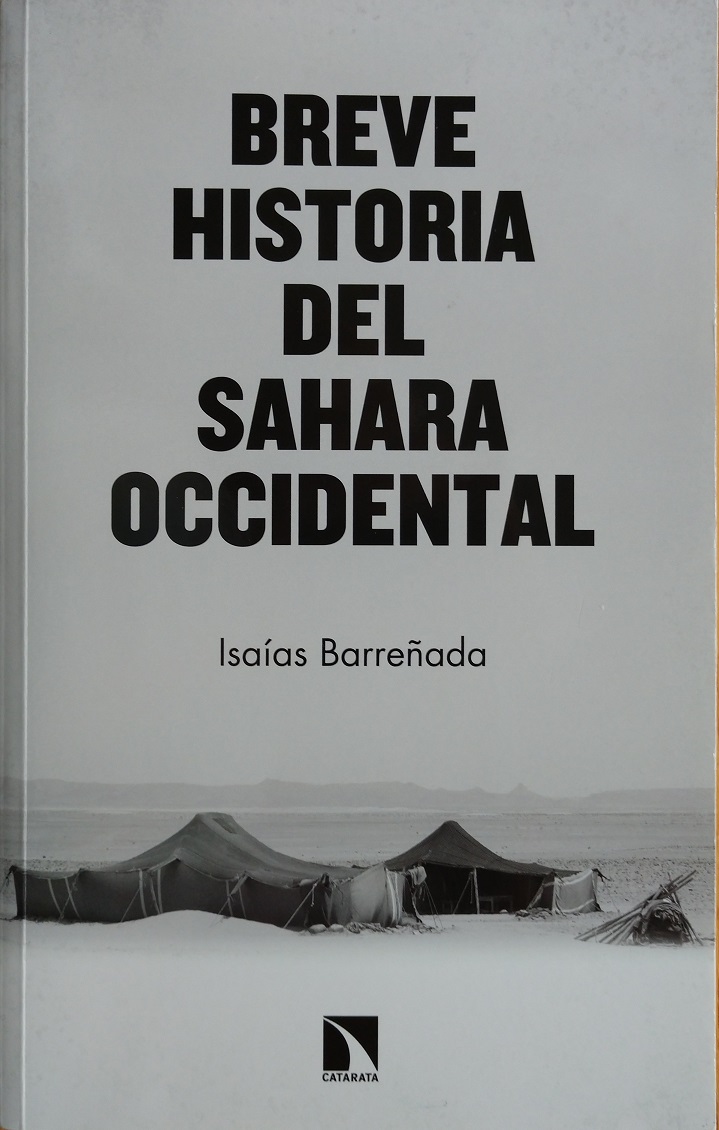
Book Review: "Breve historia del Sahara Occidental" ("A Brief History of Western Sahara") by Isaías Barreñada

Breve historia del Sahara Occidental (A Brief History of Western Sahara) (2022)
Isaías Barreñada
142 pages

Peace is not just the absence of war, it is also justice.
(La paz no es solo la ausencia de guerra, es también justicia.) (66)

Over the course of the twentieth century, peoples in colonies across the globe protested in pursuit of – and often fought protracted and bloody wars for – the right of self-determination. By the turn of the twenty-first century, many of these national liberation movements had successfully achieved independence, with most of the colonies that remained settling into some form of relatively stable relationships with their distant masters, as protectorates or territories.

In a few places, however, colonial conflicts have remained unresolved. One such disputed region is a strip of land along the north-western Atlantic coast of Africa. In his book A Brief History of Western Sahara (Breve historia del Sahara Occidental), political scientist Isaías Barreñada summarizes the events that led to the current situation in Western Sahara, and explains the conflicting interests that have both contrived to frustrate its resolution and left it under-the-radar in terms of global awareness.

Based on his biography in the book, Barreñada brings significant experience to the topic. As a professor of International Relations at Complutense University of Madrid, he has been deeply engaged in the study and analysis of events in Western Sahara and the Middle East, including serving as a member of the Observatorio Universitario International del Sahara Occidental (International University Observatory of Western Sahara).

In his overview of the colonial history of the region, Barreñada notes that Spain petitioned for, and was granted, authority over it in 1885, during a diplomatic conference in Berlin held to establish the partitioning of Africa. Though not from this book, the two images below demonstrate the extent and character of the plundering of the continent at that conference, one showing the resulting partition and the other an editorial comic from the time that already then recognized the imperious posture of the European powers.

Spanish interest in the coastal region was primarily “geostrategic: to avoid that another European colonial power settle across from the [Spanish province of] the Canary Islands, which could put into question Spanish sovereignty over that archipelago.” (20) Barreñada notes that although the Spanish colonial period in the Western Sahara was hardly benign, Spain’s engagement was relatively limited, in-line with its goal of occupying the region largely as a preventative measure.

By the 1960’s, as significant numbers of European colonies became independent nations, Spain’s geostrategic reasons for staying in Western Sahara had waned; unfortunately for the Sahrawis, however, Moroccan interest in their land grew during this period. Moroccan officials began publicly claiming their country’s supposed historical connections to Western Sahara and, with increasing adamance, claiming their right to it.

In the mid-1970’s, the Spanish government declared their intent to decolonize the region and to hold a referendum on independence. But the referendum was never held; taking advantage of Spain’s distraction during its transition from the Franco dictatorship to democracy, Morocco launched a military invasion into Western Sahara, and Spain withdrew precipitously, signing a treaty with Morocco in which it ceded control of the territory. Barreñada repeatedly refers back to this missed moment of opportunity for the Sahrawis, when Spain retreated from the region in the face of Moroccan aggression, failing to follow through on its commitment to carry out the referendum on independence.

Over the balance of the text, Barreñada explores how, from the 1970’s on, the situation in Western Sahara became increasingly complex. The Sahrawis, from their origins as Bedouin tribes, coalesced around the desire for an independent state, while the Moroccans invested heavily to try and bribe the Sahrawis into accepting Moroccan rule. During this period, Western powers such as Spain and the European Union, as well as the United States, have demonstrated an unwillingness to risk international stability for a region of the world they cared little about. And, with the West ambivalent, the United Nations has proven impotent to engage in defending the Sahrawis’ right to self-determination.

Barreñada notes the challenges faced by the Sahrawi national liberation movement, including most critically the dispersed nature of their population, split between the Moroccan occupied territory, Algerian refugee camps, and the remaining free portion of their land. Despite their dispersed population, Sahrawi’s have managed to make common cause in the fight against the occupation. Nonetheless, they struggle to counter the power of the Moroccan state and to capture the attention of a world that has averted its gaze.

On the other side of the conflict, the Moroccan regime faces both growing, armed resistance from the Sahrawis, but also challenges at home. The government’s spending in Western Sahara has begun to trigger dissatisfaction among Moroccans who would prefer to see the money used at home, while the cumulative investment over so many years makes it ever more difficult to pull out and admit having wasted so much money and effort. Perhaps most critically, the regime faces the difficulty of walking away from a narrative built over half century among Moroccans that the Western Sahara region is and always has been a part of greater Morocco.

As a part of his analysis, Barreñada compares the situation in Western Sahara to another ongoing, and much more prominent dispute, that between the Palestinians and Israel. In that context, he notes that “the term intractable conflicts has been popularized to describe conflicts of long duration (protracted), not currently resolved, and complex, if not impossible to manage to resolution.” He points out, however, that this term “implies not just a sense of complexity, but also of fatalistic “irresolvability” that prejudges the possibility of resolution.” (33) And, in the Western Sahara in particular, he argues against giving in to the fatalistic conclusion that the situation is intractable and for the will to be found to allow the Sahrawis their right to self-determination as enshrined in the UN charter.

In A Brief History of Western Sahara, Barreñada summarizes the colonial history of the Sahrawi people, and provides a comprehensive review of the challenges of finding a peaceful resolution to their pursuit of independence. In clear and engaging prose, he lays out his view of how Spain and the international community have failed the Sahrawi people, and he concludes with a powerful warning regarding the potential implications of this failure for the global order: 

The international community’s consent and permissiveness to the politics of force of certain countries is contributing to the perpetuation of conflicts. This inaction of the international community makes it co-responsible and, worse yet, runs the risk of leading to a presumption of the failure and inefficiency of international rights. (97) 

(In that context, one can wonder how the Sahrawi’s view the West’s active engagement against aggression in Ukraine, relative to its passiveness in the face of similar aggression in Western Sahara.)


Other notes and information:

The book has many helpful appendices, including: a chronology of events in Western Sahara; a comprehensive bibliography; a list of key acronyms; a list of documents regarding the conflict, with links to several of them; links to websites of organizations engaged in the conflict; and, portions of documents related to the conflict.

A review of the book by Luz Gómez appeared in the Babelia section of the El País newspaper under the title <i>Breve historia del Sáhara Occidental’, la recolonización de la descolonización</i> ("A Brief History of Western Sahara," the recolonization of decolonization").

Unfortunately, I’m not aware of an English translation of the book being available at this point.


Have you read this book, others by this author, or even similar ones by other authors? I’d enjoy hearing your thoughts.
Other of my book reviews: FICTION Bookshelf and NON-FICTION Bookshelf